Africa holds 30% of the world’s remaining natural resources and most of its uncultivated arable land, yet remains its poorest continent. This synthesis report, prepared for the Asia-Africa Democracy Forum 2021, looks at how the continent is progressing on Agenda 2030 and Africa’s own Agenda 2063, and at what Covid-19 has done to health, livelihoods, debt, human rights and elections across North, West, Central, Eastern and Southern Africa.
It reviews national SDG plans, Voluntary National Reviews, the Universal Periodic Review and citizen scorecards, tracks the state of democracy and civic space (with Cabo Verde as a success story), maps the spaces open to civil society at regional and global level, and closes with recommendations for governments and civil society.
Executive Summary
If you heal the leg of a person, do not be surprised if they use it to run away.
— Maasai (Kenya) Proverb
If you are building a house and a nail breaks, do you stop building or do you change the nail?
— Rwandan proverb
This Report is based on analysis of countries within the geographical boundaries of Africa, not it’s the political boundaries. It looks at the continent’s progress in development, including human rights and democracy, and how covid 19 has had an impact on its path to achieving both the continental development agenda, known as The Africa We Want: Agenda 2063, and the global development agenda, Transforming our World: Agenda for Sustainable Development by 2030, popularly known as 2030 Sustainable Development Goals (SDGs). Africa’s population of 1.4B is composed of over 3,000 different ethnic groups speaking more than 2,100 different languages. This explains the continent’s challenges with social cohesion, democracy and conflicts
The continent has 30% of the entire world’s remaining natural resources and 63% of total remaining arable land in the world. Eastern Africa, has 33% of total remaining fresh waters while one country, DRC has 89% of total world cobalt, used to manufacture every electronic on earth. For this reason Africa remains embroiled in a battle for its resources, mainly waged by western countries, often through a combination of Aid, economic rules and political manipulation. UNEP, for example, Reports that Africa is home to some 30 percent of the world’s mineral reserves, eight per cent of the world’s natural Gas and 12 per cent of the world’s oil reserves. It is precisely for this reason that Africa remains the most exploited continent, with artificial conflicts and instability created by various powerful countries seeking to gain control of its vast resources. The result is that the continent is not only among the poorest in the world, it has the weakest forms of governance and democratic systems.
In short Africa feeds, lights and powers the world, yet remains the poorest continent in the world!
There are five primary Regional Economic and Political Blocs recognized by the Africa Union (AU)-Arab Maghreb Union (AMU), Economic Community of Central Africa States (ECCAS), The West Africa Economic Community (ECOWAS), East Africa Economic Community (EAC) and the South Africa Economic Community (SADC). Africa’s response to covid 19, its human rights record and its progress to Sustainable Development by 2030 is heavily shaped by how its resources are extracted and used.
Covid 19 and Africa’s Development: Impact on Agenda 2030, Human Rights and Democracy
According to Africa Centre for Disease Control and Prevention (Africa CDC) the number of confirmed COVID-19 cases in Africa reached 8.3m in October 2021 while the death toll from the pandemic across the continent stood at just over 212,000. The majority of those deaths occurred in South Africa. The bulk of covid 19 cases occurred in Southern Africa sub-region. Over seven million people across the continent have recovered from the disease. South Africa, Morocco, Tunisia and Ethiopia are among the countries with the most cases in the continent.Beyond the health risks, the COVID-19 affected African economies is coming in three ways-lower trade and investment, a demand slump associated with the lockdowns, and a continental supply shock affecting domestic and intra-African trade. On the whole, Africa’s economies may lose up to $1.5T or 50% of its GDP as a result of the pandemic by end of 2022. Over 90% of African-owned businesses are classified as SMEs, the rest being multinationals that often pay little tax and have few value addition processes in the continent. This has created a continent where 89% of the population is employed in the informal sector. This volatility was exacerbated by the pandemic, testing to the limits some of its economies and democracies. Countries such as Equatorial Guinea nearly went into bankrupt due to drop in Oil prices.
Covid vaccination
The strategy, known as Africa Joint Continental Strategy for COVID-19 Outbreak pursues a threefold goal of preventing severe illness and deaths and minimizing social , as well as addressing economic consequences of COVID-19. According to the WHO just five African countries, less than 10% of Africa’s 54 nations, are projected to hit the year-end target of fully vaccinating 40% of their people, unless efforts to accelerate the pace take off.
It is not the cook’s fault when the cassava turns out to be hard and tasteless.
— Ewe Proverb
Africa Agenda 2063 and Agenda 2030 for Sustainable Development
Africa is pursuing two concurrent development agenda-Agenda 2030 for Sustainable Development, and The Africa We Want Agend a 2063. All countries are far from achieving the Agenda 2030. But some countries have made notable progress, including Seychelles,Mauritius, Algeria,Tunisia,Botswana, Libya, Gabon, Egypt and Cape Verde. Overall 70% of the countries in West Africa still experience extreme poverty while Southern African countries rank high on responsible consumption and production and climate action. The challenge for West African countries remains accelerating performance in terms of social welfare without undermining environmental sustainability. East, West and Southern Africa have done considerably better economically. Politically West and Southern African regions are considered the most stable, with countries such as Botswana and Cape verde considered among the most democratic in the world. West African countries have an average progress score of 54.27. North African countries are making progress but weighed down by effects of Climate Change. The Sahara desert, which covers most of the sub-region is advancing towards the South at a record 48km every year. In Eastern Africa all countries are making significant strides on all SDGs while Central Africa remains the most unstable sub-region in the continent. Overall progress has been made in Integration of SDGs into National Plans, laws and policies, with many countries forming implementation structures that have mainstreamed SDGs into national structures and strategies.
People’s scorecard, Gender and Peace
The Action for Sustainable Development People’s Scorecard reveals that most countries across Africa are at 45%-49% of SDG targets. The scorecard identifies key issues helping the achievement of the Goals, stronger advocacy, and visibility during HLPF Reporting and deliberate measurement and stronger citizen awareness while increasing the Implementation reflects integration of SDGs into national Plans
Success appears to be related to policies that had existed BEFORE the 2030 Agenda was adopted.
On Gender the UN Women reports that the African continent has demonstrated commitment to promoting gender equality and the empowerment of women. Almost all countries have ratified the Convention on the Elimination of All Forms of Discrimination against Women; more than half have ratified the African Union’s Protocol on the Rights of Women in Africa. Kenya stands out as the country with the highest women on corporate boards in the world.
Universal Periodic Reviews (UPR) and SDGs
With the exception of some Southern African countries, the top goal recommended by UPR for Africa is “Peaceful societies and accountable Institutions”. In Northern and Eastern Africa this is followed by Gender Equality while in Southern Africa Climate action tops the recommendations. All the countries accepted nearly all the recommendations, with the exception of North Africa that has consistently rejected recommendations on Gender and Peaceful institutions, including on democracy.
National Mechanisms
Most African countries begun with upgrading the MDG Units in Government as the coordination platform for the implementation of Agenda 2030. However the current preferred mechanisms are an integration of SDGs into National Plans and National Strategies. Integration appears to be more effective than the initial independent Units, as seen in Kenya, Sierra Leone, Egypt and Ghana. Nigeria, South Africa and Uganda have highbred structures. In all cases, it is not clear which Governments are fully using the Integration approach and which ones are “business as usual” and relying on old plans before the adoption of Agenda 2030.
Good millet is known at the harvest.
— Liberian Proverb
Voluntary National Reviews (VNRs)
All countries in Africa have made at least one presentation to the HLPF. One glaring observations from the VNR presentations is that they are largely about making the governments appear successful, and hardly reflect the true state of progress of the Agenda 2030. Notable outcome of the VNRs is the visibility, and therefore accountability, on development areas that were previously not at the centre of most national government implementation-gender, Energy, Health, inequality and climate change
Civic space, Democracy and Human Rights
Today, only three countries (Eritrea, Somalia and South Sudan) do not hold regular elections. The democratic expansion that has occurred in Africa during the third wave is considered second 'in terms of its range and scope' to the one in Latin America and the Caribbean region
West Africa is making mixed progress on press freedom, but Capo Verde, Ghana and Burkina Faso ranks highest among the 16 countries in West Africa. In Central Africa democracy and civic space is characterized by the fact that in almost all the countries, there are institutional and legal arrangements that in principle guarantee civic rights, but these arrangements are most of the time not enforced. International IDEA reports a drop in democracy and human rights in the Southern African region primarily due to the Covid-19 pandemic. North Africa is falling consistently low on democracy. It has been noted that democracy and human rights are interlinked together. CIVICUS Monitor reported that civic space for over two thirds of the countries in Africa is either “obstructed,” “repressed” or “closed.”
Engagement with Regional and International Bodies
At the Global level there are over ten spaces open to CSOs for engagement on policies around development and Agenda 2030, while at the sub-regional level there are fourteen, with most of these linked to International Financial institutions such as the World Bank and Africa Development Bank, the AU or the UN. Even the Africa CSO Regional Forum on Sustainable Development is linked to the UN Economic Commission. With the exception of central Africa, there are no sub-regional spaces for collective CSO engagement, other than the larger continental platform- the Africa CSO mechanism for SDGs.
Conclusion and Recommendations
While attention is focused on finding a vaccine for covid 19, what has become clear is that resources should be directed at achieving and realizing all of the Sustainable Development Goals. It is not enough to commit resources to a vaccine when the world may face another crisis arising from other development challenges. Covid 19 is only one of the many challenges facing global development. It is its intensity and scale that has given it so much attention. That attention should lead us to a higher goal beyond self-preservation-working to collectively ensure resources are available for the wide range of development agenda.
Africa’s progress to Agenda 2030 for sustainable development will be shaped not just by its response to covid 19, but its ability to address various economic and social challenges that have existed in the continent and only exacerbated by the pandemic.
But it is clear that the region has made considerable progress on democracy, although this appears to be slowed down by its human rights violations. Economically reliant on raw materials export, minerals and debt, especially to IMF and the World Bank will continue to be a major challenge to the continent’s progress. North Africa has to address the core SDG issues around democracy and gender, while Southern Africa must grapple with the effects of climate change.
Rain beats the leopards skin but it does not wash out the spots.
— Kenyan Proverb
Selected Recommendations
- Government should establish national mechanisms on SDGs and Mainstream CSOs role in achieving SDGs.
- African governments should provide CSO with resources to help in accountability and co-partnership in realizing sustainable development goals
- Africa Governments priority should be on establishing own Vaccine manufacture under the Africa CDC
- Civil society should come together and challenge and fight vaccine apartheid
- Key focus should be placed on Development as Public Goods
- CSOs should look beyond traditional spaces for advocacy and engagement while ensuring that global policies are localized, instead of focusing on global implementation
A canoe does not know who the leader is when it turns over, everyone gets wet.
— Madagascar Proverb
Not everyone who chased the zebra caught it, but he who caught it, chased it.
— Zulu (South Africa) Proverb
Context and Introduction: Africa, the Poorest and Richest Continent on Earth
كان صاحبك عسل ما تلحسوش الكلّ-If your friend is honey, do not lick him thoroughly.
— Tunisia Proverb
A bird that flies off the earth and lands on an anthill is still on the ground.
— Igbo (Nigeria) Proverb
1.1 Understanding Africa-The Poorest and Richest continent on earth
Depending on who you ask, Africa has either 54 countries, 55 or 59! And this is where the complexity of the continent remains. The United Nations recognizes 55 countries, which excludes Western Sahara (claimed by Morocco) and Somaliland Republic. The Africa Union, on the other hand, also recognizes 55 countries, but this includes Western Sahara. Reunion and Mayotte are still controlled by France while St Helena is controlled by Britain. From a developmental and political perspective, the continent is divided further. North Africa is not considered part of Africa, and is usually classified together with Western Asia (Middle East) in what the UN calls Middle East and North Africa-MENA
These difficult geopolitical classifications are important in that they determine data availability and acceptability, as well as determination of Africa’s economic and political mapping.
1.2 Africa’s Diversity and Regional Economic Blocs
Africa is one of the most diverse societies in the world. Its population of 1.4 B is composed of over 3,000 different ethnic groups speaking more than 2,100 different languages. While this is nearly as many as Asia, Asia is a population of 4.6B, with most of the countries have asset of few languages shared by the entire population. Europe on the other hand, has just about 160 culturally distinct groups and only 24 official languages. Its total number of languages is less than the languages in one African country- Nigeria.
This diversity, which often comes with distinct cultures and political leadership styles that existed before European colonizers hurriedly combined the various ethnic groups into countries, makes the continent’s search for cohesion, an inclusive governance system, and co-existence difficult.
Regional Groupings
There are five primary Regional Economic and Political Blocs recognized by the Africa Union (AU)-Arab Maghred Union (AMU- Algerian, Libyan, Mauritanian, Moroccan and Tunisian), Economic Community of Central Africa States (ECCAS- Angola, Burundi, Cameroon, Central African Republic, Chad, Democratic Republic of Congo, Equatorial Guinea, Gabon, Republic of the Congo, São Tomé and Príncipe),The West Africa Economic Community (ECOWAS- Benin, Burkina Faso, Cabo Verde, Cote d'Ivoire, The Gambia, Ghana, Guinea, Guinea-Bissau, Liberia, Mali, Niger, Nigeria, Senegal, Sierra Leone, and Togo.), The East Africa Economic Community (EAC- Burundi, Kenya, Rwanda, South Sudan, Tanzania, and Uganda), and the South Africa Economic Community (SADC- Angola, Botswana, Comoros, Democratic Republic of Congo, Eswatini, Lesotho, Madagascar, Malawi, Mauritius, Mozambique, Namibia, Seychelles, South Africa, Tanzania, Zambia and Zimbabwe).
Of these the ECA is considered the most integrated, according to the Africa Regional Integration Index (ARII), while ECOWAS is the most politically united. ECA and ECOWAS both have visa-free travel for all its citizens, with ECOWAS at advanced stages to launch a common single currency in 2027. SADC is considered the strongest economic Bloc, but least integrated, although it’s still dominated by the powerful South Africa. The EAC is the bloc with the highest level of trade among its members, and recently it has been seeking to build a political Union. ECCAS is complex in that the economies and fiscal policies of their members are so intertwined with France-in a relationship known as Francafrique-that it has become challenging for Central African economies to do business with the rest of Africa, let alone the rest of the world. The AMU is largely symbolic in terms of its impact on Africa trade and relations since Arab countries are generally more included to align with the Arab League than the AU.
Teeth do not see poverty.
— South Sudanese proverb
In 2021 Africa officially launched a new trading bloc covering the entire continent- the Africa Continental Free Trade Area (ACfTA).
Central Africa sub-region could be considered the riches sub-region in Africa in consideration of its vast natural resources and rich agricultural land. The Congo Basin, for example, is considered the second largest forest density in the world. East Africa has the 33% of the remaining fresh water on earth while Ethiopia has one of the largest arable land in the world. One of the largest natural gas deposits was recently discovered in Mozambique. Southern African countries have minerals while Western African countries are known for their cash crop production and their vast oil and natural gas. Equatorial Guinea, a former Spanish colony, is considered among the top producers of Oil in the world, yet its poor political leadership has put its poverty levels at 76.8%, making it among the poorest countries in the world.
West African economies are considered among the strongest in the region, and it is not surprising that they score significantly high on their SDG progress.
But despite these, the so called “strong economies” does not significantly impact lives of its citizens.
Nigeria, for example, is considered the largest and most vibrant economy in Africa. Yet it has a poverty rate of 40% and an unemployment rate of 32.5%.
1.3 Development in Africa- So Rich, yet So Poor
In order to understand Africa’s development path (or lack of it) it is important to understand why the continent remains what former GAVI Chair J Naidoo once called “the richest continent under the ground, and the poorest above it”. Africa’s response to covid 19, its human rights and its progress to Sustainable Development by 2030 is heavily shaped by how its resources are extracted and used.
Many have wondered by such a rich continent is also so poor. And while it’s easy to point to its poor governance and political leadership, the real issues behind Africa’s poverty are more obvious than thought.
It has its history in the Eurafrica project, an ideology that shapes the way Africa relates with Europe and to a large extent the rest of the world until today.
Feeding the world
Former French president Jacques Chirac acknowledged that "without Africa, France will slide down into the rank of a third rate power." Chirac's predecessor François Mitterand, as Interior Affairs Minister in 1957 already prophesied :
“…car sans l’Afrique il n’y aura pas d’Histoire de France au XXIè siècle.”
(…for without Africa, France will have no history in the 21st century.”)
UNEP Reports that Africa is home to some 30 percent of the world’s mineral reserves, eight per cent of the world’s natural Gas and 12 per cent of the world’s oil reserves. The continent has 40 percent of the world’s gold and up to 90 percent of its chromium and platinum. The largest reserves of cobalt, diamonds, platinum and uranium in the world are in Africa. It holds 65 per cent of the world’s arable land and ten percent of the planet’s internal renewable fresh water source. It is no surprise that consumption-driven countries that have hardly raw materials of their own such as Europe and some part of Asia, often try to take control of the continent’s political and development agenda in order to extract and exploit its resources.
A seer who invoked a storm on his people cannot prevent his house from destruction.
— Nigerian proverb
Africa is courted and in many cases forced to act as the breadbasket for most of Europe and parts of Asia. Former colonizers such as Britain, France, Germany, Netherlands, Portugal, and Spain, remain with vast economic control of the continent, with France having strict rules that include control of the monetary and fiscal policies of all its 14 former colonies. British citizens and corporations control vast amounts of land in Kenya and Zimbabwe that continues to be the source of major conflicts. Collectively the OECD countries
have the strictest rules governing the ability of the continent to in international trade without passing through European corporations. The result is that the continent is not only among the poorest in the world, it has the weakest forms of governance and democratic systems. Cohesion and the social contract is weak as most of its political leadership are proposed and sustained by economic blocs keen to control its vast resources. If we consider the fact that with over 3,000 ethnic groups that were forced to live together in geographical boundaries created by colonial powers, almost all of them against their will and without consultations with the different communities, Africa is a powder keg that will take decades to develop. The world is moving towards sustainable development while the continent is still caught in economic extractives that ensures it has no domestic resources for its own development agenda.
In short Africa feeds, lights and powers the world, yet remains the poorest continent in the world
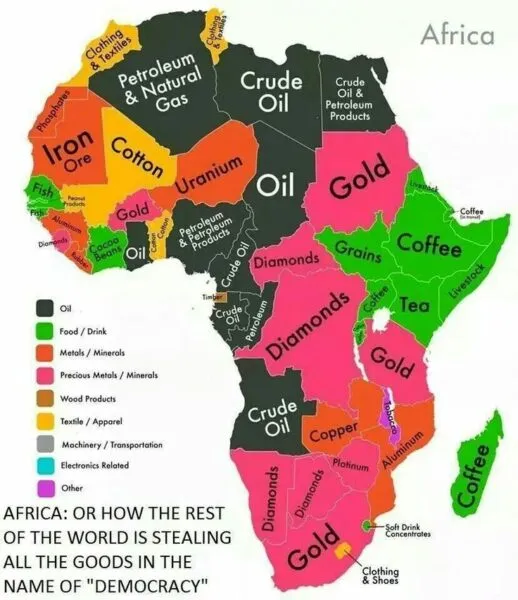
Africa’s wealth in Summary
Africa has 30% of the total Value of earth's remaining natural resources. These includes:
92% of the world’s cobalt
89% of the World's Gold
73% of the World's Diamond
66% of total world arable land (despite being 45% desert)
16% of the World's Uranium
9% of the World's Bauxite
2% of the World's steel
5% of the World's Aluminium
5% of the World's Copper
60% (600 million hectares) global arable land
Even the best cooking pot will not produce food.
— Cameroon Proverb
Why is Africa Poor?
Many people loudly lament the steady injection of fruitless foreign aid and economic assistance. But many fail to realize the rewards of extractive activities by both Europeans and their political backers in Africa are so substantial that they provide huge incentives for maintaining the status quo. The aid flow into Africa is tiny compared with the value of the exploited resources flowing in the other direction.
“Outsiders often think of Africa as a great drain of philanthropy, a continent that guzzles aid to no avail and contributes little to the global economy in return. But look more closely at the resource industry, and the relationship between Africa and the rest of the world looks rather different. A decade ago, fuel and mineral exports from Africa were worth $333 billion, more than seven times the value of the aid that went in the opposite direction (and that is before you factor in the vast sums spirited out of the continent through corruption and tax fiddles).”
These figures have since doubled after discovery of more natural resources such as Gas in Mozambique and oil in Kenya and Uganda.
Trying to “expose” the theft of Africa’s resources is pointless. The shell companies and foreign governments engaged in looting Africa, often in partnership with governments they help prop up, have far much to lose by changing their business ethics with the continent. The empires of colonial Europe and the Cold War superpowers have given way to a new form of dominion over the continent that serves as the mine of the world — new empires controlled by nations and alliances of unaccountable African rulers governing through shadow states, middlemen who connect them to the global resource economy, and multinational companies from the West and the East that cloak their corruption in corporate secrecy. We prefer not to think of the mothers of eastern Congo, the slum dwellers of Luanda, and the miners of Marange as we talk on our phones, fill up our cars, and propose to our lovers. As long as we go on choosing to avert our gaze, the looting machine will endure.”- paraphrased from “The Looting Machine:Warlords, Oligarchs, Corporations, Smugglers, and the Theft of Africa’s Wealth,” by Tom Burgis
Even the lion, the king of the forest, protects himself against flies.
— Ghanaian proverb
Covid-19 and Africa’s Development: Impact on Agenda 2030, Human Rights and Democracy
2.1 Covid cases and caseloads
According to Africa Centre for Disease Control and Prevention (Africa CDC) the number of confirmed COVID-19 cases in Africa reached 8.3m in October 2021,. The death toll from the pandemic across the continent stands at 212,000 while some 7,671,969 patients across the continent have recovered from the disease. South Africa, Morocco, Tunisia and Ethiopia are among the countries with the most cases in the continent. In terms of the caseload, southern Africa is the most affected region, followed by the northern and eastern parts of the continent, while central Africa is the least affected region in the continent. West Africa, with a population of 367 million people, had confirmed 412,178 cases of COVID-19 with over 5300 deaths as of March 2021. This is considered low, and it is thought that African countries have leveraged on experiences from past epidemics such as Ebola to build resilience and response strategies, which may be contributing to protecting the continent's health systems from being overwhelmed.
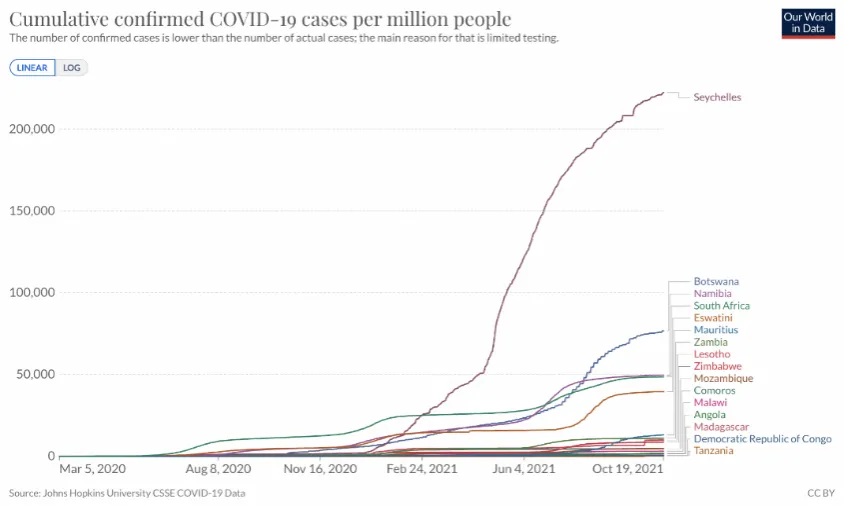
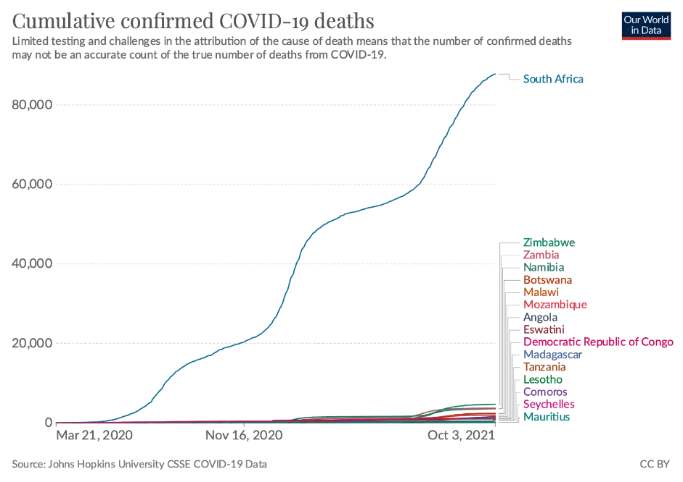
The Highest cases were reported in Seychelles-over 200,000-while the highest deaths occurred in South Africa-80,000
Key Observations
Cases, Democracy and Human Rights
1. In West Africa the covid situation led to serious human rights violations, leading to an open letter of protest by over 90 intellectuals from across Africa. In South Africa, the clash between refugees and asylum seekers led to major protests and violent confrontations between citizens and foreigners in South Africa, the country with the highest number of refugees and asylum seekers in the sub-region.
2. Some 19,610 expired AstraZeneca vaccines have had to be incinerated in Malawi because they were expired just 18 days after being shipped to the country. In total African countries have been forced to destroy over 450,000 vaccines because they were delivered late.
Cumulative Confirmed Cases and Deaths-Southern Africa
Be a mountain or lean on one.
— Somali proverb
Table 1: COVID 19 Cases & Deaths in North Africa (As of 2 October 2021)
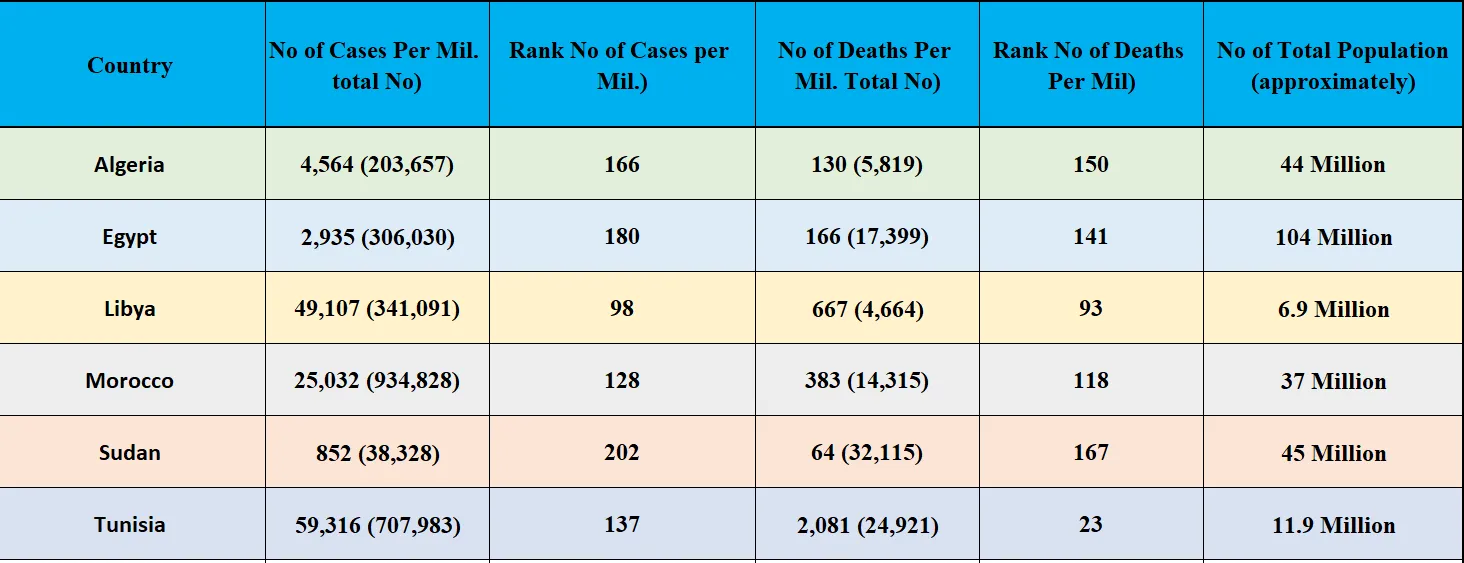
3. In North Africa, Morocco and Tunisia succeeded in controlling the spread of covid 19 during the first wave through a combination of measures such as public awareness and case management. Tunisia created the National Coronavirus Response Authority while Morocco created a committee for health to specifically respond to the pandemic. However in subsequent waves of the epidemic nearly all the countries in the region suffered from severe cases of illness and high cases of death.
5. Countries such as Egypt whose citizens rely heavily on daily paid labour, were most hit at household levels.
The Egyptian government had to intervene and provide a $33 cash hand-outs to cushion its citizens.
6. In Southern Africa women were affected and infected most-due to double expectations- work from home while still taking care of children
2.2 Covid 19 and Agenda 2030
Africa is primarily an informal economy with 80.8 % of its entire workforce working in informal sectors, sometimes known simply as SMES.
North Africa stands out as the region with the highest levels of “Day-wage” labour, followed by South Africa, West and East in that order. Central Africa has a mixed economy. Countries such as Ivory Coast have fairly established formal economies while CAR has hardly any formal economy.
Africa is a primary exporter of raw materials, with the exception of Egypt, Algeria and South Africa.
Economic impact
The OECD reports that beyond health risks, the COVID-19 shock to African economies is coming in three waves: (i) lower trade and investment (ii) a demand slump associated with the lockdowns (iii) a continental supply shock affecting domestic and intra-African trade. According to Africa Platform, The health protocols established by the World Health Organization (WHO) to try and contain the spread of the pandemic, and which soon became standard requirement around the world, dealt a particularly heavy blow on African countries, whose economies are primarily informal and rely on commodities export. Countries like Equatorial Guinea are estimated to have lost as much as $300 million in export revenue, equivalent to 2.7% of its entire GDP, in the first six months of the pandemic. It is estimated that 30 million jobs were lost in the first three months of the pandemic while countries that rely on Oil such as Nigeria, Angola, Algeria, and Egypt are estimated to have lost $65B in ninety days.
On the whole, Africa’s economies may lose up to $1.5T or 50% of its GDP as a result of the pandemic.
We desire to bequeath two things to our children. The first one is roots; the other one is wings.
— Sudanese proverb
While attention is focused on finding a vaccine for covid 19, what has become clear is that resources should be directed at achieving and realizing all of the Sustainable Development Goals. It is not enough to commit resources to a vaccine when the world may face another crisis arising from other development challenges. Covid 19 is only one of the many challenges facing global development. It is its intensity and scale that has given it so much attention. That attention should lead us to a higher goal beyond self-preservation-working to collectively ensure resources are available for the wide range of development agenda.
Africa’s debt, especially to IMF and the World Bank has increased by nearly tenfold due to covid. For example, Equatorial Guinea nearly went bankrupt due to covid 19 economic challenges in 2020 while South Africa, for the first time, borrowed money from the World Bank.
2.3 Covid 19 civic freedom, Democracy and Agenda 2030
Central African Republic and Congo are the countries of Central Africa that had elections amid the COVID-19 pandemic. Central Africa has thus been exposed to two kinds of shocks by the COVID-19 pandemic. The exogenous one came from direct trade and other links between affected partner continents such (Asia, Europe and America), with down turn of tourism, decline in remittances from African Diaspora, decline in Foreign Direct Investment (FDI). The endogenous one, resulted from the rapid spread of the virus within countries, with the corresponding morbidity and mortality as well as effects on the economic activities.
Covid restrictions and control measures have become sources of violations of human rights. In Kenya citizens were killed in what the government said was curfew enforcement. Activists were also arrested for protesting the IMF loans given under the guise of covid 19 response. In Egypt, Sudan and Uganda covid measures made it very difficult for journalists to gather information. In Libya citizen held demonstrations in what they saw as violations of their freedoms of movement under the pretext of covid containment. IN Cameroon and part so central Africa, the covid restrictions merely provided justifications to escalate an already oppressive regime, especially on journalists.
Elections were postponed or cancelled due to covid in Uganda,Tunisia, Mali, Cameroon, Guinea, Kenya, Zimbabwe, Sao Tome and Principe,Somalia, Niger, Tchad, Gabon, Ethiopia and Libya . Egypt, Tunisia, Mali, Kenya, Ethiopia, CAR,Togo, Liberia, Ghana, Niger, Zambia, Mali, Cameroon, Morrocco, South Africa and Gambia either proceeded or held previously cancelled elections.
2.4 Covid vaccination
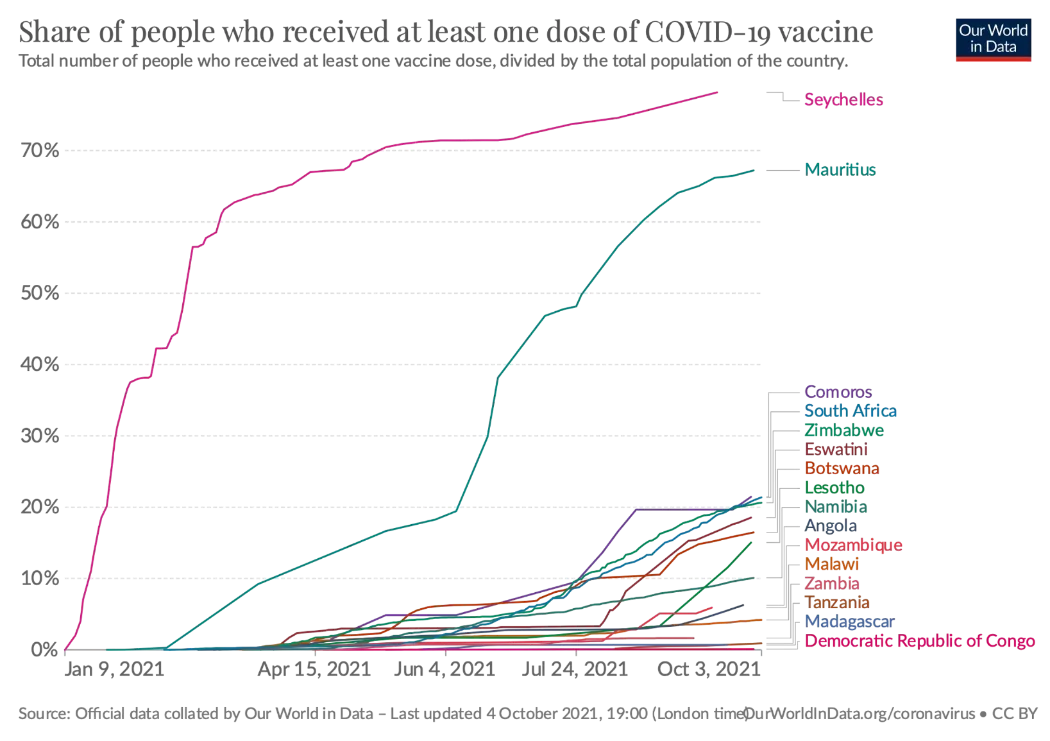
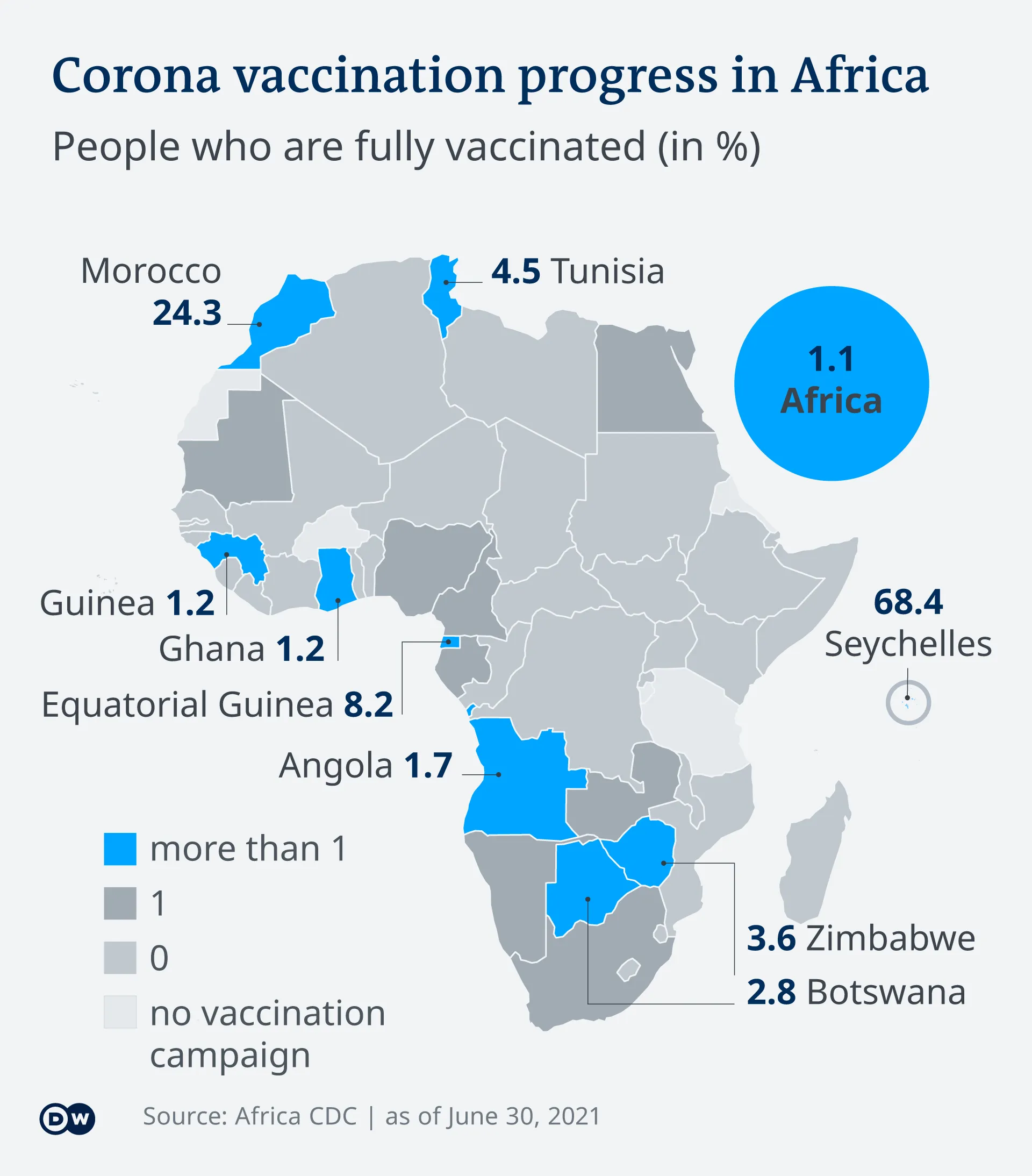
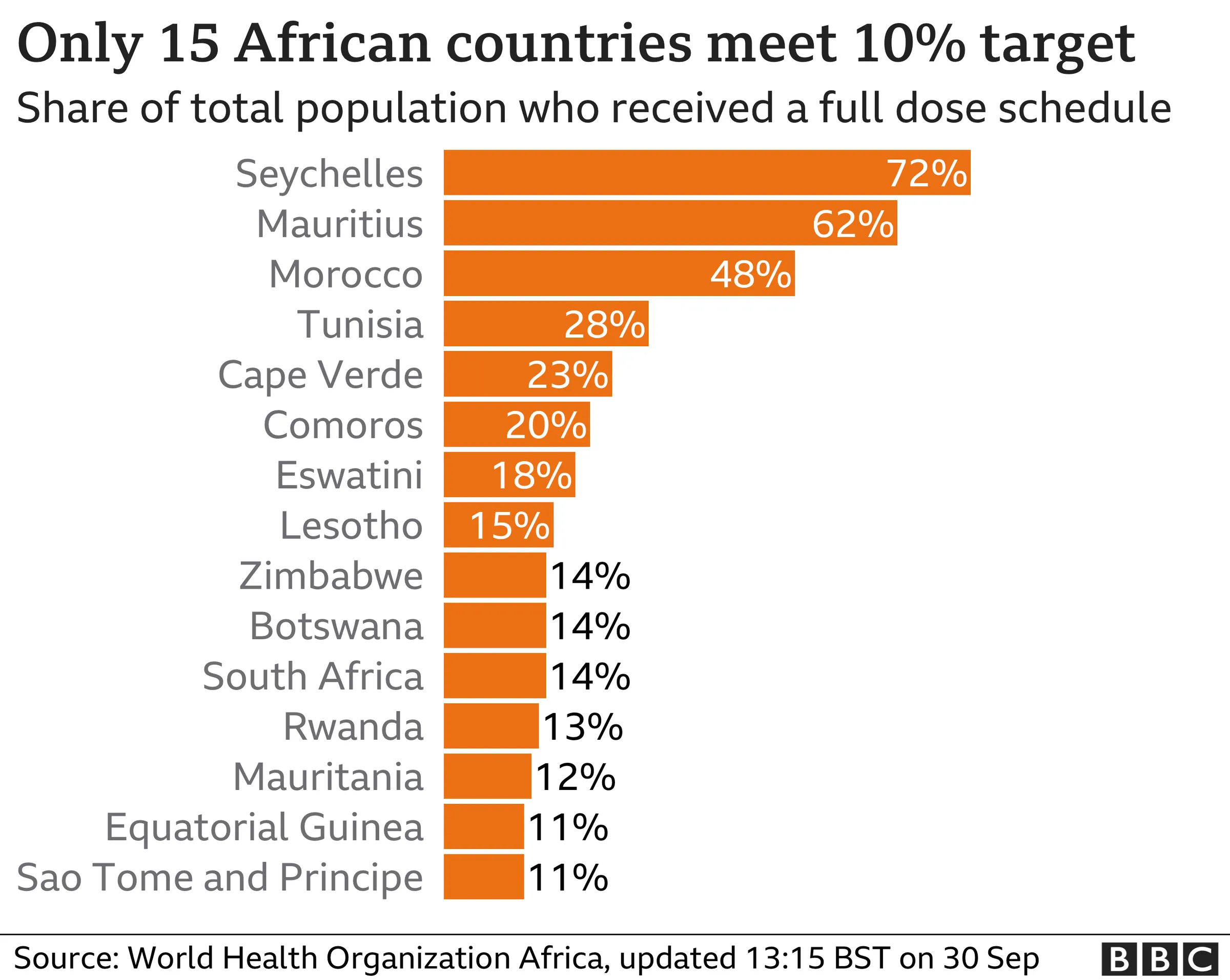
The Africa CDC has outlined a strategy to address covid at multiple levels. According to Africa CDC, the strategy, known as Africa Joint Continental Strategy for COVID-19 Outbreak pursues a threefold goal of preventing severe illness and deaths and minimizing social disruption and economic consequences of COVID-19. While behavioural preventative measures based non-pharmaceutical interventions like the wearing of masks in public, physical distancing and hand sanitization do assist in preventing transmission, other public health measures such as enforced lockdowns, although partially effective in slowing down the spread of the virus, exacerbate the pandemic’s economic and social consequences. The only way to achieve the threefold goal of preventing transmission, preventing deaths, and minimizing social and economic consequences is to end the pandemic by successfully immunizing a critical mass of the African population. Similar to other countries around the world, African countries need accessible and effective COVID-19 vaccine to save lives, protect the health of vulnerable people and 1. Background 2 Framework for Fair, Equitable and Timely Allocation of COVID-19 Vaccines in Africa maintain economic development.According to the WHO just five African countries, less than 10% of Africa’s 54 nations, are projected to hit the year-end target of fully vaccinating 40% of their people, unless efforts to accelerate the pace take off. Three African countries, Seychelles, Mauritius and Morocco, have already met the goal that was set in May by the World Health Assembly. At the current pace just two more countries, Tunisia and Cabo Verde, will also hit the target. It is not just concerns around vaccine apartheid, where countries that are premodimantly white are reluctant to share their vaccines with the rest.
Filthy water cannot be washed.
— Morocco Proverb
Percentage of vaccinated Population in Southern Africa
The issue go all the way to limited access to crucial commodities such as syringes. UNICEF has reported an imminent shortfall of up to 2.2 billion auto-disable syringes for COVID-19 vaccination and routine immunization in 2022. This includes 0.3ml auto-disable syringes for Pfizer-BioNTech COVID-19 vaccination. There is no global stockpile of the 0.3ml specialized syringes, which differ from the 0.5ml syringes used for other types of COVID-19 vaccines and routine vaccination. The market for 0.3ml auto-disable syringes is tight and extremely competitive. As such, these are in short supply and will remain so through at least the first quarter of next year. At the 2021 UN General Assembly leaders from across the Global South united in condemning Western governments and the pharmaceutical corporations sitting on vaccine patents which they are refusing to share.
Emerging Issues
- The Vaccine problem lies in a global economy that has allowed a handful of transnational corporations to patent – and thereby monopolise – these vaccines. By the end of 2021, wealthy countries will have a surplus of 1.2 billion vaccine doses, with a whopping 12 billion doses having been produced in total. But Covax, the WHO-led coalition that was to help ensure vaccines reach poorer countries, and, on which most African countries depend for their vaccines, will miss its target for vaccinations by more than 500 million doses in 2021. In other words, despite a surplus of vaccines in the rich world, the Global South has far fewer than the tiny amounts it was led to expect. Today, wealthy governments have handed control of this pandemic to the market, in the form of gigantic transnational corporations, who have taken vast sums of public money and refused to share the resulting know-how.
- Amnesty International accused multinational corporations of fuelling a human rights crisis. They pointed out that Pfizer and BioNTech, makers of a leading cutting-edge vaccine, have delivered nine times more vaccines to Sweden than to all low-income countries combined.
Do not call the forest that shelters you a jungle.
— Congo Proverb
4.Pfizer, BioNTech and Moderna will earn over $133bn in revenues by the end of 2022 on these vaccines. Yet none of them – nor indeed any other Western producer – will openly share their know-how so others can produce the vaccines we need. They thrive on the secrecy which boosts their profits. Waiving the patents and sharing the know-how behind the vaccines would allow all countries with the capacity to do so to produce their own medicines. This has become a key demand of African governments and the flourishing While negotiations around vaccine patents have been ongoing in the WTO for nearly a year, the proposal is still being blocked by European countries, most notably Britain and Germany.
Do not look where you fell, but where you slipped.
— Equatorial Guinea Proverb
Progress on the SDGs: Africa Agenda 2063 and Agenda 2030 for Sustainable Development
3.1 Africa’s Double and Complimentary Development Agenda
Over 50% of Africa’s cumulative GDP (valued at just over $2.7T) is contributed by just three countries-Egypt, Nigeria and South Africa. This is significant to know in that it explains why so many countries in the continent are struggling to raise resources for their development agenda. Africa is pursuing two concurrent development agenda-Agenda 2030 for Sustainable Development, and The Africa We Want Agenda 2063. The Africa We want, Agenda 2063 was adopted in 2013 during the 50th Anniversary of the Africa Union. It is aimed at ensuring a peaceful, integrated and prosperous continent by 2063 and according to UNDP, it is “an endogenous plan for transformation.”UNDP reports that Agenda 2063 and the 2030 Agenda broadly converge on social development (people), inclusive economic development (prosperity), on peaceful and inclusive societies and responsive institutions (peace), and on a number of environmental sustainability issues (planet).However, there are also areas of divergence: SDG areas that are not, or are only marginally covered by Agenda 2063 include inequality within and between countries, and issues related to the sustainable management of terrestrial ecosystems, forests, desertification, land degradation and biodiversity. Sustainable consumption and production is also not part of the continental agenda.
Transforming our world: The 2030 Agenda for Sustainable Development , on the other hand,is a collective strategy for sustainable development in all key aspects of societal development-social, economic and environmental. It is a culmination of a discussions that to achieve sustainable development targets that begun with the formation of the Commission for Sustainable Development by the UN in 1972.Known simply as Agenda 2030 or the SDGs, this development strategy lays emphasis on the core pillars of sustainable development. In doing this the 2030 Agenda for sustainable development is built on core principles that includes ensuring that those farthest behind are supported, that the agenda is contextual to national realities, priorities and needs, the agenda is implemented within the resource capacity and constraints of the country and that there is inter-linkages that ensures that development is integrated into
Core Pillars of Agenda 2030 for Sustainable Development (the 5Ps)
People-end poverty and hunger, in all their forms and dimensions, and to ensure that all human beings can fulfil their potential in dignity and equality and in a healthy environment.
Planet-protect the planet from degradation, including through sustainable consumption and production, sustainably managing its natural resources and taking urgent action on climate change, so that it can support the needs of the present and future generations.
Prosperity-ensure that all human beings can enjoy prosperous and fulfilling lives and that economic, social and technological progress occurs in harmony with nature.
Peace-foster peaceful, just and inclusive societies which are free from fear and violence. There can be no sustainable development without peace and no peace without sustainable development.
Partnership-mobilize the means required to implement this Agenda through a revitalized Global Partnership for Sustainable Development, based on a spirit of strengthened global solidarity, focused in particular on the needs of the poorest and most vulnerable and with the participation of all countries, all stakeholders and all people. ongoing national development agenda.The integrated nature of the Agenda 2030 are of crucial importance in ensuring that the purpose of the new Agenda is realized. If we realize our ambitions across the full extent of the Agenda, the lives of all will be profoundly improved and our world will be transformed.
The waters of the river flows on without waiting for the thirsty man.
— Senegalese Proverb
3.2 Progress and Achievements (based on SDSN SDG Index)
Note : (For purposes of this Report, these analysis is based on the SDSN SDG Progress Index. The index is disputable in that it uses data drawn mostly from subjective european sources, mainly non governmental organizations, that are not recognized by either the UN statistical commisison, the UN systems or national governments)
All countries are significantly far from achieving the Agenda 2030. But some countries have made notable progress, including Seychelles,Mauritius, Algeria,Tunisia,Botswana, Libya, Gabon, Egypt and Cape Verde. Overall 70% of the countries in West Africa still experience extreme poverty with 13 out of its 16 countries having stagnated growth. Cabo Verde and Ghana are however exceptions, with Cabo Verde considered among the best performers, ranking high in both the UN and SDSN indices.
Countries in West and Southern Africa rank high on responsible consumption and production and climate action. But these have nothing to with the investments in green energy. Instead these region has significantly low levels of manufacturing industries, with most of their exports being raw materials and natural resources
The challenge for West African countries remains accelerating performance in terms of social welfare without undermining environmental sustainability. There are also challenges in quality education, and the low manufacturing coupled with a shrinking of the agricultural sector’s contribution will continue to impact livelihoods and jobs.
East, West and Southern Africa have done considerably better economically. Nigeria is making progress according to both the SDSN and the UN SDG database. It has consistently reduced its poverty from a high of 68% over a decade ago, to less than 43% today. Other countries such as Ghana in West Africa and Kenya in East Africa are making progress on Goals 1 (poverty) and 2 (hunger), largely due to being agricultural powerhouses. Ethiopia, considered among the most agriculturally productive countries on earth, is in the final stages of starting to extract vast natural gas reserves recently discovered in the country.
Politically West and Southern African regions are considered the most stable, with countries such as Botswana and Cape verde considered among the most democratic in the world.
Selected Sub-Regional Analysis
West African countries have an average progress score of 54.27 and the highest progress on Goal health, gender equality and infrastructure. But there is slow progress on targets related to education, water and sanitation, sustainable energy, and sustainable cities
Cabo Verde and Ghana are the best performers, ranking 5th and 8th in the SDSN Index. These two countries have done well on key goals such as responsible consumption and production and climate action.
The challenge for West African countries still remains institutional mechanisms for social welfare without undermining environmental sustainability. tor’s contribution to GDP and the increase in the service sector’s contribution accompanied by a decline or, at best, a stagnation in the contribution made by the industrial sector – more specifically, the manufacturing sector – suggests a pseudo-transformational process, of which the overall impact on growth and poverty needs to be properly assessed.
No matter how hot your anger is it cannot cook yams.
— Ghana Proverb
North African countries are making progress but weighed down by effects of Climate Change. The Sahara desert, which covers most of the sub-region is advancing towards the South at a record 48km every year. Of the 20 million beneficiaries of the dwindling Lake Chad’s water, 80-90% live off agriculture, livestock and fisheries. The dwindling of the region’s lifeblood resource threatens it with food insecurity and conflict. Libya, which used to be mostly non-desert in the 1920s, is now mostly desert, having experienced a 500 km advance of the Sahara during the dry season. Persistent concerns about equity/ income inequality and governance have also plagued the sub region. Mali is plagued with conflict which is partly driven by climate change induced-drought. The Sahara is growing at a rate of 48km per year in the area, exacerbating food insecurity and further feeding Mali’s instability. The region has one drawback- the development agenda is too focused on the “MDG-type’ Agenda areas and Infrastructure development at the expense of the other agenda areas such as equity, governance, all round economic growth and effective utilization of resources to preserve people and planet. Egypt’s dispute with Ethiopia over the Nile, for example, is one such struggle of balance between exploitation of natural resources and preservation of the same resource into the future.
Nearly all countries in North Africa have national SDGs plan. However, the national plans are disjointed and many are not linked in any way to Agenda 2030. Countries such as Egypt, Sudan and Libya have placed emphasis on the goals around poverty, but hardly make mention of goals around gender equality and peaceful institutions.The sub-regions greatest drawback is the theoretical frameworks of their strategies that do not appear linked to actual development and investment by the government. And with little attention paid to goals around partnerships, it is difficult to know how the goals are linked to the overall global partnership agenda envisaged by the Agenda 2030, including connections to the Paris Agreement and the Addis Ababa Action Agenda. Algeria has good progress on the development agenda compared to the rest of the countries in the sub-region.Morocco with a score of 70.5 on the SDSN Index comes second. Egypt is ranked among the lowest in Agenda 2030 progress.
South and West Africa’s main challenges remain reliance on commodities and natural resources as primary sources of revenue and economic development. Actions to reverse the effects of climate change are considered most important by Southern African countries. Madagascar has placed Gender Equity among its top 3 SDG targets. This however, has had no significant impact on other goals, especially on hunger and poverty. In Southern Africa key challenges are in goals around poverty while the sub-region is surprising making progress in health, specifically Zimbabwe. In Malawi, the government has integrated the SDGs into its national development planning framework - The Malawi Growth and Development Strategy. In Mauritius, several laws have been established forming a supportive legal environment for economic and social development. Twelve countries have shown efforts to integrate the SDGs into their national plans in different capacities. Zimbabwe has even committed itself to implementing all the SDGs
When a sewing needle falls into a well, many people will look into the well, but only a few will be ready to go down after it.
— Ivory Coast Proverb
In Eastern Africa, all the countries have made considerable progress, except Djibouti, Somalia and South Sudan. East Africa (led by Kenya) is making significant strides on all SDGs, followed by West Africa, Southern Africa, North Africa and Central Africa in that order.
The highest progress is, ironically on Climate Action, despite these countries having the lowest forest covers and several industries, as well as coal mining. The least performing Goal on development of new Industries, innovation and infrastructure. Improvements have been noted in agricultural production and sustained infrastructure investment. It is also hoped that a peaceful resolution will be found to the Ethiopian conflict, leading to stability in the region.
Access to energy has improved greatly especially in in rural areas. The region has been recognized for its use of mobile phone and other technologies to drive development in key areas around health, education and production. In 2016 the mobile industry contributed to $110 billion to Sub-Saharan Africa economies, the bulk of these in Eastern Africa. In 2020 East Africa was hit by a double challenge of covid 19 and Locust invasion. Tanzania has recorded remarkable progress on goals around poverty and most recently on Gender. Following the death of the previous President, Tanzania now joins CAR, Ethiopia and Liberia as the only three countries in Africa to have had female Heads of States. Central Africa remains the most unstable sub-region in the continent, with countries controlled by various factions and lacking strong democratic governments. Mali, for example, is literally controlled by the French Military. Across the sub-region the overall achievement levels of the SDGs is still low.
The biggest challenge for these countries, however, is its fiscal and monetary policies, which has made it very difficult to strengthen their national economies. The sub-region remains the only economies whose monetary policies are controlled and determined by France, as opposed to the IMF and International Policies, including printing of the region’s currencies.
This has significantly affected their ability to move forward on many of the SDGs, mainly because this affects their domestic resource mobilization capabilities.
The sub-region is rich in natural and forest resources, and contains the bulk of minerals and other natural resources in the world. The DRC, for example, is known as the “world’s extractive epicentre” with multiple countries across Europe, North America and Far East engaged in legal and illegal extractive activities, further hindering the ability of these countries, especially DRC, Mali and CAR, to effectively self-govern and exploit their resources.
Central African Countries- France’s 102nd Prefecture
France created the French Colonies of Africa (CFA) franc in the wake of World War II, when it oversaw the world’s second largest colonial empire. With help from the World Bank and International Monetary Fund, this exploitative system of monetary control has outlasted colonialism, which largely ended in the early 1960s, and allowed France to farm a vast African territory for strategic resources and secure lucrative export markets. Historically, the CFA system has also generated additional revenue for France by requiring CFA nations to deposit initially 100 percent and, in recent years, 50 percent of their reserves in France’s Treasury, where it served as productive interest-bearing capital. Between 1945 and the introduction of the euro in 1999, French authorities devalued the CFA franc against the French franc by 99.9 percent, increasing French purchasing power against African nations and subsidizing the French way of life.
Today, the CFA zone encompasses 12 former French colonies—Benin, Burkina Faso, Cameroon, Chad, Central African Republic, Gabon, Ivory Coast, Mali, Niger, the Republic of Congo, Senegal, and Togo—as well as newer entrants Guinea-Bissau and Equatorial Guinea. Paris also holds similar sway over Comoros’ currency through the Comorian franc. To put this in perspective, France’s monetary control extends over more than 965,000 square miles of African territory and more than 180 million people. That is an area 80 percent the size of India—larger than the European Union—and home to more than the combined populations of France and Germany.
The chicken that can dig for food will not sleep hungry.
— Congolese Proverb
Ivory Coast is considered the most progressive on the development agenda in the sub region, and is on track to achieving some of the key goals around poverty and hunger. Compared to the rest of the countries in the sub region, the SDSN reports that Central African Republic (CAR) is on track to achieving decent work and Economic Growth. Ironically CAR has the lowest levels of formal economic activities of all the countries in the region.
Gabon is also making progress on Agenda 2030 areas around clean energy.
The weakest areas for the sub-region are goals around stable democracies and strong and peaceful institutions.
As of 2021, the overall achievement level of the SDGs is still low in Central Africa and the situation varies from one country to another, both in terms of particular goals where progress is made and the level of achievement. Central Africa remains the least progressing country on the SDSN indices. Countries such as CAR are completely in stagnation.
Challenges of Primary Healthcare and Inequality- Most countries are facing challenges of inadequate health systems, especially primary healthcare that is putting a burden in secondary healthcare. Covid also exposed the lack of secondary healthcare facilities, with countries such as Kenya, Egypt reportedly overwhelmed during covid 19 peaks in 2021. The UNDP Inequality Report, reports that nearly all countries across Africa are unable to narrow the gap between the poorest and the top wealthiest in society, mainly because of low paying jobs that is characteristic with the extractive nature of the continent’s investments.
According to SDSN Index most countries are falling short on the full range of SDG targets, with a majority of African countries way below 50% achievement levels after five years. As the world moves towards the Decade of achievement only South Africa, Namibia and Mauritius are on the path to achieving sustainable development on a broad range of goals and targets. The SDSN Report is a contrast the UN Data Index for Africa that shows that not only are the countries lagging far behind, but none of the countries are likely to achieve the sustainable development targets by 2030.
A review of national SDGs contextualization documents indicates that the number of targets prioritized by countries in Central Africa varies between 37 and 169. Central African Republic (CAR) and Equatorial Guinea adopted the fewest targets (37 and 77 respectively), while Congo and Chad adopted the most (169). Cameroon adopted 153, Gabon 109 and the Democratic Republic of Congo 100.
All the countries in Central Africa relied on UN Rapid Integrated Assessment (RIA) tool to contextualize agenda 2030
The key challenges remain the integration of SDGs into national frameworks of individual countries.
Progress areas and Challenges
Progress has been made in these areas, but only in specific countries.
1. Integration-Malawi (growth and Development strategy), Kenya, Nigeria, South Africa and Sierra Leone
2. Laws and policies on Sustainable Development Goals Agenda -Mauritius, Algeria
3. Policies governing implementation of sustainable development goals- Eswatini, Egypt, Botswana, Namibia and Nigeria.
When the village chief himself goes around inviting people to a meeting, know there is something wrong with the system.
— Malawian Proverb
The key challenges to the realization of Agenda 2030, however, remains the inability to develop and ensure implementation of the policies and laws on Development, with many countries such as Egypt, Uganda, Namibia, Malawi, CAR, Togo and even progressively open countries like South Africa facing this challenge.
3.3 Gender Equity, Inequality and Peaceful societies in Africa
According to the UN Women the African continent has demonstrated commitment to promoting gender equality and the empowerment of women. Almost all countries have ratified the Convention on the Elimination of All Forms of Discrimination against Women; more than half have ratified the African Union’s Protocol on the Rights of Women in Africa. Across the sub regions gender equity, Peaceful Institutions and Inequality remain a cause for concern, with the North Africa sub region choosing to remain mostly silent on reporting progress on peaceful societies, partnerships, and gender equity. Kenya remains among the most unequal countries in Africa and the world, while nearly twenty five years after the end of apartheid inequality along racial lines remains the greatest cause of conflict and dissent in South Africa. The struggle with inequality has different names in different sub regions- in Southern Africa where it’s mainly between whites and blacks it’s known as “race struggle”,in North Africa its “class struggle” in North, while in Central, East and West Africa its known as “discrimination” In West Africa Benin has major challenges in achieving the gender equality and equity. Other countries that have slowed down in this Goal are Burkina Faso, Cabo Verde, Cote D'ivoire, Gambia, Ghana, Guinea, Guinea Bissau, Nigeria, Senegal and Togo. All has major challenges on goal 10.
In the moment of crisis, the wise build bridges and foolish build dams.
— Benin Proverb
North Africa’s Persistent Gender Problem
Algeria
- Marital rape is not forbidden
- Early marriage can be allowed by law in some cases
- The rapist will not be prosecuted if he marries the victim
Egypt
- Domestic violence is not prohibited by law
- Marital rape is not prohibited by law
- Labor law does not protect domestic workers
- The rapist is prosecuted even if he married the victim
Libya
- Domestic violence is not prohibited by law
- Marital rape is not prohibited by law
- The rapist will not be prosecuted if he marries the victim
- First female MFO was appointed this year & 4 other female ministries
- Wages equality between males and females
Morocco
- Marital rape is not prohibited by law
- Women are restricted by law from working in some professions
- The constitutions recognizes gender equality
- The rapist is prosecuted even if he married the victim
- Laws and mechanisms to combat women trafficking
- Women can marry without a guardian
Sudan
1. martial rape is not prohibited by law
2. Early marriage is culturally spread
3. Women must have a guardian to get married
Tunisia
1. Women are restricted by law from working in some professions
- Vast gap between laws and practices
- High rates of domestic violence
- Ratifying on CEDAW with no restrictions
- The constitutions recognizes gender equality
- Polygamy is forbidden by law
- Rape abortion is allowed by law
- Women can marry without a guardian
An army of sheep led by a lion can defeat an army of lions led by a sheep.
— Ghanaian and Botswana Proverb
Sudan faces the worst situation facing major challenges in implementing SDG 10 based on SDSN. Algeria has the best situation in the region regarding reducing inequalities while still having challenges remain. Egypt, Morocco and Tunisia face significant challenges in this area.
The main challenges regarding inequality in North Africa are around social injustice, high poverty and disparities in pay.
Peace, justice and strong institutions
The scores for countries in this area is varied, and often differs from target to target. For example Burkina Fas scores high for property rights but low for access to and affordability of justice. Liberia scores low on press, but making progress on and reduced corruption.
In South Africa the government has invested heavily in curbing violence with the introduction of new laws while in Eswatini, cases of abuse and violence keeps on increasing. Lesotho is on track and positive trajectory on good governance.
Cabo Verde is the only country across Africa that is making progress on all targets of the Peace and strong institutions.
In North Africa the main challenge remains Corruption. In 2020, only 28% of the region's citizens thought that their governments are transparent.
Armed violence is rampant in Libya and Sudan because of the political instability while ethnic violence continues in Morocco. The North African countries have several documented cases of human rights violations. Nearly all the governments are violating basic human rights. Freedom of speech is regularly violated by the governments that use detention or violence to stifle dissent . The Media in countries such as Egypt and Morocco is controlled by governments while Civic space face severe restrictions. Civil society organizations often work only in the narrow areas of economic and social rights rather than political and civil rights.
Stronger advocacy by CSOs appears to be helping with visibility of key goals that were previously ignored- Gender, Energy,Health
3.4 Universal Periodic Review and SDGs
In Central Africa that the top goal recommended by UPR, and accepted for implementation is on “Peace, Security and Strong Institutions”. This probably reflects the willingness of these countries to address the challenges that face them with regard to conflicts, insecurity, weak institutions and limited access to justice, undermining the achievement of sustainable development. The recommendations of Universal Periodic Reviews (UPR) allow for better implementation of the SDGs.
In North Africa all the six countries applied for three UPR cycles except Sudan Peaceful societies and inclusive societies (Goal 16) remains the goal picked by nearly all in the UPR recommendations for all North African countries. It is followed by SDG 5 for all countries too. This may be explained by the conflicts, corruption and human rights violations that are spread in the NA region
The corruption may explain the focus of the recommendations on SDG 10 considering that North African countries are full of rich resources but with unequal benefits distribution.
For Southern Africa the highest average performance score by SDG for countries like Angola, DRC, Eswatini, Lesotho, Madagascar, Malawi, Mozambique, Tanzania, Zambia, Zimbabwe is in the area of Climate Action . Overall, Data collected from 14 countries shows that 10 of those 14 countries performed best in Climate Action. The 14th SDG (Life Below Water) was the third best implemented SDG by countries like Angola, DRC, Mozambique and Tanzania. Madagascar, Malawi and Namibia had Gender Equality (5th SDG) as their third- best performing SDG. The fourth SDG on the top 5 implemented SDGs list for countries like Angola, DRC, Lesotho, and Zimbabwe is Life on Land (15th SDG).
The fifth SDG on the top 5 implemented SDG list for countries like Madagascar, Malawi, Mozambique and Tanzania is the 8th SDG (Decent Work and Economic Growth).
Merging Universal Periodic Reviews with Human Rights- Rwanda
Despite constitutional guarantees for the right to freedom of speech and the media in Rwanda, there remain gaps in legislation and policy to protect these rights. As part of its response to this problem, the Human Rights First Rwanda Association (HRFRA) engaged with the Ministry of Justice to provide input into Rwanda’s Universal Periodic Review (UPR) report, drawing attention to the challenges of access to information, freedom of expression and access to justice. HRFRA undertook its own legal analysis of existing legislation on media freedom and access to information and incorporated relevant report findings from bodies such as the Rwanda Media Commission. As a result of HRFRA’s lobbying, one of the key recommendations from the UPR process called for better protections of the rights to freedom of expression, the media and access to information. HRFRA used this as the basis for their advocacy, engaging in open dialogue with the government on how to take this recommendation forward. Subsequently, Parliament passed Law N°02/2013, which removed certain restrictions on the press in Rwanda, and Law N°04/2013, which gave every person the right to information in the possession of public, and some private, bodies. (See details here
In Eastern Africa all the countries accepted to participate. Uganda had 228 recommendations and it accepted accepted 148 Recommendation. SDG 16 seems to be the top on the top 5 SDGs recommendation across West Africa. SDGs 4, 8 and 10 follows respectively. In Central Africa Cameroon received 196 recommendations and supported 133 recommendations; an increase of 10% with respect to the 2nd cycle is noticed.
As of year 2021, only Cameroon and Gabon had both SDG5: “Gender Equality” and SDG10: “Reduced Inequalities” among their Top Five SDGs. The other countries had only SDG 5. Out of 9 Human Rights Treaties, Cameroon and Chad have ratified 9, CAR, Congo and Sao Tome and Principe have ratified 8, DRC has ratified 7 while Equatorial Guinea and Gabon have ratified 6.
Whoever tells the truth is chased out of nine villages.
— Capo Verde Proverb
Voluntary National Reviews and SDG Citizen Accountability
4.1 Voluntary National Reviews (VNRs)
All countries in Africa that are members of the UN have made at least one presentation to the HLPF. In 2021-Angola, Cabo Verde, Chad, Egypt, Madagascar, Namibia, Niger, Sierra Leone, Tunisia and Zimbabwe made presentations to the HLPF. Fifteen out of 16 countries in West Africa have reported to the HLPF at least once. The exception is Guinea Bissau which has committed to report in 2022.
In Eastern Africa Uganda was the earliest to submit its VNR reports in 2016.This was followed by Ethiopia and Kenya who submitted their VNR reports for the first time in 2017. Tanzania and DRC Congo were the third to submit their VNR Reports for the first time on 2019.
Since 2016 these VNRs presentations at the HLPF have been preceded by peer presentations at the Africa Regional Forum on Sustainable Development.
While most countries have limited their presentations to the HLPF focus themes and SDG Goals selected for each VNR period, Seychelles is the only country that made a first presentation covering all the SDGs. This enabled it to receive feedback on the whole range of the development agenda that has become key to the country measuring progress and integrating all the 2030 agenda targets.
One glaring observations from the VNR presentations is that they are largely about making the governments appear successful, and hardly reflect the true state of progress of the Agenda 2030. Notable exceptions include Cameroon, Tanzania, South Africa, Cape Verde, Sierra Leone and Botswana. These countries have gone out their way to present their areas of need and the action agenda towards getting closer to Agenda 2030 target.
Another notable outcome of the VNRs is the visibility, and therefore accountability, on development areas that were previously not at the centre of most national government implementation-gender, Energy, Health, inequality and climate change.
Key Observations
- VNRs have become a key vehicle for monitoring the progress on SDGs at a national level, and with citizens.
- VNRs have contributed immensely to the acquisition of knowledge and the implementation of the 2030 Agenda.
- The VNR process in each country has itself opened the door to better problem-solving at the national level by providing opportunity for the respective governments to develop their statistical system to evaluate progress on the SDGs using disaggregated data. This, in turn, has help to build linkages between statisticians and ministries.
- Countries are increasingly involving stakeholders, including local authorities, the private sector, and civil society, in both the preparation of VNRs and their review—a process that is expanding transparency and inclusivity.
Main Challenges across Africa raised by VNR Reports
- Strengthening social cohesion/Dealing with Diversity-The sheer diversity of the continent- with vast geographical sizes and thousands of ethnic groupings makes it difficult to create cohesion among societies. Nigeria, for example, has over 200 distinct ethnic groups while countries such as Ethiopia and Nigeria are individually larger than Europe.
- Resources, especially Domestic Resource mobilization-With its vast natural resources, Africa is still unable to raise sufficient resources for its own development. This is primarily because the continent remains largely extractive, with investments in natural resources under the control of European and Asian corporations who opt to process the raw materials in their own countries as opposed to the countries of source.
- Managing multiple interest in the continent due to its wealth in natural resources- This is by far the greatest challenge to the continent. Most of Africa’s conflicts are directly linked to the interests of European and Asian countries over its resources, geographical location and political interests. This makes most of Africa completely unable to govern itself.
In dancing with the enemy, one follows his steps even if counting under one's breath.
— Djibouti Proverb
Policies without Action- Case study of Zimbabwe
An example is Zimbabwe which has committed to achieve SDG Goals 2,3,4,5,6,7,8,9,13 and 17, complete with a country vision and focus on what they call “Enabling Goals” But there no indication of a strategy to realize these commitments
We have not inherited this land from our ancestors; rather we have borrowed it from our children.
— Gambia Proverb
Policies… But No Implementation- A case study of Zimbabwe
Africa’s performance and progress on the Sustainable Development Goals is significantly low in key areas, but also making progress on many others. On the core Agenda 2030 Principles of People, Poverty, Planet, Peace and Prosperity, many African countries are making progress on climate change and building cohesion. But there are also challenges on addressing equal prosperity and dealing with poverty.
Policy Implementation Gap- Why Zimbabwe Fell from Grace
"Policy implementation encompasses those actions by public or private individuals (or groups) that are directed at the achievement of objectives set forth in prior policy decisions." Here, policy implementation refers to the accomplishment of policy objectives through the planning and programming of operations agreed upon. They view implementation as not simply a managerial or administrative problem, but as a political process concerned with who gets what, when, how, where, and from whom. Implementation is evolution if people act to implement a policy then bring a change.
In Zimbabwe in particular, policies have invariably been formulated to cater for the populace in the post-colonial era in order to address previous socioeconomic imbalances. From 1991 to 2015 several policies have been developed as reflected in the Framework for Economic Reform, Zimbabwe Programme for Economic and Social Transformation (ZIMPREST) and Letters of Intent to the International Monetary Fund through to the current Zimbabwe Agenda for Sustainable Socio Economic Transformation (Zim-Asset) among other blueprints. Findings indicate that policy problems in Zimbabwe are largely due to implementation failure against well thought out intelligible proposals. Implementation gaps reside in the absence of capacity to translate proposals into action, poor sequencing of policies, political inaction to account for the failure and lack of resources.
Implementation gaps identified include lack of capacity, inadequate material resources and lack of continuity in government policies. Debate on international policy shows that implementation requires a sense of local ownership and buy-in. This applies to domestic policy as well. This implies that policy is best implemented if it is owned by those charged with the task of implementation. It is not clear if Zimbabwe has sought buy-in from policy implementers. A number of policy sequencing issues are noted where implementers have got things wrong. For example, trade liberalisation came before macroeconomic stabilization and in the financial sector new banks were established way before changes to the regulatory apparatus. In the education and health sectors, cost recovery measures were introduced before measures to cushion the vulnerable groups. Reforms of the public sector, though not yet implemented, remain more focussed on reducing numbers and less on quality and efficiency.
The failure can also be attributed to the politics of the country which appear to condone policy implementation failure. Mechanisms to ensure government sticks to its budget may be required to bring fiscal discipline, reduce high budget deficits and maintain expenditure ceilings. Parliament needs to be capacitated to ensure policy compliance and implementation. Civil service reforms which have failed in the past need to be revisited. Policy statements like Vision 2020 should start showing effects on the ground beyond rhetoric together with the Zimbabwe Agenda for Sustainable Socio-Economic Transformation (Zim- Asset). See Full study here
Milk and honey have different colors, but they share the same house peacefully.
— African Proverb
4.2 SDG Accountability and The People’s Scorecard
Developed by Action for Sustainable Development, The People’s scorecard is a citizen driven accountability framework for the SDGs. It looks at selected SDG goals and targets through the lens of civil society.
The central theme from Peoples scorecard is that most countries across Africa are at 45%-49% of SDG targets
The scorecard identifies key issues helping the achievement of the Goals
- Stronger advocacy
- Visibility during HLPF Reporting and ARFSD Sessions
- Deliberate measurement and stronger citizen awareness
- Increasingly the Implementation reflects integration of SDGs into national Plans
- National Plans aligned into SDGs into Sierra Leone
- Countries across Africa are at 55% on Paris Agreement Targets
Other emerging issues
- Goal 16 remains biggest challenge in Reporting and Realization-except in Kenya, South Africa, Ghana, Namibia, Botswana, Tunisia where there were strong constitution frameworks
- Success appears to be related to policies that had existed BEFORE the 2030 Agenda was passed-Gender, Energy,
Key Considerations for advancing Accountability of SDGs Implementation
1. Public Engagement
Kenya is one of the few countries in Africa that has a specific constitutional requirement that the public should be involved in all key policy decisions. This is why in assessing public participation in the SDG implementation Kenya ranks significantly higher than other countries across Africa.
In North Africa, all the seven countries have mentioned public participation, but there is no indication that there was any form of citizen engagement in any of the seven countries.
In Cameroon the CSOs played considerable part in ensuring public engagement. This is also the case in Ghana, Nigeria, and Togo
2. Policies without implementation
In Cameroon the national development plan that was adopted for the period 2010-2019 and ascribed in the Growth and Employment Strategy Paper (GESDP) to reflect the first part of Vision 2035
4.3 National Plans and Mechanisms
Most African countries begun with upgrading the MDG Units in Government as the coordination platform for the implementation of Agenda 2030. The MDG Units were set up during the fisteen years of implementation of the MDGs. The MDG units soon gave room to Special SDG Units whose organization and oversight varied from Parliamentary to Executive. However the current preferred mechanisms are an integration of SDGs into National Plans and National Strategies. Chad embarked in a SDGs ownership process by organising a high-level workshop on the SDGs fundamental principles and localization tools as well as inclusion in public policies. CAR is in its third year of implementation of the Recovery and Peacebuilding Plan (RCPCA), which forms the basis for all economic and social policies.
If you think you are too small to make a difference, you haven't spent the night with a mosquito.
— Tanzania Proverb
Countries like Congo, Equatorial Guinea, and Sao Tome & Principe adopted laws, policies or regulations aiming at accelerating the SDGs implementation,
In terms of institutional setting, Congo has a specific and autonomous institution dedicated to monitoring and coordinating the SDGs implementation, while other countries like Chad have an inter-ministerial committee for the purpose or have set that function within the Ministry in charge of Development or Economy, through a Coordination Unit for the SDGs.
Integration appears to be more effective than the initial independent Units, as seen in Kenya, Sierra Leone, Egypt and Ghana. Nigeria, South Africa and Uganda have highbred structures. In all cases, it is not clear which Governments are fully using the Integration approach and which ones are “business as usual” and relying on old plans before the adoption of Agenda 2030. Across Africa Integration appears to be more effective national mechanism for SDGs than the initial independent Units. This is the case in Kenya, Sierra Leone, Egypt and Ghana. In some countries it is not clear which Governments are doing Integration and which ones are “business as usual” since the development agenda is implemented across multiple structures.
Success on Agenda 2030 appears to be on Legislative Framework, but not on Implementation. A good case in this dual challenge is Mali which has some of the best policies, but very low success with implementation.
In North Africa all the countries have national SDGs plan. However, some of the plans didn’t use Agenda 2030 as a reference, making it harder to identify the real insufficiencies or achievements. Plans for countries such as Morocco are focused on environment, ignoring all the other SDG focus areas. Six out of the seven countries had their National plans as the main legislation for implementing SDGs. Algeria is the only country that has the constitution as the main legislation, in addition to the National plan, where they had reforms in 2016 to include the concept of development in the constitution. Libya and Morocco have additional sub-theme national strategies
All the countries in Central Africa have National Development Plans at least 70% aligned with the 2030 Agenda. There is a notable, almost deliberate, neglect for SDGs 16 and 17 in North Africa. Only three out of the seven countries (Egypt, Sudan and Tunisia) mention targets and indicators that can be related to peace and strong institutions.
4.4 People’s Scorecard and Public Engagement
The People’s scorecard is an accountability system developed by Action For Sustainable Development(A 4SD) for use by Civil society organizations.
It measures progress on SDGs through the lens of CSOs.
- The key finding from the Scorecards across Africa is that most countries are at 45%-49% in achieving their development targets as outlined in the Agenda 2030 for sustainable development.
The push factor for the progress observed across the four sub regions include the following
- Stronger advocacy
- Visibility during HLPF Reporting and ARFSD Sessions
- Deliberate measurement and stronger citizen awareness
- Increasingly the Implementation reflects integration of SDGs into national Plans
- National Plans aligned into SDGs into Sierra Leone
- Goal 16 remains biggest challenge in Reporting and Realization-except in Kenya, South Africa, Ghana, Namibia, Botswana and Tunisia where there were strong constitution frameworks. These frameworks, however, existed before the SDGs and are therefore considered reinforcements and not the outcomes of progress on these areas.
Where you sit when you are old shows where you stood when you were a youth.
— African Proverb
Key issues from the People’s Scorecard
- Success appears to be related to policies that had existed BEFORE the 2030 Agenda was passed-Gender, Energy
- Overall, the key areas most highly rated are Legal Frameworks (63%), Institutional Support (61%) and National Action Plans, Strategies and Budgets (57%), which would point to the fact that a reasonably good number of national plans and policies based on sustainable development principles and aligned with the SDG Goals and Targets are in place -in most countries and to different extents-, and that the general perception is that institutional support is also moderately good. Evidently though, this general perception varies depending on the country and specific SDG - as it will be possible to observe in the disaggregated results per SDG that are detailed below.
- a fundamental gap between the existence of frameworks and policies, and their actual implementation - given that the areas devoted to National-level and Local-level Implementation obtain lower scores, at 52% and 48% respectively.
- The highest scoring category for Goal 16 this goal is Legal Frameworks (64%), whereas the lowest scoring area is Transparency (43%) and Local Implementation (45%).
4.5 Public Engagement
Kenya is one of the few countries in Africa that has a specific constitutional requirement that the public should be involved in all key policy decisions. This is why in assessing public participation in the SDG implementation Kenya ranks significantly higher than other countries across Africa.
Public Engagement- Case study of Sierra Leone
In June 2017, Sierra Leone Coalition 2030, a civil society alliance for the SDGs, held a capacity-building retreat with 25 MPs. The training targeted the most strategic figures in parliamentary work on the SDGs: members of the informal Parliamentary Action Group on the SDGs and parliamentary leadership, including the Deputy Speaker, the Majority Leader and others. In order to maintain institutional memory beyond the electoral term, the training also engaged parliamentary clerks. The participants expressed the need to gain more knowledge on the SDGs to be better equipped to carry out their representation, oversight and monitoring functions. In addition to providing technical capacity, the training was also used as an opportunity to develop a memorandum of understanding setting out a plan for continuous engagement between the civil society alliance and members of the Parliamentary Action Group on the SDGs.
Though the lion and the antelope happen to live in the same forest, the antelope still has time to grow up.
— Malawi Proverb
In North Africa, all the seven countries have mentioned public participation, but there is no indication that there was any form of citizen engagement in any of the seven countries. In Cameroon the CSOs played considerable part in ensuring public engagement. This is also the case in Ghana, Nigeria, and Togo
If you pick up one end of a stick, you also pick up the other.
— Ethiopian Proverb
Civic Space, Democracy and Human Rights
5.1 Democracy in Africa
The African Charter on Human and Peoples' Rights (ACDHR) was adopted by the African Union's predecessor, the Organization of African Unity, in 1981, as the continent's primary human rights instrument. It incorporates the same individual rights enshrined in the UN's Universal Declaration of Human Rights, including equal protection before the law, freedom of speech, religion and assembly, the right to work, own property and have a minimum standard of living and access to health and education and freedom from arbitrary arrest, detention, degrading treatment and torture. With individual rights come individual duties, including the obligation to strengthen the family, to serve the state and to work.
The Charter also establishes a group of "peoples'" or communal rights and obligations, such as a right to national self-determination, that are absent from the 1948 Universal Declaration. Those rights, and such provisions as the obligation of states to "eliminate all forms of foreign economic exploitation" and the right of peoples to pan-African solidarity in the anti-colonial struggle, emerged from Africa's particular historical experience and what the Charter's preamble describes as "the values of African civilization."
Today, only three countries (Eritrea, Somalia and South Sudan) do not hold regular elections, the latter two because of generalized conflict and instability. Somalia holds indirect elections; consensus has not yet been reached on proposed plans for holding direct elections.
The democratic expansion that has occurred in Africa during the third wave is considered second 'in terms of its range and scope' to the one in Latin America and the Caribbean region
Brookings acknowledges that across Africa, elections perform at least three important democratizing functions: They (1) help the continent build and sustain effective democratic institutions; (2) provide the people with an effective legal tool to constrain and guard the government and minimize impunity; and (3) enhance the ability of the people to change their government and bring into public service new and more energetic and effective political leaders. Nevertheless, in order for elections to perform these three important functions and do so effectively, these elections must (i) be regular, not infrequent; and (ii) fair, free, competitive, inclusive, transparent, and credible.
In fact, while elections can help African countries consolidate, deepen, and entrench democracy, they can also pave the way for sustained majoritarian power to the detriment of the minority, as we have seen in countries like Cameroon.
It is important to note that, although elections are critical to the transition of a country from authoritarianism to constitutional democracy, they can also serve as a tool for the survival of authoritarian governments. For example, authoritarian regimes in countries, such as Cameroon, the Republic of the Congo, and Equatorial Guinea have used elections to consolidate and entrench democracy.
COVID-19 has given governments greater leverage, providing further pretext for postponing elections in Somalia and Ethiopia, muzzling opposition figures in Uganda and Tanzania, and imposing restrictions [PDF] on media across the continent. The enforcement of pandemic restrictions by security services has often been brutal, provoking demonstrations in Kenya and even in more advanced democracies such as South Africa.
If two wise men always agree, then there is no need for one of them.
— Zambian Proverb
5.2 Progress on Democracy and Human Rights
Only Guinea and Mauritania recorded very low performance, Ghana had very high performance while the rest had mid performance.
Cabo Verde has maintained the top rank on global Democracy index ranking Guinea Bissau is the lowest ranked in West Africa
West Africa is making mixed progress on press freedom while according to the World Press Freedom index 2020, Cabo Verde, Ghana and Burkina Faso ranks highest among the 16 countries in West Africa
Burundi is performing low on most democracy indices
Ethiopia had made considerable progress on democracy and participation, but this has been eroded with the internal conflict that has been raging for over a year now.
Rwanda has consistently performed low on media integrity and judicial independence while Tanzania is making progress on inclusive societies and universal suffrage.
In Central Africa democracy and civic space is overall characterised by the fact that in almost all the countries, there are institutional and legal arrangements that in principle guarantee civic rights, but these arrangements are most of the time not enforced.
According to data from Economist Intelligence (EIU) covering 15 member states of the Southern African region apart from Seychelles, the democracy index in the region as at 2020 DRC is low and operating under an authoritarian regime. Countries like Angola, Mozambique, Eswatini and Comoros also find themselves within the same structure.
Democracy and Human Rights (International IDEA)
Overall, according to the International IDEA, there has been a drop in democracy and human rights in the Southern African region primarily due to the Covid-19 pandemic. As recorded by the International IDEA, there was also a rise in gender-based violence against women in South Africa during the lockdown.
The rainmaker who doesn't know what he's doing will be found out by the lack of clouds.
— Ugandan Proverb
Success Amidst Failure: The Story of Cabo Verde
“Quem e pobre nao pode fazer uma politica de rico.” (A poor country cannot afford to adopt policies from the rich).
It is now 39 years since President first Capo Verde President, Pires, uttered these words which marked the hallmark of his presidency. Under Pires Cabo Verde prospered and outperformed many countries in Africa even rivaling much of Europe. This was as other African countries were either coerced or persuaded to follow the economic and political agenda of their colonizers.
Cabo Verde is nation of 10 islands and five islets with little arable land and within the Sahara Desert belt
The story of Cabo Verde’s economic success began in 1975 when it secured its independence from Portugal. This was one year after its twin colony Guinea-Bissau had been granted its freedom.
In 1963 both Guinea Bissau and Cabo Verde were on the verge of uniting. However, the plans were abandoned in November 1980 after a coup by Joao Bernardo Vieira in Guinea Bissau deposed its President. Relations between the two nations with a common destiny and political party worsened with the coup and in January 1981 the African Party for the Independence of Cape Verde (PAICV) was born.The Cape Verde ruling party opened the archipelago’s democratic space to allow for multi-party democracy. In 1991 it was defeated in the multi-party elections by the Movement for Democracy party led by Antonio Monteiro.
In September 2011 Pires resisted all attempts from his party’s stalwarts to extend his presidency by changing the Cabo Verdean constitution after serving his two terms. He retired after having served his country right through the independence struggle and handed over to President Jorge Carlos Fonseca. One month later Pires was awarded the Mo Ibrahim’s Prize for Good Governance in Africa.
“The fact that Cabo Verde with few natural resources can become a middle income country is an example not just to the continent but to the world. President Pires embodies the type of leadership the prize is designed to recognize.” Mo Ibrahim said at the time recognizing Pires for putting the interests of Cabo Verdeans as his guiding principle.
The citation recognizing Pires was even more revealing: “The prize committee has been greatly impressed by President Pedro Pires vision into transforming Cabo Verde into a model of democracy, stability and increased prosperity. Under his ten years as president the nation became only the second African country to graduate from the United Nations Least developed category and has won international recognition for its record on human rights and good governance.”
“The result is that Cabo Verde is now seen as an African success story, economically, socially and politically.
“Universal access to primary and secondary schools has been achieved, a strong social safety net has been set up and the benefits of growth have been distributed through an inclusive approach to policy making and nation building.”
Cabo Verde has gained international credibility for its macro-economic policies, a stable currency,good governance with low corruption rates, a simplified tax system and a reformed banking sector.
In the space of 30 years from 1982 to 2012 per capita income has increased by a factor of 3.5 in real terms. This gives an idea of the formidable achievements of this small nation.”
Cabo Verde is a genuine success story with a functioning multi-party democracy a growing economy with falling levels of poverty” is how the European Union describes Cabo Verde.
“Cabo Verde is regarded as a safe haven for investment. These achievements were also made possible by an earnest and sustained focus on building strong institutions.
“From independence onwards successive governments have fostered pluralism and a universal sense of citizenship, a participatory political process and trust between the government and citizenry. The peaceful multi-party democracy has survived changes in leadership. It is a society based on laws that also respects human rights and civil liberties.” Adapted from a story by Wanjohi KabukuruFound here
Ears that do not listen to advice, accompany the head when it is chopped off.
— Sao Tome and Principe Proverb
North Africa is falling consistently low on democracy, but with consistently high rates of violence. North Africa is a primarily youthful sub region, but the education system is still poor.
Democracy and human rights are interlinked.
Emerging Issues on Democracy and Human Rights in Africa
- DRC and Ethiopia are beginning to open up their democratic spaces.
- Only 5 countries (11%) are listed as authoritarian
- The Bulk of African democracies, like Europe and Asia, are hybrid
- No of “clean” elections have been rising
- Cape Verde outperforms nearly every country in the world, including United States, in Democracy
- Sudan and Libya are low on Representative Government, but high on Judicial independence, media integrity, civil liberties and civic participation
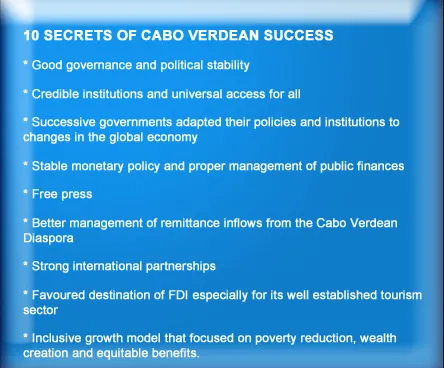
5.3 CIVICUS Index
- CIVICUS Monitor, which examines the status of civic space around the world, reported that civic space for over two thirds of the countries that reported to the HLPF in 2020 (62%) is characterized as “obstructed,” “repressed” or “closed”, meaning that civil society in these challenges are facing challenges of open activism, access to information, legal restrictions and in some cases arrest and harassment from governments. Only eight countries out of the 47 that reported to HLPF in 2020 were considered “open”, meaning that civil society can operate freely and without any restrictions. Sixteen reporting countries in Africa that reported to the HLPF were considered “obstructed, with CSOs facing challenges of funding, legal restrictions and arrests by authorities. These are Benin,
When the right-hand washes the left-hand and the left-hand washes the right-hand, both hands become clean.
Comoros, Gambia, Kenya, Liberia, Malawi, Morocco, Mozambique and Zambia) Nine (9) reporting countries were in the “repressed” category, unable to operate or even raise considerable resources for their work. These are Democratic Republic of the Congo, Niger, Nigeria, and Uganda). In 2020, four (4) reporting countries were classified as “closed. These are Burundi and Libya. This gap in VNR reports is particularly concerning given the increasing trend of closing civic space around the world.
Countries like DRC, Angola, Zimbabwe, Tanzania and Madagascar have a repressed civic space, while South Africa, Botswana, Namibia and Mauritius, considered the most democratic in the Southern Africa, are still considered to have narrowed spaces for civil society.
Based on CIVICUS data, all civic spaces in all countries in North Africa are facing major challenges and unable to engage in advocacy.
CSO reporting on the SDGs depends very closely on the level of enabling environment for Civil Society’s activities. The determining factors for Civil Society involvement in SDGs implementation also vary according to the degree or type of and stage of democracy, and openness of the government to independent voices. But, beyond this the level of involvement depends on civic capacity-ability of the CSOs to research, analyse and engage while adapting to the national context of public governance.
In addressing space for civic engagement, CSOs should be aware of three things.
- a lack of official space with indifferent Public Authorities requires that channels are created or alternative channels away from official ones are opened. a lack of official space with openness on the part of Public Authorities means that trust should be rebuilt; and
- Availability of official space without goodwill from Public Authorities means that spaces requires that this goodwill be found and if possible attained through engagement through partnerships.
When the elephants fight, it is the grass that suffers.
— African proverb
The best way to eat an elephant in your path is to cut him up into little pieces.
— Namibia Proverb
Engagement with Regional and International Bodies
6.1 Global Forums
At the Global level the following spaces are available to CSOs for engagement on policies around development and Agenda 2030
UN-Non-Governmental Liaison Services- This works directly with all UN entities.
UN-NGO Major Groups and Others under UN ECOSOC/ Department for Economic and Social Affairs
UN Security Council
Other UN Agencies including UN Human Rights Council, UNFPA- Civil Society Advisory Group and the UNDP-Civil Society Advisory Committee.
Other spaces exist within the World Bank Group Civil Society Engagement and other International Financial Institutions.
6.2 Regional and Sub-Regional Forums
Within Africa the following spaces are available
- UNDP-Regional Program Advisory Group (CSO Representation)
- World Bank “Africa CSO and Parliamentary Development Dialogue,”
- Africa Platform for Development Effectiveness
- UNECA-Africa Regional Forum on Sustainable Development- ARFSD
- OSAA-Office of Special Advisor on Africa
- IGAD- Intergovernmental authority on Development
- AfDB-Africa Development Bank
- The AU through the Citizens & Diaspora Directorate (CIDO)-CIDO has a unit that serves as the Secretariat for ECOSOCC, an advisory organ of the AU that provides African civil society organisations (CSOs) with a platform to directly influence AU decision-making processes and institutions
- AUD-NEPAD- an ad hoc space for CSOs.
- Regional Intergovernmental bodies including ECOWAS, EAC and SADC
Sub-regional Multi-stakeholder Fora on the SDGs
With the exception of central Africa, there are no sub-regional spaces for collective CSO engagement, other than the larger continental platform- the Africa CSO mechanism for SDGs.
The main regional forum on the SDGs in Africa is the African Regional Forum on Sustainable Development (ARFSD)
The ARFSD is a follow-up mechanism for the SDGs with specific focus on the Africa Region. CSO are part of the stakeholders admitted to the ARFSD and there is a coordinating mechanism to that effect: the Africa Regional Mechanism of the Major Groups and other Stakeholders (ARMMGOS) which was officially launched during the sixth session of the African Regional Forum on Sustainable Development (ARFSD) held in Victoria Falls, Zimbabwe in 2020.
If you are kicked from behind, it means you are in front.
— Rwanda Proverb
North Africa has always been seen as outside of Africa and part of the MENA region. Thus, the region does not have a special forum for SDGS. However, the region's stakeholders participate in African and Arab forums. In addition to the Africa Regional Forum on Sustainable Development, North Africa participates in The Arab Forum for Sustainable Development (AFSD) and Arab Sustainable Development Week (ASDW).
Civil Society can participate in this forum by engaging in the sessions' discussions and panels. CSO does not have a specific mechanism in this forum.
Reality: Engagement… Or Dialogue
Case study- The Africa Development Bank Civil Society Engagement
The Africa Development Bank has been engaging with Civil Society for over a decade.
It works through its own framework and selects the CSOs with which it engages.
It has an operating framework for Civil Society Engagement is composed of:
- CSO regional consultations
- Internal awareness of Bank staff
- Country dialogue with CSOs – CSO open days
- The Bank-Civil Society Forum
- The Bank-CSO Database
Concerns
Civil Society organizations do not know about the Bank’s strategic framework and operations.
The Bank has a closed “database” style consultations, engaging with CSOs that agree with its agenda and direction
Civil Society organizations are not involved in influencing the decisions of the bank at any level
Engagement is at fairly junior level, with senior level engagement limited to presentations
Engagement with the UN- Study Findings
Global Policy Watch conducted an independent survey of CSOs with commitment and experience of working with the UN primarily in programme countries on their knowledge and understanding of the reforms needed and areas of engagement that they need the most. The results shows a very high level of commitment to UN values and principles. For a number of CSO respondents, the UN system is appreciated for its inspiration, legitimization and promotion of the values they stand for but is also viewed as a competitor for funds and influence, often displacing the social sector instead of building it. And frequently it is seen as both at the same time. Despite substantial emphasis on partnerships including with civil society, there is limited and uneven engagement between CSOs and UN country Teams. Results indicate that CSOs in programme countries are largely unaware of the existence of the UN Sustainable Development Cooperation Framework and only a minority are regularly engaged with their country’s UN Resident Coordinator.
The CSOs believe the UN is relevant and they find the 2030 Agenda for Sustainable Development even more relevant. Their work is focused on achieving the Sustainable Development Goals (SDGs) in a variety of ways, including establishing new partnerships and participating in the political process of assessment. Yet, those partnerships rarely include the UN. Or, inversely, the UN country teams do not include independent CSOs in the partnerships they form. Similarly, when the official processes to monitor progress on the SDGs do not accommodate them, which seems to be in a majority of the cases, they find or create initiatives to voice their own conclusions and participate in the national, regional and global debates.
The results are summarized below
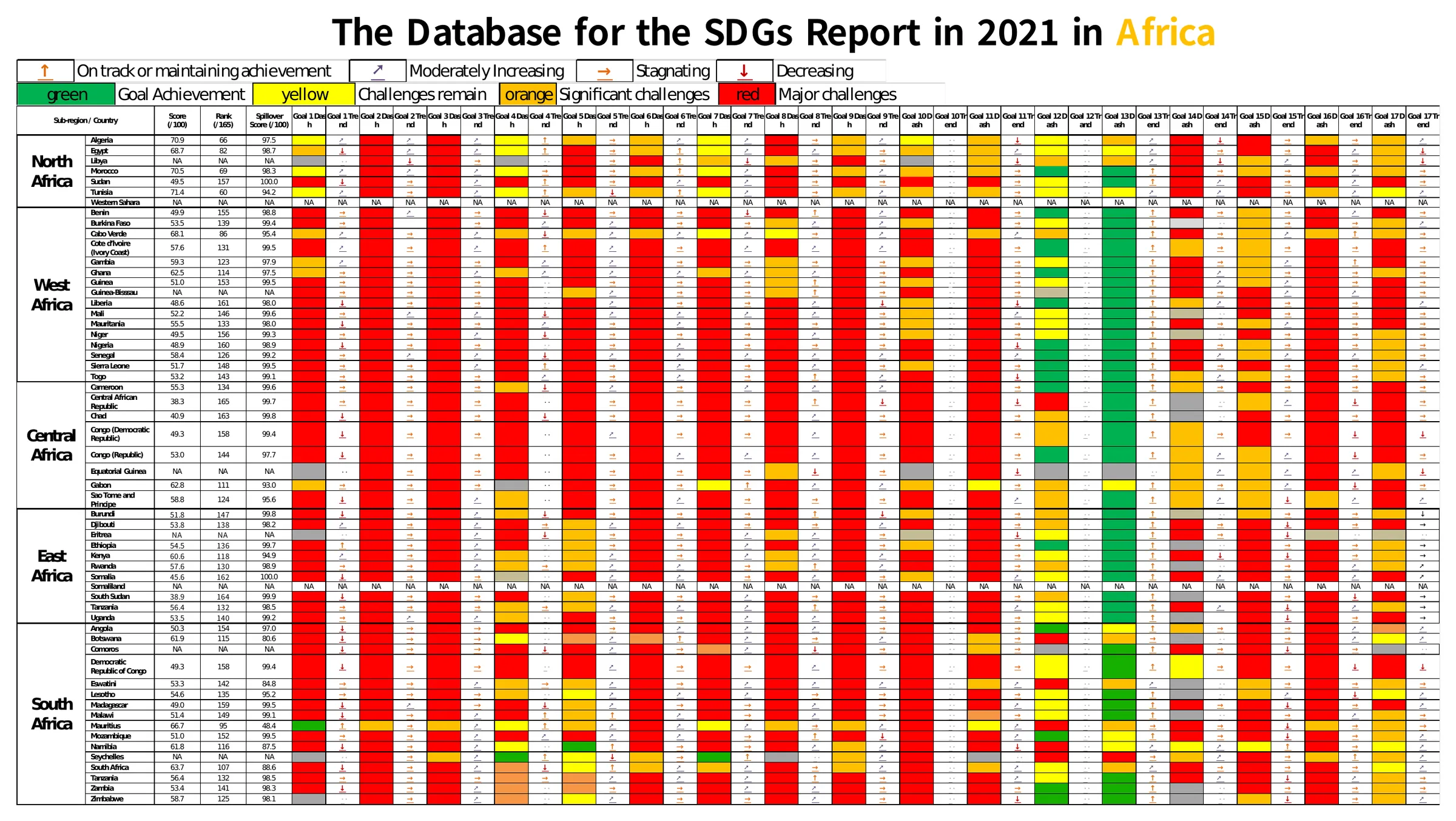
Trust in Allah. But tie your donkey.
— Egyptian Proverb
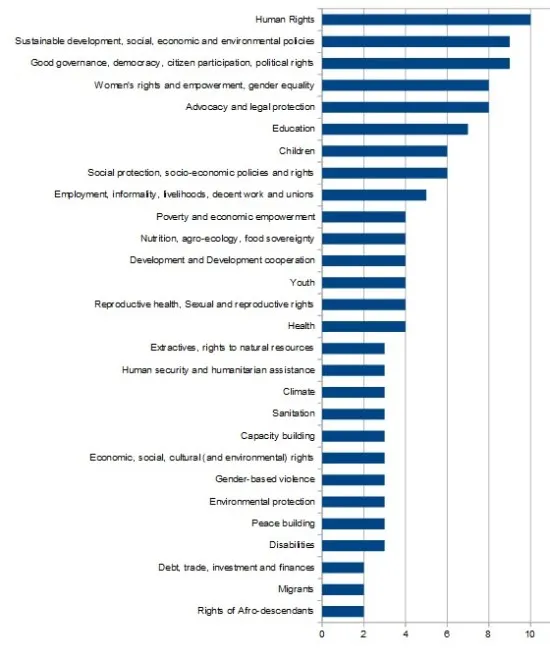
The axe forgets, but the tree remembers.
— Niger Proverb
Conclusions and Recommendations
7.1 Conclusions
This Report reveals progress in development, including human rights and democracy, and how covid 19 has had an impact on its path to achieving both the continental development agenda, It is clear that covid 19 has had a prefund impact on the continent’s progress on Agenda 2030 and there is a need to recalibrate the path to development as we work on the final decade oif the Agenda
The continent has to challenge the narrative that it is poor and instead begin to claim its use of resources for its own development
The effects of covid 19 will continue to be felt across all sectors, but the continent must not give up the fight on vaccine acquisition and manufacture.
Over 50% of Africa’s cumulative GDP (valued at just over $2.7T) is contributed by just three countries-Egypt, Nigeria and South Africa. This is significant to know in that it explains why so many countries in the continent are struggling to raise resources for their development agenda. Africa is pursuing two concurrent development agenda-Agenda 2030 for Sustainable Development, and The Africa We Want Agenda 2063
On Agenda 2030 the national mechanisms in place for implementation will continue to require support and monitoring by civil society and citizens, while the fight to open up democratic space for citizens, media and CSOs should involve stronger partnerships with other CSOs from across the world.
While attention is focused on finding a vaccine for covid 19, what has become clear is that resources should be directed at achieving and realizing all of the Sustainable Development Goals. It is not enough to commit resources to a vaccine when the world may face another crisis arising from other development challenges. Covid 19 is only one of the many challenges facing global development. It is its intensity and scale that has given it so much attention. That attention should lead us to a higher goal beyond self-preservation-working to collectively ensure resources are available for the wide range of development agenda.
Africa’s progress to Agenda 2030 for sustainable development will be shaped not just by its response to covid 19, but its ability to address various economic and social challenges that have existed in the continent and only exacerbated by the pandemic.
But it is clear that the region has made considerable progress on democracy, although this appears to be slowed down by its human rights violations. Economically reliant on raw materials export, minerals and debt, especially to IMF and the World Bank will continue to be a major challenge to the continent’s progress. North Africa has to address the core SDG issues around democracy and gender, while Southern Africa must grapple with the effects of climate change.
The interlinkages of the SDGs means we must look beyond “SDG” Platforms to engage.
These interlinkages are captured in the five pillars of the Agenda 2030-people, planet, poverty, partnership and prosperity as well as the focus on Leaving No one Behind that seeks to ensure that the development agenda does not focus only on a trickledown effect, which deliberately seeks to uplift everyone and every aspect of society.
7.2 Recommendations
On SDG Implementation and Africa Agenda 2063
- Government should establish national mechanisms on SDGs that integrate national plans with regional peer learning and support mechanisms
- Support multi-stakeholder accountability and collaboration on “Whole-of-SFG” approach instead of focus on select Agenda targets and goals
- Consider options to strengthen implementation of peace and inclusive societies, specifically in the case of Northern and Central African countries.
- Northern African countries should immediately address the concerns around treatment of women and girls in their countries, to ensure equity and full compliance with CEDAW
- African Governments should consider resourcing CSOs in the same way that OECD countries do to their CSOs.
If the stomachache were in the foot, one would go lame.
— Sychelles Proverb
This will ensure support for core government policies that are not linked to the “funder-first syndrome’ currently witnessed among Africa CSOs
- CSOs to become more consistent with the preparations of Shadow Reportage as alternative perspectives to official VNR processes
- Key focus should be placed on Development as Public Goods, and advocate on Rights to sustainable development
Strengthen decentralized Local Authorities in effective Domestic Resources Mobilization for the implementation of the SDGs;
Creation of a national multi-stakeholder monitoring framework to act as a review and accountability platform for SDG implementation;
On Covid-19 and Vaccination
- Africa governments’ priority should be on establishing own Vaccine manufacture under the Africa CDC
- Civil society should come together and challenge and fight vaccine apartheid
- Build trust among and with citizens as prerequisite to managing current and future pandemics Partner and engage with other civil society, private sector, local communities and other stakeholders in inclusive recovery efforts.
- Specific research with a view to designing packages for sustainable recovery from the COVID-19, beyond the emergency short term solutions.
- Research to develop domestic vaccines and treatments in Africa and avoid dependence to others.
On Democracy and Civic Space
- Strengthen existing independent human rights institutions to monitor and address human rights violations.
- CSOs to build collaborative platforms among civic actors for solidarity and collective advocacy
- Establish cross-border alliances and networks in the region to build solidarity, international partnerships.
- Support CSO investment in digital infrastructure for a more robust advocacy while protecting themselves against rogue governments using technology to stifle voice and dissent.
- Focus on ensuring and promoting a culture of constitutionalism across Africa as opposed to ad hoc laws. Kenya shows that constitutions do not guarantee democracy and civic freedom. CSO as should therefore expand their advocacy work to ensure Implementation of policies and laws, not just the passage of good laws, policies and constitutions.
- While they are important steps to democracy, elections should not be the primary focus of CSOs. Instead CSOs should place emphasis on advocating for FULL Rule of Law and Good Governance to avoid the challenges witnessed in Uganda, Egypt and Tanzania
- Build and strengthen Solidarity. Solidarity. Solidarity as the key to civic freedom.
- Work with civil society to advocate for the enforcement of existing legal and institutional framework, in collaboration with Parliaments, as a way to promoting civic space and press freedom for a better consideration of human rights;
- Setting own sub-regional indexes to measure democracy taking into consideration specific norms of the region
- Strengthening public support for democratic principles by investing in civic education
- Strengthening laws that guard against foreign influence over government officials.
Those who are born on top of the anthill take a short time to grow tall.
— Mozambique Proverb
On Citizen Voice and Participation
- Civic voice around voices and power of citizens as complimentary to existing CSO voice
On International Engagement
- CSOs should undertake more evidence- based research and share these finding at international forums.
- CSOs should build and work in alliances in order to strengthen their position
- CSOs beyond traditional spaces- For Africa there are more effective spaces outside the HLPF –OSAA, UNDP Civil Society Advisory Committee, UNIFEM CSOs Advisory Unit, Peace Building Commission, IGAD Forums and AUD-NEPAD
- Build solidarity with Global and other Regional CSOs for greater advocacy at global stage
- Ensure global policies are localized, instead of focusing on global implementation
- Develop a formal monitoring and reporting mechanisms, to evaluate the progress, actions and outcomes related to civil society recommendations and calls-to-action at relevant Ministerial Meetings and the Summit.
- Ensure a feedback mechanism with citizens, among CSOs and with governments.
- Strengthen interregional platforms with a view to generating ensuring experiences sharing among sub-regions on the promotion and implementation of the SDGs;
- Cooperating with other national and regional NGOs to ensure exchanging experiences and success stories
When the Nile River knows a secret the desert will soon come to know it too.
— Sudanese Proverb
Annex: Comparing Africa Agenda 2063 with Agenda 2030
Comparing Africa Agenda 2063 with 2030 Agenda for Sustainable Development Goals
| # | Agenda 2063 Goals | Agenda 2063 Priority Areas | UN Sustainable Development Goals |
|---|---|---|---|
1. | A high standard of living, quality of life and well-being for all citizens. | Incomes, jobs and decent work Poverty, inequality and hunger Social security and protection, including persons with disabilities Modern, affordable and liveable habitats and quality basic services | 1. End poverty in all its forms everywhere in the world 2. End hunger, achieve food security and improved nutrition and promote sustainable agriculture. 8. Promote sustained, inclusive and sustainable Economic growth, full and productive employment and decent work for all. 11.Make cities and human settlements inclusive, safe, resilient and sustainable. |
2. | Well educated citizens and skills revolution underpinned by science, technology and innovation. |
| 4. Ensure inclusive and equitable quality education and promote lifelong learning opportunities for all. |
3. | Healthy and well-nourished citizens. |
| 3. Ensure healthy lives and promote well-being for all at all ages. |
4. | Transformed economies. |
| 8. Promote sustained, inclusive and sustainable economic growth, full and productive employment and decent work for all. 9. Build resilient infrastructure, promote inclusive and sustainable industrialization and foster innovation. |
5. | Modern agriculture for increased productivity and production. |
| 2. End hunger, achieve food security and improved nutrition and promote sustainable agriculture. |
6. | Blue/ocean economy for accelerated economic growth. |
| 14. Conserve and sustainably use the oceans, seas and marine resources for sustainable development. |
7. | Environmentally sustainable and climate resilient economies and communities. |
| 6. Ensure availability and sustainable management of water and sanitation for all. 7. Ensure access to affordable, reliable, sustainable and modern energy for all. 13. Take urgent action to combat climate change and its impacts. 15. Protect, restore and promote sustainable use of terrestrial ecosystems, sustainably manage forests, combat desertification, and halt and reverse land degradation and halt biodiversity loss. |
8. | A United Africa (Federal or Confederate). |
| |
9. | Continental financial and monetary institutions established and functional. |
| |
10. | World class infrastructure criss - crosses Africa. |
| 9. Build resilient infrastructure, promote inclusive and sustainable industrialization and foster innovation. |
11. | Democratic values, practices, universal principles of human rights, justice and the rule of law entrenched. |
| 16. Promote peaceful and inclusive societies for sustainable development, provide access to justice for all and build effective, accountable and inclusive institutions at all levels. |
12. | Capable institutions and transformative leadership in place. |
| 16.Promote peaceful and inclusive societies for sustainable development, provide access to justice for all and build effective, accountable and inclusive institutions at all levels. |
13. | Peace, security and stability is preserved. |
| 16. Promote peaceful and inclusive societies for sustainable development, provide access to justice for all and build effective, accountable and inclusive institutions at all levels. |
14. | A stable and peaceful Africa. |
| |
15. | A fully functional and operational APSA(Africa Peace and Security Architecture) |
| |
16. | African cultural renaissance is pre-eminent. |
| |
17. | Full gender equality in all spheres of life. |
| 5.Achieve gender equality and empower all women and girls. |
18. | Engaged and empowered youth and children. |
| 4. Ensure inclusive and equitable quality education and promote lifelong learning opportunities for all. 5. Achieve gender equality and empower all women and girls. |
19. | Africa as a major partner in global affairs and peaceful co-existence. |
| 17. Strengthen the means of implementation and revitalize the global partnership for sustainable development. |
20. | Africa takes full responsibility for financing her development Goals. |
| 10. Reduce inequality within and among countries. 17.Strengthen the means of implementation and revitalize the global partnership for sustainable development. |
A kraal needs a shepherd.
— Lesotho Proverb
A stone from the hand of a friend is an apple.
— Mauritania Proverb
No matter how long a log stays in the water, it does not become a crocodile.
— Mali Proverb
The cow steps on the calf but she does not hate it.
— Senegalese Proverb
Those who are absent are always wrong.
— Congolese Proverb
About This Report
Synthesis report prepared for the Asia-Africa Democracy Forum (AADF), 2021, by Paul Okumu, Africa Platform, with input from sub-regional researchers Martin Tsounkeu (Central Africa), Frank Soteri (Eastern Africa), Caroline Usikpedo-Oliseowe (West Africa), Mahendranath Busgopaul (Southern Africa) and Hagar Monsif (North Africa).

This Report is based on analysis of countries within the geographical boundaries of Africa, not It’s the political boundaries. It however does not include Western Sahara and Somaliland because there is no internationally accepted official data for these countries.
It looks at the continent’s progress in development, including human rights and democracy, and how covid 19 has had an impact on its path to achieving both the continental development agenda, known as Agenda 2063, and the global development agenda, Transforming our world by 2030, popularly known as 2030 Sustainable Development Goals (SDGs).
The report begins by looking at the effect and impact of covid 19 on the continent’s health and development, then progresses to focus on its larger development and democracy ahead as the world begins the last decade for accomplishment of the targets set out in Agenda 2030 for Sustainable Development.
About AADF 2021
Asia and Africa Democracy Forum (AADF) 2021 is a joint initiative by the Permanent Secretariat of the Community of Democracies (PSCD) and Asia Democracy Network (ADN) to defend and promote democracy and civic space through inter-regional dialogue and cooperation in the Global South.
Under the theme ‘Defending and Promoting Democracy and Civic Space through the SDGs in the context of the COVID-19 Pandemic’, the forum,, held in late October 2021, sought to address various challenges, threats to democracy and civil space as well as opportunities for international civic engagement on democracy and SDGs, in particular, the SDG 16 plus.
The main objective of the AADF is to promote international solidarity and cooperation among CSOs and democracy advocates in Asia and Africa engaged in civic advocacy and public diplomacy with policymakers of the governmental and inter-governmental organizations on democracy, civic space, human rights and SDGs.
The AADF is a part of the ADN’s efforts to promote international networking and research-based discourse on advocacy for democracy and civic space in Asia through international democracy forums held in various countries since 2018.