كان صاحبك عسل ما تلحسوش الكلّ-If your friend is honey, do not lick him thoroughly.
— Tunisia Proverb
A bird that flies off the earth and lands on an anthill is still on the ground.
— Igbo (Nigeria) Proverb
1.1 Understanding Africa-The Poorest and Richest continent on earth
Depending on who you ask, Africa has either 54 countries, 55 or 59! And this is where the complexity of the continent remains. The United Nations recognizes 55 countries, which excludes Western Sahara (claimed by Morocco) and Somaliland Republic. The Africa Union, on the other hand, also recognizes 55 countries, but this includes Western Sahara. Reunion and Mayotte are still controlled by France while St Helena is controlled by Britain. From a developmental and political perspective, the continent is divided further. North Africa is not considered part of Africa, and is usually classified together with Western Asia (Middle East) in what the UN calls Middle East and North Africa-MENA
These difficult geopolitical classifications are important in that they determine data availability and acceptability, as well as determination of Africa’s economic and political mapping.
1.2 Africa’s Diversity and Regional Economic Blocs
Africa is one of the most diverse societies in the world. Its population of 1.4 B is composed of over 3,000 different ethnic groups speaking more than 2,100 different languages. While this is nearly as many as Asia, Asia is a population of 4.6B, with most of the countries have asset of few languages shared by the entire population. Europe on the other hand, has just about 160 culturally distinct groups and only 24 official languages. Its total number of languages is less than the languages in one African country- Nigeria.
This diversity, which often comes with distinct cultures and political leadership styles that existed before European colonizers hurriedly combined the various ethnic groups into countries, makes the continent’s search for cohesion, an inclusive governance system, and co-existence difficult.
Regional Groupings
There are five primary Regional Economic and Political Blocs recognized by the Africa Union (AU)-Arab Maghred Union (AMU- Algerian, Libyan, Mauritanian, Moroccan and Tunisian), Economic Community of Central Africa States (ECCAS- Angola, Burundi, Cameroon, Central African Republic, Chad, Democratic Republic of Congo, Equatorial Guinea, Gabon, Republic of the Congo, São Tomé and Príncipe),The West Africa Economic Community (ECOWAS- Benin, Burkina Faso, Cabo Verde, Cote d'Ivoire, The Gambia, Ghana, Guinea, Guinea-Bissau, Liberia, Mali, Niger, Nigeria, Senegal, Sierra Leone, and Togo.), The East Africa Economic Community (EAC- Burundi, Kenya, Rwanda, South Sudan, Tanzania, and Uganda), and the South Africa Economic Community (SADC- Angola, Botswana, Comoros, Democratic Republic of Congo, Eswatini, Lesotho, Madagascar, Malawi, Mauritius, Mozambique, Namibia, Seychelles, South Africa, Tanzania, Zambia and Zimbabwe).
Of these the ECA is considered the most integrated, according to the Africa Regional Integration Index (ARII), while ECOWAS is the most politically united. ECA and ECOWAS both have visa-free travel for all its citizens, with ECOWAS at advanced stages to launch a common single currency in 2027. SADC is considered the strongest economic Bloc, but least integrated, although it’s still dominated by the powerful South Africa. The EAC is the bloc with the highest level of trade among its members, and recently it has been seeking to build a political Union. ECCAS is complex in that the economies and fiscal policies of their members are so intertwined with France-in a relationship known as Francafrique-that it has become challenging for Central African economies to do business with the rest of Africa, let alone the rest of the world. The AMU is largely symbolic in terms of its impact on Africa trade and relations since Arab countries are generally more included to align with the Arab League than the AU.
Teeth do not see poverty.
— South Sudanese proverb
In 2021 Africa officially launched a new trading bloc covering the entire continent- the Africa Continental Free Trade Area (ACfTA).
Central Africa sub-region could be considered the riches sub-region in Africa in consideration of its vast natural resources and rich agricultural land. The Congo Basin, for example, is considered the second largest forest density in the world. East Africa has the 33% of the remaining fresh water on earth while Ethiopia has one of the largest arable land in the world. One of the largest natural gas deposits was recently discovered in Mozambique. Southern African countries have minerals while Western African countries are known for their cash crop production and their vast oil and natural gas. Equatorial Guinea, a former Spanish colony, is considered among the top producers of Oil in the world, yet its poor political leadership has put its poverty levels at 76.8%, making it among the poorest countries in the world.
West African economies are considered among the strongest in the region, and it is not surprising that they score significantly high on their SDG progress.
But despite these, the so called “strong economies” does not significantly impact lives of its citizens.
Nigeria, for example, is considered the largest and most vibrant economy in Africa. Yet it has a poverty rate of 40% and an unemployment rate of 32.5%.
1.3 Development in Africa- So Rich, yet So Poor
In order to understand Africa’s development path (or lack of it) it is important to understand why the continent remains what former GAVI Chair J Naidoo once called “the richest continent under the ground, and the poorest above it”. Africa’s response to covid 19, its human rights and its progress to Sustainable Development by 2030 is heavily shaped by how its resources are extracted and used.
Many have wondered by such a rich continent is also so poor. And while it’s easy to point to its poor governance and political leadership, the real issues behind Africa’s poverty are more obvious than thought.
It has its history in the Eurafrica project, an ideology that shapes the way Africa relates with Europe and to a large extent the rest of the world until today.
Feeding the world
Former French president Jacques Chirac acknowledged that "without Africa, France will slide down into the rank of a third rate power." Chirac's predecessor François Mitterand, as Interior Affairs Minister in 1957 already prophesied :
“…car sans l’Afrique il n’y aura pas d’Histoire de France au XXIè siècle.”
(…for without Africa, France will have no history in the 21st century.”)
UNEP Reports that Africa is home to some 30 percent of the world’s mineral reserves, eight per cent of the world’s natural Gas and 12 per cent of the world’s oil reserves. The continent has 40 percent of the world’s gold and up to 90 percent of its chromium and platinum. The largest reserves of cobalt, diamonds, platinum and uranium in the world are in Africa. It holds 65 per cent of the world’s arable land and ten percent of the planet’s internal renewable fresh water source. It is no surprise that consumption-driven countries that have hardly raw materials of their own such as Europe and some part of Asia, often try to take control of the continent’s political and development agenda in order to extract and exploit its resources.
A seer who invoked a storm on his people cannot prevent his house from destruction.
— Nigerian proverb
Africa is courted and in many cases forced to act as the breadbasket for most of Europe and parts of Asia. Former colonizers such as Britain, France, Germany, Netherlands, Portugal, and Spain, remain with vast economic control of the continent, with France having strict rules that include control of the monetary and fiscal policies of all its 14 former colonies. British citizens and corporations control vast amounts of land in Kenya and Zimbabwe that continues to be the source of major conflicts. Collectively the OECD countries
have the strictest rules governing the ability of the continent to in international trade without passing through European corporations. The result is that the continent is not only among the poorest in the world, it has the weakest forms of governance and democratic systems. Cohesion and the social contract is weak as most of its political leadership are proposed and sustained by economic blocs keen to control its vast resources. If we consider the fact that with over 3,000 ethnic groups that were forced to live together in geographical boundaries created by colonial powers, almost all of them against their will and without consultations with the different communities, Africa is a powder keg that will take decades to develop. The world is moving towards sustainable development while the continent is still caught in economic extractives that ensures it has no domestic resources for its own development agenda.
In short Africa feeds, lights and powers the world, yet remains the poorest continent in the world
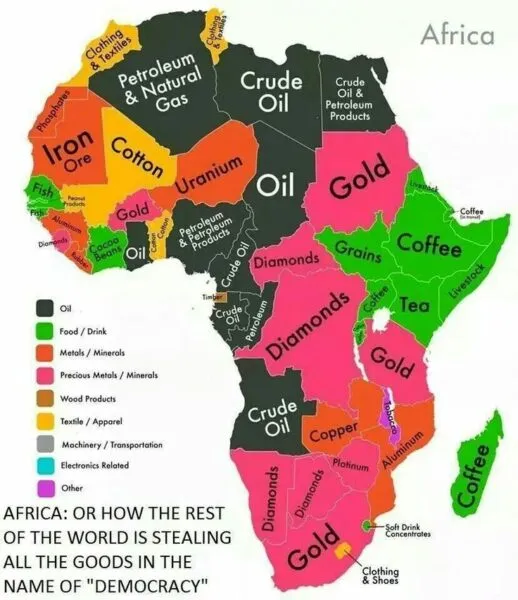
Africa’s wealth in Summary
Africa has 30% of the total Value of earth's remaining natural resources. These includes:
92% of the world’s cobalt
89% of the World's Gold
73% of the World's Diamond
66% of total world arable land (despite being 45% desert)
16% of the World's Uranium
9% of the World's Bauxite
2% of the World's steel
5% of the World's Aluminium
5% of the World's Copper
60% (600 million hectares) global arable land
Even the best cooking pot will not produce food.
— Cameroon Proverb
Why is Africa Poor?
Many people loudly lament the steady injection of fruitless foreign aid and economic assistance. But many fail to realize the rewards of extractive activities by both Europeans and their political backers in Africa are so substantial that they provide huge incentives for maintaining the status quo. The aid flow into Africa is tiny compared with the value of the exploited resources flowing in the other direction.
“Outsiders often think of Africa as a great drain of philanthropy, a continent that guzzles aid to no avail and contributes little to the global economy in return. But look more closely at the resource industry, and the relationship between Africa and the rest of the world looks rather different. A decade ago, fuel and mineral exports from Africa were worth $333 billion, more than seven times the value of the aid that went in the opposite direction (and that is before you factor in the vast sums spirited out of the continent through corruption and tax fiddles).”
These figures have since doubled after discovery of more natural resources such as Gas in Mozambique and oil in Kenya and Uganda.
Trying to “expose” the theft of Africa’s resources is pointless. The shell companies and foreign governments engaged in looting Africa, often in partnership with governments they help prop up, have far much to lose by changing their business ethics with the continent. The empires of colonial Europe and the Cold War superpowers have given way to a new form of dominion over the continent that serves as the mine of the world — new empires controlled by nations and alliances of unaccountable African rulers governing through shadow states, middlemen who connect them to the global resource economy, and multinational companies from the West and the East that cloak their corruption in corporate secrecy. We prefer not to think of the mothers of eastern Congo, the slum dwellers of Luanda, and the miners of Marange as we talk on our phones, fill up our cars, and propose to our lovers. As long as we go on choosing to avert our gaze, the looting machine will endure.”- paraphrased from “The Looting Machine:Warlords, Oligarchs, Corporations, Smugglers, and the Theft of Africa’s Wealth,” by Tom Burgis
Even the lion, the king of the forest, protects himself against flies.
— Ghanaian proverb