6.1 Global Forums
At the Global level the following spaces are available to CSOs for engagement on policies around development and Agenda 2030
UN-Non-Governmental Liaison Services- This works directly with all UN entities.
UN-NGO Major Groups and Others under UN ECOSOC/ Department for Economic and Social Affairs
UN Security Council
Other UN Agencies including UN Human Rights Council, UNFPA- Civil Society Advisory Group and the UNDP-Civil Society Advisory Committee.
Other spaces exist within the World Bank Group Civil Society Engagement and other International Financial Institutions.
6.2 Regional and Sub-Regional Forums
Within Africa the following spaces are available
- UNDP-Regional Program Advisory Group (CSO Representation)
- World Bank “Africa CSO and Parliamentary Development Dialogue,”
- Africa Platform for Development Effectiveness
- UNECA-Africa Regional Forum on Sustainable Development- ARFSD
- OSAA-Office of Special Advisor on Africa
- IGAD- Intergovernmental authority on Development
- AfDB-Africa Development Bank
- The AU through the Citizens & Diaspora Directorate (CIDO)-CIDO has a unit that serves as the Secretariat for ECOSOCC, an advisory organ of the AU that provides African civil society organisations (CSOs) with a platform to directly influence AU decision-making processes and institutions
- AUD-NEPAD- an ad hoc space for CSOs.
- Regional Intergovernmental bodies including ECOWAS, EAC and SADC
Sub-regional Multi-stakeholder Fora on the SDGs
With the exception of central Africa, there are no sub-regional spaces for collective CSO engagement, other than the larger continental platform- the Africa CSO mechanism for SDGs.
The main regional forum on the SDGs in Africa is the African Regional Forum on Sustainable Development (ARFSD)
The ARFSD is a follow-up mechanism for the SDGs with specific focus on the Africa Region. CSO are part of the stakeholders admitted to the ARFSD and there is a coordinating mechanism to that effect: the Africa Regional Mechanism of the Major Groups and other Stakeholders (ARMMGOS) which was officially launched during the sixth session of the African Regional Forum on Sustainable Development (ARFSD) held in Victoria Falls, Zimbabwe in 2020.
If you are kicked from behind, it means you are in front.
— Rwanda Proverb
North Africa has always been seen as outside of Africa and part of the MENA region. Thus, the region does not have a special forum for SDGS. However, the region's stakeholders participate in African and Arab forums. In addition to the Africa Regional Forum on Sustainable Development, North Africa participates in The Arab Forum for Sustainable Development (AFSD) and Arab Sustainable Development Week (ASDW).
Civil Society can participate in this forum by engaging in the sessions' discussions and panels. CSO does not have a specific mechanism in this forum.
Reality: Engagement… Or Dialogue
Case study- The Africa Development Bank Civil Society Engagement
The Africa Development Bank has been engaging with Civil Society for over a decade.
It works through its own framework and selects the CSOs with which it engages.
It has an operating framework for Civil Society Engagement is composed of:
- CSO regional consultations
- Internal awareness of Bank staff
- Country dialogue with CSOs – CSO open days
- The Bank-Civil Society Forum
- The Bank-CSO Database
Concerns
Civil Society organizations do not know about the Bank’s strategic framework and operations.
The Bank has a closed “database” style consultations, engaging with CSOs that agree with its agenda and direction
Civil Society organizations are not involved in influencing the decisions of the bank at any level
Engagement is at fairly junior level, with senior level engagement limited to presentations
Engagement with the UN- Study Findings
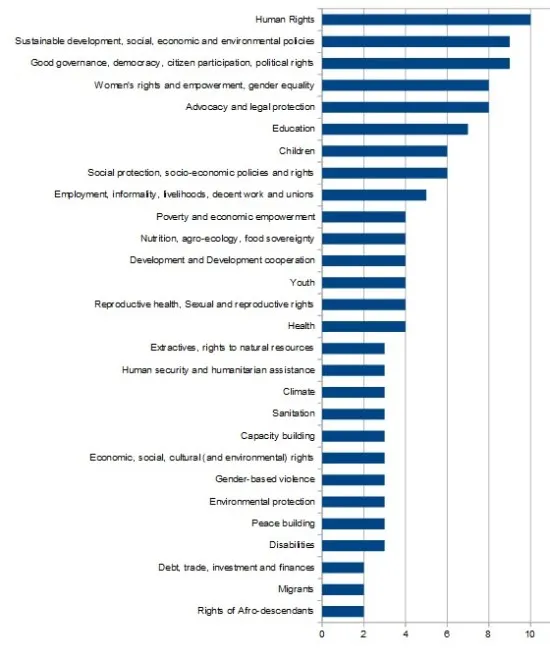
Global Policy Watch conducted an independent survey of CSOs with commitment and experience of working with the UN primarily in programme countries on their knowledge and understanding of the reforms needed and areas of engagement that they need the most. The results shows a very high level of commitment to UN values and principles. For a number of CSO respondents, the UN system is appreciated for its inspiration, legitimization and promotion of the values they stand for but is also viewed as a competitor for funds and influence, often displacing the social sector instead of building it. And frequently it is seen as both at the same time. Despite substantial emphasis on partnerships including with civil society, there is limited and uneven engagement between CSOs and UN country Teams. Results indicate that CSOs in programme countries are largely unaware of the existence of the UN Sustainable Development Cooperation Framework and only a minority are regularly engaged with their country’s UN Resident Coordinator.
The CSOs believe the UN is relevant and they find the 2030 Agenda for Sustainable Development even more relevant. Their work is focused on achieving the Sustainable Development Goals (SDGs) in a variety of ways, including establishing new partnerships and participating in the political process of assessment. Yet, those partnerships rarely include the UN. Or, inversely, the UN country teams do not include independent CSOs in the partnerships they form. Similarly, when the official processes to monitor progress on the SDGs do not accommodate them, which seems to be in a majority of the cases, they find or create initiatives to voice their own conclusions and participate in the national, regional and global debates.
The results are summarized below
Trust in Allah. But tie your donkey.
— Egyptian Proverb
The axe forgets, but the tree remembers.
— Niger Proverb