5.1 Democracy in Africa
The African Charter on Human and Peoples' Rights (ACDHR) was adopted by the African Union's predecessor, the Organization of African Unity, in 1981, as the continent's primary human rights instrument. It incorporates the same individual rights enshrined in the UN's Universal Declaration of Human Rights, including equal protection before the law, freedom of speech, religion and assembly, the right to work, own property and have a minimum standard of living and access to health and education and freedom from arbitrary arrest, detention, degrading treatment and torture. With individual rights come individual duties, including the obligation to strengthen the family, to serve the state and to work.
The Charter also establishes a group of "peoples'" or communal rights and obligations, such as a right to national self-determination, that are absent from the 1948 Universal Declaration. Those rights, and such provisions as the obligation of states to "eliminate all forms of foreign economic exploitation" and the right of peoples to pan-African solidarity in the anti-colonial struggle, emerged from Africa's particular historical experience and what the Charter's preamble describes as "the values of African civilization."
Today, only three countries (Eritrea, Somalia and South Sudan) do not hold regular elections, the latter two because of generalized conflict and instability. Somalia holds indirect elections; consensus has not yet been reached on proposed plans for holding direct elections.
The democratic expansion that has occurred in Africa during the third wave is considered second 'in terms of its range and scope' to the one in Latin America and the Caribbean region
Brookings acknowledges that across Africa, elections perform at least three important democratizing functions: They (1) help the continent build and sustain effective democratic institutions; (2) provide the people with an effective legal tool to constrain and guard the government and minimize impunity; and (3) enhance the ability of the people to change their government and bring into public service new and more energetic and effective political leaders. Nevertheless, in order for elections to perform these three important functions and do so effectively, these elections must (i) be regular, not infrequent; and (ii) fair, free, competitive, inclusive, transparent, and credible.
In fact, while elections can help African countries consolidate, deepen, and entrench democracy, they can also pave the way for sustained majoritarian power to the detriment of the minority, as we have seen in countries like Cameroon.
It is important to note that, although elections are critical to the transition of a country from authoritarianism to constitutional democracy, they can also serve as a tool for the survival of authoritarian governments. For example, authoritarian regimes in countries, such as Cameroon, the Republic of the Congo, and Equatorial Guinea have used elections to consolidate and entrench democracy.
COVID-19 has given governments greater leverage, providing further pretext for postponing elections in Somalia and Ethiopia, muzzling opposition figures in Uganda and Tanzania, and imposing restrictions [PDF] on media across the continent. The enforcement of pandemic restrictions by security services has often been brutal, provoking demonstrations in Kenya and even in more advanced democracies such as South Africa.
If two wise men always agree, then there is no need for one of them.
— Zambian Proverb
5.2 Progress on Democracy and Human Rights
Only Guinea and Mauritania recorded very low performance, Ghana had very high performance while the rest had mid performance.
Cabo Verde has maintained the top rank on global Democracy index ranking Guinea Bissau is the lowest ranked in West Africa
West Africa is making mixed progress on press freedom while according to the World Press Freedom index 2020, Cabo Verde, Ghana and Burkina Faso ranks highest among the 16 countries in West Africa
Burundi is performing low on most democracy indices
Ethiopia had made considerable progress on democracy and participation, but this has been eroded with the internal conflict that has been raging for over a year now.
Rwanda has consistently performed low on media integrity and judicial independence while Tanzania is making progress on inclusive societies and universal suffrage.
In Central Africa democracy and civic space is overall characterised by the fact that in almost all the countries, there are institutional and legal arrangements that in principle guarantee civic rights, but these arrangements are most of the time not enforced.
According to data from Economist Intelligence (EIU) covering 15 member states of the Southern African region apart from Seychelles, the democracy index in the region as at 2020 DRC is low and operating under an authoritarian regime. Countries like Angola, Mozambique, Eswatini and Comoros also find themselves within the same structure.
Democracy and Human Rights (International IDEA)
Overall, according to the International IDEA, there has been a drop in democracy and human rights in the Southern African region primarily due to the Covid-19 pandemic. As recorded by the International IDEA, there was also a rise in gender-based violence against women in South Africa during the lockdown.
The rainmaker who doesn't know what he's doing will be found out by the lack of clouds.
— Ugandan Proverb
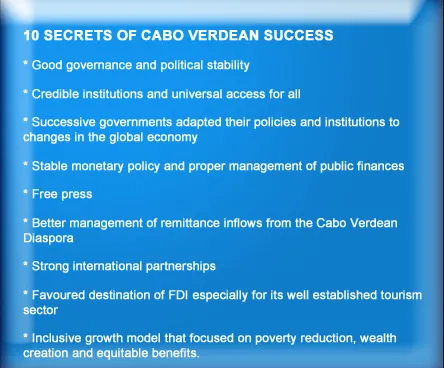
Success Amidst Failure: The Story of Cabo Verde
“Quem e pobre nao pode fazer uma politica de rico.” (A poor country cannot afford to adopt policies from the rich).
It is now 39 years since President first Capo Verde President, Pires, uttered these words which marked the hallmark of his presidency. Under Pires Cabo Verde prospered and outperformed many countries in Africa even rivaling much of Europe. This was as other African countries were either coerced or persuaded to follow the economic and political agenda of their colonizers.
Cabo Verde is nation of 10 islands and five islets with little arable land and within the Sahara Desert belt
The story of Cabo Verde’s economic success began in 1975 when it secured its independence from Portugal. This was one year after its twin colony Guinea-Bissau had been granted its freedom.
In 1963 both Guinea Bissau and Cabo Verde were on the verge of uniting. However, the plans were abandoned in November 1980 after a coup by Joao Bernardo Vieira in Guinea Bissau deposed its President. Relations between the two nations with a common destiny and political party worsened with the coup and in January 1981 the African Party for the Independence of Cape Verde (PAICV) was born.The Cape Verde ruling party opened the archipelago’s democratic space to allow for multi-party democracy. In 1991 it was defeated in the multi-party elections by the Movement for Democracy party led by Antonio Monteiro.
In September 2011 Pires resisted all attempts from his party’s stalwarts to extend his presidency by changing the Cabo Verdean constitution after serving his two terms. He retired after having served his country right through the independence struggle and handed over to President Jorge Carlos Fonseca. One month later Pires was awarded the Mo Ibrahim’s Prize for Good Governance in Africa.
“The fact that Cabo Verde with few natural resources can become a middle income country is an example not just to the continent but to the world. President Pires embodies the type of leadership the prize is designed to recognize.” Mo Ibrahim said at the time recognizing Pires for putting the interests of Cabo Verdeans as his guiding principle.
The citation recognizing Pires was even more revealing: “The prize committee has been greatly impressed by President Pedro Pires vision into transforming Cabo Verde into a model of democracy, stability and increased prosperity. Under his ten years as president the nation became only the second African country to graduate from the United Nations Least developed category and has won international recognition for its record on human rights and good governance.”
“The result is that Cabo Verde is now seen as an African success story, economically, socially and politically.
“Universal access to primary and secondary schools has been achieved, a strong social safety net has been set up and the benefits of growth have been distributed through an inclusive approach to policy making and nation building.”
Cabo Verde has gained international credibility for its macro-economic policies, a stable currency,good governance with low corruption rates, a simplified tax system and a reformed banking sector.
In the space of 30 years from 1982 to 2012 per capita income has increased by a factor of 3.5 in real terms. This gives an idea of the formidable achievements of this small nation.”
Cabo Verde is a genuine success story with a functioning multi-party democracy a growing economy with falling levels of poverty” is how the European Union describes Cabo Verde.
“Cabo Verde is regarded as a safe haven for investment. These achievements were also made possible by an earnest and sustained focus on building strong institutions.
“From independence onwards successive governments have fostered pluralism and a universal sense of citizenship, a participatory political process and trust between the government and citizenry. The peaceful multi-party democracy has survived changes in leadership. It is a society based on laws that also respects human rights and civil liberties.” Adapted from a story by Wanjohi KabukuruFound here
Ears that do not listen to advice, accompany the head when it is chopped off.
— Sao Tome and Principe Proverb
North Africa is falling consistently low on democracy, but with consistently high rates of violence. North Africa is a primarily youthful sub region, but the education system is still poor.
Democracy and human rights are interlinked.
Emerging Issues on Democracy and Human Rights in Africa
- DRC and Ethiopia are beginning to open up their democratic spaces.
- Only 5 countries (11%) are listed as authoritarian
- The Bulk of African democracies, like Europe and Asia, are hybrid
- No of “clean” elections have been rising
- Cape Verde outperforms nearly every country in the world, including United States, in Democracy
- Sudan and Libya are low on Representative Government, but high on Judicial independence, media integrity, civil liberties and civic participation
5.3 CIVICUS Index
- CIVICUS Monitor, which examines the status of civic space around the world, reported that civic space for over two thirds of the countries that reported to the HLPF in 2020 (62%) is characterized as “obstructed,” “repressed” or “closed”, meaning that civil society in these challenges are facing challenges of open activism, access to information, legal restrictions and in some cases arrest and harassment from governments. Only eight countries out of the 47 that reported to HLPF in 2020 were considered “open”, meaning that civil society can operate freely and without any restrictions. Sixteen reporting countries in Africa that reported to the HLPF were considered “obstructed, with CSOs facing challenges of funding, legal restrictions and arrests by authorities. These are Benin,
When the right-hand washes the left-hand and the left-hand washes the right-hand, both hands become clean.
Comoros, Gambia, Kenya, Liberia, Malawi, Morocco, Mozambique and Zambia) Nine (9) reporting countries were in the “repressed” category, unable to operate or even raise considerable resources for their work. These are Democratic Republic of the Congo, Niger, Nigeria, and Uganda). In 2020, four (4) reporting countries were classified as “closed. These are Burundi and Libya. This gap in VNR reports is particularly concerning given the increasing trend of closing civic space around the world.
Countries like DRC, Angola, Zimbabwe, Tanzania and Madagascar have a repressed civic space, while South Africa, Botswana, Namibia and Mauritius, considered the most democratic in the Southern Africa, are still considered to have narrowed spaces for civil society.
Based on CIVICUS data, all civic spaces in all countries in North Africa are facing major challenges and unable to engage in advocacy.
CSO reporting on the SDGs depends very closely on the level of enabling environment for Civil Society’s activities. The determining factors for Civil Society involvement in SDGs implementation also vary according to the degree or type of and stage of democracy, and openness of the government to independent voices. But, beyond this the level of involvement depends on civic capacity-ability of the CSOs to research, analyse and engage while adapting to the national context of public governance.
In addressing space for civic engagement, CSOs should be aware of three things.
- a lack of official space with indifferent Public Authorities requires that channels are created or alternative channels away from official ones are opened. a lack of official space with openness on the part of Public Authorities means that trust should be rebuilt; and
- Availability of official space without goodwill from Public Authorities means that spaces requires that this goodwill be found and if possible attained through engagement through partnerships.
When the elephants fight, it is the grass that suffers.
— African proverb
The best way to eat an elephant in your path is to cut him up into little pieces.
— Namibia Proverb