Most of the attention paid to Africa’s trade goes to its deals with Europe, the United States and China. This study looks the other way: at trade between African countries, which is growing faster, carries far more manufactured and processed goods, and is driven by smallholder farmers who grow most of the food the continent eats.
It examines the regional trade blocs (the Tripartite Free Trade Area, the EAC, COMESA and ECOWAS) and the African Continental Free Trade Area, with their opportunities and weaknesses for farmers, and sets them against the EU and UK Economic Partnership Agreements, which it argues push Africa back towards exporting raw materials. It closes with recommendations, scenarios and a plan for coalition advocacy.
Executive Summary
Any attempt to define fairness in global trade relations should teach humility. Because even if we could transcend the self-serving bias inherent in the judgment of all interested parties, there is still no conclusive and incontrovertible way of assessing fairness”- Andrew G. Brown and Robert M. Stern
Centrality of Trade Agreements
Trade agreements are central to the very core of a nation’s survival. A misplaced or wrong agreement can set the nation back several decades. Because they are usually long term (often more than 20 years) their impact transcend various democratic cycles, which is why there is trend where powerful countries sign trade agreements during periods in which the partner countries are led by puppet or weak regimes.
Of greater concern, however, are two issues. First is how trade agreements set precedence that force poor countries with weak negotiating powers in a race to the bottom where it must constantly cede ground with every subsequent trade agreement. The second is a demonstration of the extent to which trade agreements have become easy instruments for major policy changes in countries whose ideology and economies the strong countries want to control.
Trade agreements should be seen as critical instruments for safeguarding and protecting economies of countries, not as opportunities to sign away exports of a country’s agricultural produce and other raw materials.
Implication for the African Farmer
The study shows that it is impossible to engage in Trade in Africa without engaging with the African farmer. Agriculture, especially small scale farming, is the backbone and lifeblood for a continent that has 33% of the world’s remaining arable land and 60% of its fresh water. It is therefore not surprising that agriculture and farming remain the centre of all trade agreements with Africa. Its other land wealth-oil, minerals and human resource, are the other central features in these agreements
The study looks at alternative trading partnerships- intra-Africa trade that includes bilateral cross border trade, trade among regional trading blocs, and the intercontinental free trade agreement (ACFTA) that came into force in 2020. Findings show that intra-Africa trade is not only of higher quality (most of it involves trade in manufactured goods as opposed to trade in raw materials with countries outside the continent, but despite the many constraints trade agreements among African countries offer the best chance to grow Africa’s farmers and its economy. An examination of agreements among regional trading blocs, as well as the ACFTA shows that these agreements have allowed for more opportunities for farmers to secure cross border raw materials and ensure value addition and export of manufactured products as opposed to external trade agreements that are primarily focused on exports of cheap raw materials.
Intra Africa Trade and the Role of Small Holder farmers
While much attention has been paid to Africa’s trade with external actors, Intra-African trade, driven primarily by agriculture and small traders, has undergone rapid transformation, presenting significant opportunities for the continent’s economic growth and industrialization. A detailed analysis of Africa’s export statistics highlights a notable shift in the importance of regional markets compared to traditional export destinations like the European Union (EU).
Agricultural exports within Africa are growing at a much faster rate. For certain sub-regions, such as the East African Community (EAC), and countries like Zambia, Senegal, and Kenya, intra-African trade has already surpassed exports to the EU in importance.
Almost all of Inter-Africa trade exports is from manufactured and processed agricultural produce. In fact, Africa is a much larger market for SSA’s manufactured agricultural exports than Europe. This trend underscores a critical opportunity for SSA countries aiming to move up the industrial value chain and diversify their trade. Unlike the EU market, where SSA exports primarily consist of raw materials and energy products—90% of SSA’s exports to Europe from 2004 to 2024 fall into this category.
Smallholder family farmers dominate this trade. They representing 80% of all farms and produce up to 90% of food in some countries. Over 33 million smallholder farmers provide more than 70% of the food consumed across the continent, contributing to two-thirds of Africa’s workforce and approximately 35% of the region’s Gross Domestic Product (GDP)
For some countries such as Ethiopia, agriculture is the backbone of the economy, driving over 70% of its export revenue. Africa’s agricultural productivity growth should come from increased productivity, not land expansion. Attempts at an African Green Revolution has failed in all ways except creating markets for large corporations the spectacular failure of AGRA.
While African governments focus on expanding export markets, smallholder farmers face significant barriers to participation in global and regional trade. Intra-African trade in agricultural produce also remains underdeveloped due to trade barriers like tariffs and non-tariff barriers (NTBs).
One notable shift seen in African agriculture is the rise of industrial models, marked by the monopolization of land, seeds, markets, and inputs by large corporations. Under this model, only farmers capable of scaling their operations are integrated into corporate value chains, leaving the majority excluded. This transition undermines Africa’s agricultural sustainability. It is exacerbated by policies aimed at ending malnutrition that replicate industrialized farming models without considering Africa’s unique environmental and socio-economic contexts.
This misalignment has stagnated productivity, leaving African nations increasingly reliant on food imports. If current trends continue, the projected growth of Africa’s agricultural market from $280 billion in 2023 to $1 trillion by 2030, will disproportionately benefit corporate entities while sidelining smallholder farmers.
3.2 Opportunities within Regional and continental Trade Agreements
There are over 20 regional trade agreements among African countries, all offering exceptional incentives for cross border and intra Africa trade. This study finds vast opportunities, despite their challenges, including specially reduced tariffs, value addition and manufacturing incentives, tax advantages as well as other policy concessions across core regional trading blocs such as the COMESA-EAC-SADC Tripartite Free Trade Area (TFTA), The East Africa Community (EAC), Common Market for Eastern and Southern Africa (COMESA), and the ECOWAS Trade Liberalization Scheme (ETLS)
At the continental level ACFTA is intended to accelerate the continent’s economic integration by addressing barriers to trade and foster a more connected, prosperous Africa, in line with the objectives outlined in the African Economic Community (AEC), as established by the 1991 Abuja Treaty, and in Africa’s Agenda 2063. But while there are claims of a huge rise in intra-African trade projected at upto 52.3 per cent to the ACFTA has its critiques. On the positive side the ACFTA includes several support mechanisms. The ACFTA has Tariff structures that divides market liberalization into three categories that are beneficial to farmers and small businesses across Africa
It opens new markets for African agricultural products and could stimulate job creation, income growth, and improved food security, particularly for rural women, informal traders, youth, and peasant farmer. There are potential benefits in improved market access and the liberalization of food products offers new export opportunities for smallholder farmers Critiques however argue that while ACFTA fosters market access and increased trade, it also highlights the continent's dependency on food imports.
Critiques observe, however that ACFTA has glaring weaknesses, key being the fact that its members are unwilling to actualize the levels of liberalization aspirations envisaged in the agreement. Far from promoting regional integration of the continent it will disintegrate it strongly in opening wide the doors to multinationals already well implemented in most African countries and which would concentrate their activities in the most competitive countries from which they would export to the others. They argue that current customs unions at the sub-regional RECs l are already higher than ACTF. Further critiques have observed that the geopolitics have shown over time that it would be almost impossible to establish common trade rules in Africa with a population with very different political institutions, poor transport infrastructures, and where per capita GNI (gross national income) goes from $260 in Burundi to $14,760 in Seychelles
Beyond WTO: Free Trade Agreements (FTAs)
The collapse of negotiations within the WTO, particularly after the failure of its dispute resolution mechanisms, led to trade crisis for the weaker economies, which exacerbated systemic protectionism and triggered trade wars. This turmoil became a key driver for the rise of Free Trade Agreements (FTAs). Between 2000 and 2022, over 360 FTAs came into force globally. In recent years, numerous African countries, including Kenya, Rwanda, Cape Verde, and 14 others, have either signed or are about to sign FTAs with countries in Europe, America, and East Asia. North African nations, curved out of Africa when it comes to trade agreements, also maintain multiple trade agreements with these regions.
While these trade agreements offer opportunities, they come with significant challenges where a region and country’s economy is not sufficiently diversified. This lack of diversification continues to hold back broader economic development, as exports from Central and Northern Africa became increasingly dependent on just a few sectors.
6. Conclusions, Recommendations and Call to Action
The study reveal the lack of interest of Africa’s farmers and businesses as the greatest challenge facing the continent. It allows its governments to sign skewed agreements that have a negative impact on trade both within and with other partners, often for decades.
Trade Agreements are More Than Just About Trade
It is clear that Trade agreements do not originate from new thinking. Instead they reflect attempts to replicate ideas and strategies that have succeeded in the past. This requires that we study and consider trade agreements within their broader historical context.
Secondly the persistence of the two major European powers that have great influence over Africa-the EU and UK, was indeed not just about accomplishing their goal of securing raw materials for their own industries, but a strategy to wear out and finally divide the continent. The concept of divide and conquer is alive, and it is becoming clear that attempts are unity-both in trade and politics- will face severe resistance from those that benefit from the divisions. This calls for African countries to invest more in securing any gains at unity and collective voice. By dividing the EAC, for example, the EU and UK have succeeded in nearly dismantling not just the trade agreements that have been the backbone of the region, but other progress such as those on monetary and political union are now facing a serious threat.
Trade agreements alone are not the instruments of control. The non-tariff barriers deserve our just as much attention just as much. Africa should direct just as much efforts to challenging policies such as those on Deforestation, Carbon tax, biofuels, fertilizer and other issues around business environment and taxation.
Opportunities for Farmers
There are also significant opportunities for African farmers to trade with one another.
These are critical assets that the continent should not just exploit to the full, but ensure are preserved for the benefit of its own society. The pre-occupation with exports of primary goods such as agricultural products will continue to play into the hands of those who would like to see Africa remain poor. A typical bag of Maize in Kenya, for example, costs $21 while the cheapest car from Germany costs $ 30,000. A Maize farmer relying on exports to Europe of maize that is none processed will need 1,428 bags of maize to just buy a single car from Germany.
There are already several agreements that have not only been signed, but ratified. This does not mean that there are no opportunities to stop them. Many of these Trade Agreements, including the 14 EPAs with the EU and the EPAs with the UK, have provisions for amendment and review. Africa should not consider the current state a lost battle.
Addressing Internal Barriers to Trade
There are three major categories of obstacles to intra-African trade that must be addressed-weak productive capacities and limited economic diversification, tariff-related trade costs; and high non-tariff-related trade costs.
However, it is key to note that trade agreements that solely emphasizes the removal of tariff and non-tariff barriers, on its own, cannot deliver on the stated goals of promoting sustainable development for the continent, but should be accompanied by the building of productive capacities, the acceleration of structural transformation and the unleashing of the potential of the private sector.
The study offers options for addressing concerns that Trade Agreements are Instruments of Control, how to harness trade agreements to benefit, farmers and Agriculture: and how to ensure the continent takes advantage of Opportunities in Regional Trade: Intra-African trade agreements, such as ACFTA and regional bloc arrangements, offer better opportunities for growth.
Introduction: Trade Agreements as Instruments of Change and Survival
What Africa’s Leaders have said of the EU Trade Agreements with Africa over the years
“If 30 years of nonreciprocal free market access into the EU (which was to supposedly benefit Africa at the expense of the EU) did not improve the economic situation of the African countries), how can a reciprocal trading arrangement achieve anything better?” - Aliyu Modibo, Minister Umar, Minister For Commerce, Nigeria, speaking in 2007
________________________
“The EPAs are a divide-and-rule tactic being advanced by Europe for selfish interests.”- Bingu wa Mutharika, President of Malawi, speaking in 2014
______________________
“We never said we will not implement the (EPA) Free Trade agreement, but we don’t know how to implement this agreement,” Nelson Ndirangu,Director, Economics and External Trade, Ministry of Foreign Affairs, speaking in 2014
_____________________________
“This is a major quadrennial event where all UN Member States negotiate guidance for UNCTAD, a UN institution working on trade and development. For the European Commission, it would have been a propitious place for a signature ceremony in order to project the EPA as a ‘trade and development’ agreement to the benefit of EAC. Yet, the agreement is antithetical to Tanzania’s as well as the region’s trade and development prospects”-Benjamin Mkapa, President of Tanzania, opposing an EU undiplomatic act of trying to force a side meeting of Africa Heads of States to sign the EPA during the 14th Ordinary Session of United nations Conference on Trade and Development (today renamed UNTAD)
______________________________________
“We were not legally obliged to enter into the EPA process but we did so because we thought it could be a step to regional integration. I’m afraid it has worked out in an end game that could contribute to regional disintegration.”- Rob Davies, South Africa’s Minister of Trade
___________________________________________
“…this (attempt to force a signing of EPA at a Heads of States Gathering) is an unprecedented power game rarely witnessed at an African heads of nations meeting”- An unnamed Africa Union Official speaking during the break at an AU meeting in 2016
Trade Agreements as Instruments of Change and Survival
Trade Agreements and the Power of the Weak
Of greater concern, however, are two issues. First is how trade agreements set precedence that force poor countries with weak negotiating powers in a race to the bottom where it must constantly cede ground with every subsequent trade agreement.
Taking Advantage of Weak Regimes to Bind Countries for Decades
Trade agreements are therefore central to the very core of a nation’s survival. A misplaced or wrong agreement can set the nation back several decades. Because they are usually long term (often more than 20 years) their impact transcend various democratic cycles, which is why there is usually a trend where powerful countries sign trade agreements during periods in which the partner countries are led by puppet or weak regimes (as is the case with Kenya and the DRC), or by military dictatorships as was the case in the 90s and early 2000s when European countries such as Netherlands and France signed long term agreements with Uganda, Nigeria, Sierra Leone and Ghana.
In their groundbreaking research, The Africa Capacity Building Foundation reveals how the British dismantled existing trade arrangements and manipulated trade agreements among Africans on the one hand and Arabs and Indians on the other by inserting themselves in the existing trade as middlemen and not as producers. The rise of commission agents in Europe, who for a small commission received the produce of African traders and sold them on the European market, and in return bought European manufactured goods and shipped these to their African clients opened up African trade to systemic one sided agreements where both the consumers and extractors were Europeans. Europe gradually became producers, but this time not of raw materials. Instead Africa’s raw materials became the engine of their production processes.
Implications for Farmers, Small Businesses and Africa Economies
The African farmer has borne the brunt of trade agreements.
Our analysis show that many African businesses, especially those acting as middle men between European consumers and African farmers, have pushed for trade agreements that focus on exports of raw materials and agricultural produce with no regard to value addition at all.
They cite “easy access” to the European Market and Africa’s complicated and disorganized trade environment as pushing farmers to sell unprocessed agricultural produce. They therefore get carried away by trade agreements that promise “duty free, quota free” for raw materials.
This study shows that despite the many constraints to intra-Africa trade, Trade Agreements among African countries offer the best chance to grow Africa’s farmers. An examination of agreements among regional trading blocs, as well as the Africa Continental Free Trade Area (ACFTA) shows that these agreements have allowed for more opportunities for farmers to secure cross border raw materials and ensure value addition and export of manufactured products as opposed to external trade agreements that are primarily focused on exports of cheap raw materials.
Trade agreements should be seen as critical instruments for safeguarding and protecting economies of countries, not as opportunities to sign away exports of a country’s agricultural produce and other raw materials.
It is surprising that there is little engagement in Trade related advocacy by Africa’s businesses and farmers, and yet these are often the greatest “first responder” losers in any trade agreement.
From Scramble to Free Trade Agreements: A Brief History of Trade Agreements with Africa
Trade agreements are not a new concept for Africa. For centuries, the continent engaged in various trade arrangements, such as those with the Omani Arabs along East Africa’s coast and the powerful kingdoms of Mali, Benin, Oyo, and the Ibo in West Africa. The Africa Capacity Building Foundation (ACBF) has catalogued a detailed history of Trade among African nations and with other nations, going as way back as the 13th Century. According to these research trade networks in West Africa were so well-established by 1471 that the Portuguese struggled to break into them. These historic trade patterns highlight Africa’s deep-rooted role in global commerce, long before colonial powers imposed their influence.
However, the nature of trade agreements in Africa dramatically shifted following the colonization of the continent. The forced and often imbalanced trade agreements, done through coercion, brute force, violence and manipulation of Africa’s Kings and Queens, were not only devastating in their immediate and long term extractive nature, but they put in Europe an appetite for, and easy strategy to access Africa’s resources and raw materials. Interestingly this mindset continues to shape its relationship with the continent.
These agreements were constructed around foreign-imposed norms and rules, over which African nations had little to no control or input.
One hundred and forty seven years later, these norms and rules persist and are at the heart of three key institutions that control and oversight any trade agreement: the Bretton Woods institutions, which control the global financial architecture; the World Trade Organization (formerly the General Agreement on Tariffs and Trade (GATT); and the Organization for Economic Co-operation and Development (OECD) , which plays a central role in supporting policy and social development necessary for trade to flourish. The former two institutions, directly and indirectly through their cooperative arrangements with the UN, were established long before African countries were invited to the negotiating table. The latter was until recently the domain of the inner circle of global development and economic powers. The three are responsible for establishing global norms, what we often refer to as “international standards on trade.
When referencing “international standards on trade,” it is crucial to understand that these standards were set by entities that have long excluded Africa from meaningful participation in shaping the rules. African countries have had difficult experiences with these institutions. Yet the norms and global systems are such that it is impossible to trade without being part of these systems.
The collapse of negotiations within the WTO, particularly after the failure of its dispute resolution system, led to trade crisis for the weaker economies, which exacerbated systemic protectionism and triggered trade wars. This turmoil became a key driver for the rise of Free Trade Agreements (FTAs). Between 2000 and 2025, over 360 FTAs came into force globally. While these trade agreements offer opportunities, they come with significant challenges where a region and country’s economy is not sufficiently diversified.
Africa, whose trade with the world continues to be structured around extractivism largely remains reliant on revenues from extractive industries. Only a few nations, such as Rwanda, Senegal, and Sudan, made strides toward export diversification. As a result, Africa’s export profile remained concentrated in a limited number of commodities. This lack of diversification continues to hold back broader economic development, as exports from Central and Northern Africa become increasingly dependent on just a few sectors.
The failure to diversify Africa’s economy underscores the limitations of current trade agreements, which often reinforce Africa’s role as a supplier of raw materials rather than fostering value-added industries that could propel long-term economic transformation.
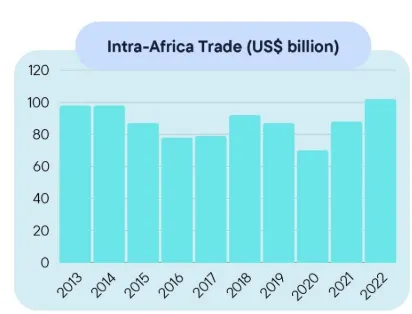
Over the decades Inter-Africa Trade, especially in agricultural produce has undergone rapid transformation, presenting significant opportunities for the continent’s economic growth and industrialization. A detailed analysis of Africa’s export statistics highlights a notable shift in the importance of regional markets compared to traditional export destinations like the European Union (EU).
Agricultural exports within Africa are growing at a much faster rate. For certain sub-regions, such as the East African Community (EAC), and countries like Zambia, Senegal, and Kenya, intra-African trade has already surpassed exports to the EU in importance (South Centre, 2010).
This trade continues to be fueled by agriculture, which remains Africa’s economic backbone.
While the top 3 traded goods (accounting for 50% of Africa’s exports outside the continent) are non agricultural products, almost all of Inter-Africa trade exports is from manufactured and processed agricultural produce.
 -
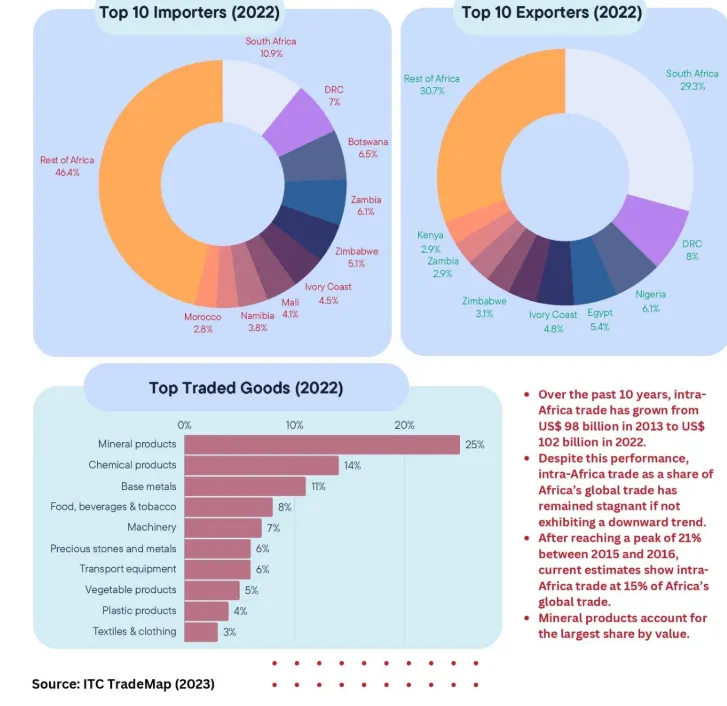
In fact, Africa is a much larger market for Sub Saharan Africa’s (SSA) manufactured agricultural exports than Europe. This trend underscores a critical opportunity for SSA countries aiming to move up the industrial value chain and diversify their trade. Unlike the EU market, where SSA exports primarily consist of raw materials and energy products—90% of SSA’s exports to Europe from 2004 to 2008 fell into this category, excluding South African exports—the intra-African market demands more manufactured goods, providing a platform for industrialization.
1.4 Small holder Agriculture: The Backbone of Inter-Africa Trade
Smallholder family farmers dominate this trade. They representing 80% of all farms and produce up to 90% of food in some countries. Over 33 million smallholder farmers provide more than 70% of the food consumed across the continent, contributing to two-thirds of Africa’s workforce and approximately 35% of the region’s Gross Domestic Product (GDP) (AFSA, 2022; AfDB, 2023).
1.5 Smallholder Farming and Trade in Africa
Agricultural exports are crucial to many African economies, contributing significantly to GDP and serving as a major source of employment. The sector accounts for 20–50% of GDP in sub-Saharan Africa and dominates exports in many countries. Key export crops include cotton, tobacco, coffee, cocoa, tea, and horticultural products like fruits and flowers. Pulses from East and Southern Africa are also critical for export, particularly to the Indian subcontinent.
For some countries, agriculture is the backbone of the economy. Ethiopia, for instance, derives over 70% of its export revenue from agriculture. However, the emphasis on exports often comes at the expense of domestic food security, as governments prioritize cash crops over staple food production.
The relative importance of agriculture for export varies depending on the country's revenues from oil, metals and minerals.
In Ethiopia, for example, agriculture accounts for more than 70% of exports.2 If export targets are not met in terms of the contribution to African countries tend to focus on exports rather than food security.
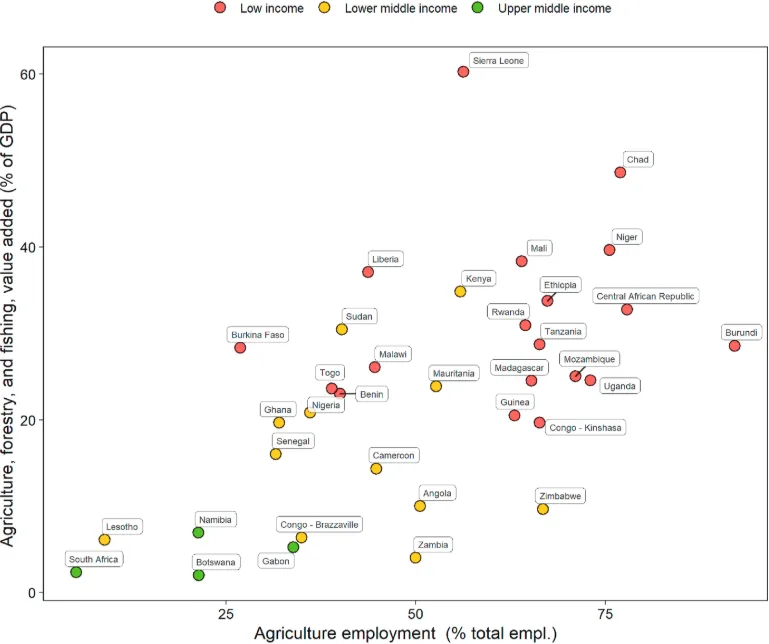
The proportion of GDP earned from agriculture, forestry and fishing plotted against employment in agriculture for countries of sub-Saharan Africa ( (Data sources: Y-axis – World Bank Data, World Bank national accounts data, and OECD National Accounts data files, /; X-axis – ILOSTATS, Labor Force Survey and other country specific sources)
It is therefore surprising that Africa’s agricultural productivity growth has largely stemmed from land expansion rather than increased productivity Although agricultural production has increased substantially in sub-Saharan Africa over the past decades, this has largely been due to cultivation of more land rather than increases in land productivity (Sanchez, 2002).. A notable exception is Ethiopia, where productivity has surged since the adoption of its Agricultural Growth Plan, though some critics question the reliability of these statistics.
1.6 Africa’s Green Revolution: Ambitions and Challenges
The 2004 Kofi Annan’s clarion call for an African Green Revolution to address hunger, malnutrition, poverty, soil health, and infrastructure deficits sought to boost agricultural productivity while embracing Africa’s diverse agro ecological conditions. Central to this approach was the principle of sustainable intensification—enhancing productivity without further expanding cultivated land, while ensuring environmental sustainability (Garnett et al., 2013).
However, the Alliance for a Green Revolution in Africa, an organization formed by Koffi Annan to address the challenges he raised in his clarion call, has seen limited success other than creating markets for large corporations as revealed by its own evaluation report. Localized achievements have failed to translate into continent-wide impact. Diverse farming systems, high population density, and limited capital availability remain barriers to widespread agricultural transformation (Jayne et al., 2014a).
1.7 Challenges to Integrating Farmers into International Trade
While African governments focus on expanding export markets, smallholder farmers face significant barriers to participation in global and regional trade. Poor rural infrastructure, limited access to inputs, and inadequate market access hinder their productivity and profitability. For instance, high transport costs, particularly for landlocked countries, inflate the prices of agricultural inputs, making farming less viable for smallholders.
Research highlights that farming primarily supports rural livelihoods rather than acting as an engine for economic growth. Smallholders, constrained by limited land and poor profitability, are unlikely to intensify their production, reducing their contribution to national food self-sufficiency. A 15-year longitudinal study in Mali’s Guinea Savanna, for example, found little change in agricultural practices, likening the situation to stagnation rather than progress.
1.8 Barriers to Intra-African Agricultural Trade
Intra-African trade in agricultural produce remains underdeveloped due to trade barriers like tariffs and non-tariff barriers (NTBs). For instance, in 2021, Senegal’s food exports to other African countries grew by 9%, but high tariffs limited further expansion. Similarly, while Tanzania exported nearly $1 billion worth of maize in 2022, NTBs imposed by neighboring countries such as Kenya and Zambia hindered market access. These barriers prevent smallholder farmers from fully benefiting from regional trade opportunities.
The Rise of Industrial Agriculture
One notable shift seen in African agriculture is the shift towards industrial models, marked by the monopolization of land, markets, and inputs by large corporations. Initiatives like the Memorandum of Understanding (MoU) between the Alliance for a Green Revolution in Africa (AGRA) and the African Continental Free Trade Area (ACFTA) Secretariat prioritize large-scale, industrialized farming at the expense of smallholder farmers.
Under this model, only farmers capable of scaling their operations are integrated into corporate value chains, leaving the majority excluded. This transition not only marginalizes smallholders but also undermines Africa’s agricultural sustainability. Industrial farming practices—such as monocultures, excessive chemical use, and short-term yield-focused strategies—degrade the environment and weaken ecosystem services.
Policy Misalignments and Environmental Risks
Agricultural policies aimed at combating hunger and malnutrition often replicate industrialized farming models without considering Africa’s unique environmental and socio-economic contexts (Leakey, Mabhaudhi, and Gurib-Fakim, 2021). This misalignment has stagnated productivity, leaving African nations increasingly reliant on food imports. If current trends continue, the projected growth of Africa’s agricultural market from $280 billion in 2023 to $1 trillion by 2030 (AfDB, 2023) will disproportionately benefit corporate entities while sidelining smallholder farmers.
1.9 Incorporating Farmers into International Trade
While the focus of governments across Africa is on how to expand export markets for Africa’s farmers, research shows that Rather than viewing intensification of agriculture as the engine for economic growth, farming should primarily be understood for its role in the livelihoods of rural households. Increasing and diversifying production is certainly important for household food and nutrition security. But given land constraints and the poor profitability of farming, smallholders are unlikely to intensify their production, which limits their ability to contribute to their own, or national food self-sufficiency.
The lack of change witnessed in a longitudinal study encompassing a 15-year period in the Guinea Savanna of Mali was likened to ‘stagnation’ rather than intensification or extensification. Further, rural infrastructure is often poor, which contributes to lack of access to agricultural inputs and to markets for produce. Many African countries are land-locked meaning that the costs of transport to import agricultural inputs are high
The Future of Agriculture in Global Trade
Agriculture has been shown to play key roles in global trade only if the following conditions are met:
- Policies to support modernisation of agriculture and the use of new technologies
- Consolidation of fragmented fields into viable economic farm units
- Policies to encourage small, unviable farms to quit farming
- Tariffs and price support to provide a living income for farmers
- Special measures to support farmers
- Large injection of funds from governments.
These conditions cannot apply to a continent where farming is largely family owned, land is present in small sizes and policies remain focused on extracting taxes from farmers while injecting little or no resources to support farmers
Regional Trade Agreements: Opportunities and Challenges
A lot of attention has been paid to the opportunities available to African businesses in the international markets such as the EU, UK, United State and China.
This is misleading because in fact Africa’s trade, especially across borders, is significantly higher than trade outside the continent.
The main reason why this kind of trade rarely makes it to our radar is because it is informal, carried out by small traders and does not feature in the big data of organizations such as the WTO and UNTAD.
Over 83% of Africans obtain their livelihood from this forms of trade.
It is therefore important that we look at opportunities for trade within Africa before seeking to find out what exists beyond.
The first opportunity is cross border trade, primarily carried out under rules and trade agreements of the various regional economic blocs.
There are over 20 regional trade agreements among African countries, although the AU only recognizes eight-Southern African Development Community (SADC), Economic Community of West African States(ECOWAS), Arab Maghreb Union, the Common Market for Eastern and Southern Africa (COMESA), the Economic Community of Central African States (ECCAS), the Economic Community of the Great Lakes Countries (ECGLC), East African Community (EAC), and the Community of Sahel-Saharan States (CEN-SAD). The latest one is a much broader tripartite alliance that brings together multiple trade areas across the continent.
Below is an analysis of the core intra Africa trade Agreements
2.2 COMESA-EAC-SADC Tripartite Free Trade Area (TFTA)
The COMESA-EAC-SADC Tripartite Free Trade Area (TFTA), established in 2015, encompasses 29 countries, representing 53% of the African Union membership, more than 60% of the continent's GDP (estimated at $1.88 trillion), and a population of 800 million (Onyango, 2023). On July 25, 2024, the TFTA officially came into force following the ratification by 14 out of the 29 member states. This agreement serves as a cornerstone for Africa’s broader continental integration efforts, facilitating deeper economic ties between countries.
According to the Tripartite Task Force (TTF) “the Tripartite framework is based on three pillars: Market Integration, which involves trade liberalisation through the creation of a Free Trade Area and arrangements for the movement of business persons; Infrastructure Development, which focuses on enhancing connectivity and reducing business costs; and Industrial Development, which aims to create a supportive environment by improving regulatory and legal frameworks, adding value, diversifying industries, increasing productivity and competitiveness, and implementing programmes for structural change. COMESA Secretariat leads the Market Integration Pillar, SADC the Industrialisation Pillar and EAC the Infrastructure Pillar.”
One of the key objectives of the TFTA is to enhance regional and continental integration, promoting smoother trade flows and cooperation among African nations. While the ratification process has been slower than expected, significant progress has been made in establishing the rules, structures, and negotiation modalities. In fact, the African Continental Free Trade Area (AfCFTA) has drawn valuable lessons from the tripartite frameworks to guide its negotiations, especially in areas like trade in goods, principles, and tariff schedules.
The TFTA presents a more ambitious tariff liberalization schedule compared to the AfCFTA.
While the AfCFTA aims for 90% tariff liberalization for non-sensitive products, with 7% for sensitive products and 3% on the exclusion list, the TFTA’s goal is 100% tariff liberalization (with some security exemptions). Under this agreement, 60% -85% of tariff lines will be liberalized immediately upon implementation, with the remaining 15% to 40% of tariff lines to be negotiated over 5-8 years (Onyango, 2023).
One of the core sectors of interest under the TFTA is food security, with the agreement aiming to liberalize staple foods like maize, beans, and pulses. By facilitating the free movement of these products across the region, the TFTA aims to allow countries with surplus production to assist those facing food shortages, thereby boosting food security within the bloc (COMESA, 2024). This also creates market opportunities for businesses, particularly for those in the East African Community (EAC). For example, South Africa stands out as the top destination for EAC exports within the TFTA, accounting for 35.3% of the region’s exports. Other significant markets include Egypt (27%), Zambia (16.5%), Ethiopia (7.7%), and Sudan (4.7%) (EAC, USAID & TMA, 2023).
However, the TFTA also protects certain sensitive products such as dairy, sugar, and tobacco, which are shielded from immediate tariff liberalization. Countries heavily dependent on these industries, like Kenya’s dairy sector and Zambia’s sugar production, often lobby for these products to remain protected to avoid disruption from more competitive imports. This tariff protection provides critical support for local economies that rely on such sectors.
The agreement has also seen tariff offers exchanged between Customs Unions, particularly the Southern Africa Customs Union (SACU) and the EAC, which have agreed to liberalize about 90% of their tariff books immediately upon the commencement of the TFTA (Onyango, 2023). Other member states, such as Madagascar, Mauritius, Malawi, Seychelles, Zimbabwe, and Zambia, have based their tariff offers on the level of liberalization they have already achieved within their respective Regional Economic Communities (RECs), such as COMESA and SADC. These countries are expected to continue their high levels of tariff liberalization within the tripartite framework.
Ultimately, the TFTA holds considerable promise for fostering greater trade integration, providing businesses with access to new markets, and enhancing food security within the region, while carefully balancing the needs of sensitive sectors
Trade Opportunities with TFTA
- Expanding Regional Market Access for Diverse Crops: The TFTA opens opportunities for businesses to trade a broader range of products across twenty-seven member states, supporting businesses and farmers with unique or high-demand crops. In Kenya, for instance, smallholder tea farmers can reach markets in Southern African countries like South Africa or Zambia, which have a growing demand for tea (Onyango, 2023). The broader market access provided by the TFTA helps diversify income sources and stabilize prices for farmers who might otherwise face price dips in oversaturated local markets (ibid). This large market scope is particularly valuable for smallholders producing high-value crops, as it encourages investment in quality improvements.
- Sensitive Product Protections and Competition Challenges: Under the TFTA, certain sensitive products, such as dairy, sugar, and poultry, retain protective tariffs, which shield smallholder farmers from competition with larger producers in the bloc. In Malawi, smallholder sugarcane farmers benefit from protected prices, ensuring a stable income despite fluctuations in international sugar markets (WEF, 2024). However, larger producers within the TFTA, such as those in South Africa, still have the advantage of economies of scale, which can overshadow small-scale production. For instance, South African poultry producers can still outcompete smaller farmers in less developed TFTA member states despite regional protections, as they have access to better inputs and processing facilities (European Commission, 2022). This dynamic creates market pressure on smallholders, highlighting the need for support policies that address both protective tariffs and the unequal resource access among TFTA countries.
Logistical challenges, such as high transport costs across long distances, still remain a major stumbling block for TFTA and can reduce the profitability of this expanded access, making infrastructure development a crucial priority.
EAC’s Export potential in TFTA (for top 10 partner countries)
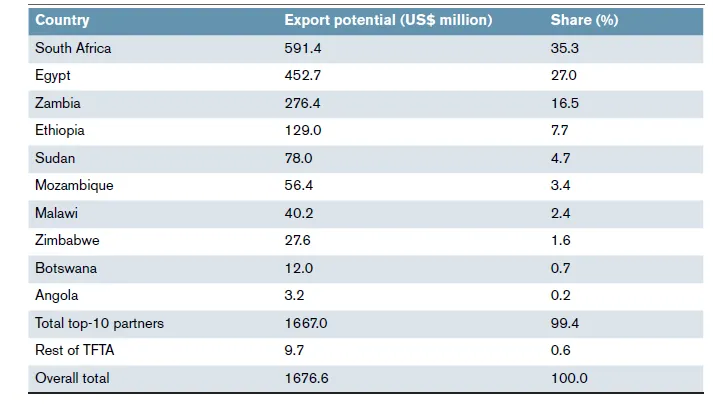
Table 4. Source: EAC, USAID & TMA, 2023
2.3 The East Africa Community (EAC)
The EAC aims to enhance trade within East African countries (Kenya, Uganda, Tanzania, Rwanda, Burundi, DRC and South Sudan) through reduced tariffs. Liberalized agricultural products often include staple foods such as maize, beans, millet, and other cereals that are essential for food security across member states (Anyanzwa, 2023). The EAC's Common External Tariff (CET) exempts most of these essential goods from high tariffs, making them affordable and accessible within the region. However, certain products, like sugar, dairy, and poultry, are protected to safeguard domestic producers from cheaper imports (Tondel, 2017). These products face higher tariffs under the CET to limit competition from outside the EAC. For instance, the EAC imposes a 60percent tariff on sugar imports from non-member countries, as the sugar sector is vital to economies like Kenya’s (Anyanzwa, 2023).
Implications on small-scale farmers
Facilitating Trade for Staple Foods and Reducing Price Volatility
Within the EAC, tariff liberalization for staple foods supports smallholder farmers by reducing price volatility across the region, allowing countries to trade essentials such as maize and beans during shortages. For instance, during periods of drought in Kenya, farmers in Uganda or Tanzania can export their surplus maize and beans tariff-free, addressing food insecurity while ensuring farmers benefit from regional demand (FEWS NET, 2022). This helps stabilize prices for smallholders, who can plan their production and sales with greater predictability. For EAC smallholders, this free movement of staple crops offers an essential buffer against price crashes during bumper harvests, as cross-border trade can alleviate oversupply. However, this benefit largely hinges on regional political cooperation and effective enforcement of tariff agreements, as occasional non-tariff barriers or border closures disrupt this arrangement.
Protection of Sensitive Sectors and Income Stability
The EAC’s protection of sensitive agricultural sectors, such as sugar, dairy, and poultry, offers income stability for smallholder farmers in these industries. For example, Kenyan smallholder dairy farmers benefit from high tariffs on dairy imports from non-EAC countries, which protect them from competition with large-scale global producers (Gérout & Larvor, 2024). This allows local farmers to sell milk and dairy products at competitive prices within the EAC, where demand is strong. While protectionism maintains their income stability, it may also limit growth opportunities by restricting their access to competitive input prices and innovations in the global market. Still, for subsistence-based dairy farmers in Kenya, these protective measures create a necessary shield against income instability, ensuring they can compete domestically and within the EAC.
Limited Access to Cheaper Inputs from Global Markets
Protective tariffs in the EAC can also limit smallholder farmers’ access to affordable agricultural inputs from outside the region, impacting productivity and growth potential. For instance, tariffs on imported fertilizers and seeds are high to protect regional industries, yet they increase costs for smallholders with limited capital (Longley, et al., 2021). Farmers in Uganda, for example, face higher prices for essential inputs, limiting crop yields and reducing their ability to compete in the EAC’s expanded market (ibid). While local input industries may benefit, small-scale farmers encounter a trade-off between price stability for their products and the ability to enhance productivity through cost-effective inputs. This challenge highlights a need for policy adjustments that balance local industry support with affordable access to global inputs, promoting both farmer stability and growth.
2.4 Common Market for Eastern and Southern Africa (COMESA)
The Common Market for Eastern and Southern Africa (COMESA) is a broader trade bloc that includes twenty-one member states and aims to reduce intra-regional tariffs, creating a large, unified market for agricultural and other products. COMESA’s FTA liberalizes staple foods and primary products, such as grains, pulses, and certain vegetables, which small-scale farmers typically produce. By removing tariffs on these goods, COMESA aims to reduce food prices and enhance market access for small-scale farmers, especially in high-demand countries within the bloc (Tondel, 2017). However, sensitive products like wheat, sugar, and poultry are subject to restrictions to shield domestic producers (Tondel, 2017). For instance, countries with substantial sugar industries (like Zambia and Malawi) lobby for protective measures against cheaper sugar imports. Additionally, countries producing wheat restrict imports to stabilize local prices (ibid).
Boosting Regional Market Access and Income Opportunities
COMESA’s tariff liberalization for staple crops has notably expanded market access for smallholder farmers in the region, enabling them to trade surplus produce across borders with minimal tariffs. For example, Ugandan maize farmers easily sell to markets in Kenya or Sudan, benefiting from demand in countries experiencing maize shortages (FAO, 2020). Reduced tariffs make it possible for small-scale farmers to bypass local market saturation and avoid price drops due to oversupply. This expanded regional market, coupled with fewer restrictions, can enhance income by ensuring farmers reach new buyers. However, a lack of infrastructure for transportation and storage limits their ability to capitalize fully on this liberalization, especially in more remote rural areas (FAO, 2020). Despite these challenges, for farmers in crop-abundant regions like western Uganda, COMESA’s liberalized policies provide vital income avenues that may not exist locally.
Challenges with Input Costs Due to Tariff Protections
While COMESA’s tariff-free policies on certain crops benefit farmers, protective tariffs on specific agricultural inputs, like fertilizers or pesticides, pose challenges for smallholders. For instance, the protected fertilizer industry in Zambia means imported fertilizers from non-COMESA countries are expensive, putting a strain on local small-scale producers who rely on these inputs for crop yields (Onyango, 2023). Although tariff protection aims to promote local manufacturing, it raises costs for smallholders unable to access domestically produced fertilizers affordably. High input prices mean that smallholder farmers in countries like Zambia often cannot achieve the yields necessary to capitalize on expanded regional trade opportunities (Onyango, 2023). Consequently, this limits their competitiveness against better-resourced commercial farms within COMESA, as high production costs make it difficult for them to price crops competitively in regional markets.
Protective Tariffs and Competition from Large Producers
COMESA’s protective tariffs on products like sugar and poultry have a dual effect on smallholder farmers. In countries like Kenya and Malawi, small-scale sugarcane and poultry farmers benefit from the protection against cheaper imports, as it stabilizes domestic prices and sustains their incomes. For instance, Kenyan poultry farmers are shielded from competition with low-cost poultry imports, particularly from South Africa and other larger producers within Africa (FAO, 2020). However, in some cases, these protections benefit large-scale producers more than smallholders, as larger firms have the resources to take full advantage of domestic market stability. This creates an uneven playing field within COMESA, where smallholders are often overshadowed by large-scale producers who can more readily meet the demand in protected sectors, limiting smallholders’ potential market share and growth prospects despite the tariff protections.
Across the EAC, COMESA, and TFTA, small-scale farmers generally benefit from liberalized trade in staple products, enabling them to access broader markets and improve their incomes. The protective tariffs help shield them from low-cost competition in sensitive sectors, though this also limits their access to more affordable input. Consequently, while liberalization opens doors to larger markets, tariff protection remains critical for sectors where domestic producers, particularly smallholders, face intense competition from large-scale regional or global producers. Understanding these dynamics helps policymakers balance support for small-scale farmers’ market access with the need for protective tariffs in strategic sectors.
2.5 ECOWAS Trade Liberalisation Scheme (ETLS)
The Economic Community of West African States (ECOWAS) Trade Liberalisation Scheme (ETLS) was adopted by the Community as a means of promoting market integration and the development of the ECOWAS sub-region as an economic space, improve the intra-regional trade and move away from dependence on raw materials. It also seeks to contribute to the progress and development of the African Continent. The ECOWAS Treaty, signed in 1975 and revised in 1993, set out the broad ambit under which the terms of trade scheme were formalized through protocols and regulations to govern the Community trade specifically the free movement of goods, persons and services. Now most agricultural products have been put into the fourth or fifth band of 35 percent (maximum) under the Common External Tariffs (CET) of the Economic Community of West African States. This means that countries in the ECOWAS region can only raise its agricultural tariffs to this maximum afforded by the CET and the constraints of other regional and bilateral agreements.
In accordance with the provisions of article 38 of the ECOWAS Revised Treaty, the following are regarded as originating from the community: products wholly obtained in one or several Member States under, products obtained in one or several Member States and containing non- originating raw materials, provided that these raw materials have undergone sufficient processing or transformation in the Community under, originating products made of materials wholly obtained or sufficiently transformed in two or many Member States are regarded as products originating from the Member State where the last processing or transformation took place as long as the processing or transformation carried out goes beyond those covered.
Beyond Regional Trade Agreements: Opportunities for Farmers in the African Continental Free Trade Area
3.1 Introduction
The African Continental Free Trade Area (ACFTA) represents a strategic response to Africa's development challenges, designed to accelerate the continent’s economic integration. This agreement seeks to address barriers to trade and foster a more connected, prosperous Africa, in line with the objectives outlined in the African Economic Community (AEC), as established by the 1991 Abuja Treaty.
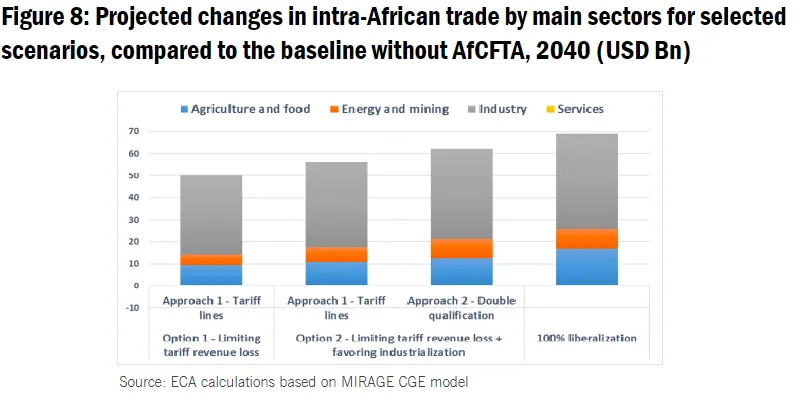
UNECA assessment of June 2012 claims a huge rise in intra-African trade: "It would add up to USD 34.6 billion (52.3 per cent) to the baseline in 2022. Imports of African countries from the rest of the world would come down by USD 10.2 billion, well compensated by the significant projected increase in intra-African trade... While the share of intra-African trade would increase from 10.2% in 2010 to 15.5% in 2022 after the establishment of a CFTA, it would more than double over the twelve years period (increasing from 10.2% in 2010 to 21.9% in 2022) when trade facilitation measures are considered. Similarly, real income for Africa improves by nearly 1 per cent whatever the trade policy considered"
History of the ACFTA
The initiative to establish the ACFTA emerged from the African Union (AU) Summit in 2012 with the aim of creating a unified market across Africa, encompassing 1.3 billion people and a combined GDP of approximately USD 3.4 trillion.
It had the following key objectives
- Establish a single continental market for goods and services, with free movement of business professionals and investments
- Accelerating the establishment of the Continental Customs Union and the African customs union.
- Expand intra-African trade through better harmonization and coordination of trade liberalization and facilitation across Regional Economic Communities (RECs) and across Africa.
- Resolve the challenges of multiple and overlapping memberships and expedite the integration processes.
- Enhance competitiveness at the industry and enterprise level by exploiting opportunities for scale production, continental market access and better reallocation of resources.
The ACFTA has several protocols including those covering Trade in Goods, Trade in Services, Investment, Intellectual Property Rights, Competition Policy, Digital Trade, and specific protocols for Women and Youth. Additionally, the framework includes provisions for the Free Movement of Persons and Dispute Settlement
The ACFTA came into force in 2019 while negotiations are ongoing on several pending protocols.
The journey to ACFTA
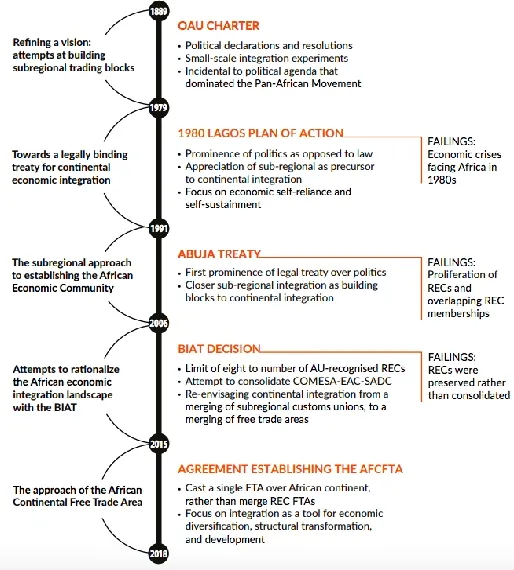
Source: Assessing Regional Integration in Africa IX,2019 United Nations Economic Commission for Africa, African Union, African
Development Bank, and United Nations Conference on Trade and Development. Adapted from Gerout, MacLeod and Desta, 2019
(The AfCFTA was envisaged as implemented in two phases, with the final phase coming to an end in 2020. This has not been achieved however. It is nevertheless to details the two phases to demonstrate the care that was to be taken to ensure that weaker economies, especially those of the Least Developed Countries, do not suffer significantly shocks or rushed liberalization.
Phase I provides a framework for the liberalisation of trade in goods and services, and a mechanism for dispute settlement. For trade in goods, the agreement sets the path for eliminating tariffs on 90 percent of product categories. Countries can implement tariff reductions over a longer period in the case of sensitive goods, or maintain existing tariffs— where the products are excluded—for the remaining 10 percent of product categories (tariff lines). The protocol on trade in goods includes annexes on tariff concessions, rules of origin, customs cooperation, trade facilitation, non-tariff barriers, technical barriers to trade, sanitary and phytosanitary measures, and transit and trade remedies. Phase II was to cover competition policy, investment, and intellectual property rights.)
3.2 ACFTA Implementation and Support Measures
The ACFTA includes several support mechanisms aimed at easing the transition for businesses, especially SMEs and small-scale farmers. These initiatives include:
- SME Financing Facility: This fund aims to support SMEs, particularly those led by women and youth, providing them with access to finance to compete effectively within the ACFTA framework.
- African Trade Gateway: This digital platform offers vital information on customs procedures, market trends, and payment systems, improving access to information and enhancing trade opportunities.
- ACFTA Adjustment Fund: This fund is designed to help member states and the private sector adapt to the changes brought about by ACFTA, covering the anticipated disruptions from tariff reductions and changes in industrial sectors.
- Pan-African Payment and Settlement System (PAPSS): This system facilitates efficient and secure cross-border payments, promoting financial inclusion and reducing the costs associated with currency exchange and money transfers.
3.3 Overall Benefits for smallholder farmers and Businesses
The United Nations Trade and Development Agency (UNTAD) has estimated the quantitative effects of the ACFTA according to 2 long-term scenarios: a full Free Trade Agreement (FTA) and Special Product Categorization (SPC). (6)
A full Free Trade Agreement (FTA) eliminating all tariffs in the ACFTA could generate gains of US$ 16.1 billion, at the cost of US$ 4.1 billion in trade revenue losses (representing 9.1% of current tariff revenues). GDP and employment are expected to grow by 0.97% and 1.17% respectively. Intra-African trade growth is estimated at 33% and the continent’s trade deficit is expected to drop by 50.9%. (6)
Special Product Categorization (SPC) permanently exempts sensitive products from liberalization. In a scenario in which the sector with the highest current tariff revenue would be exempted from liberalization, UNTAD estimate a gain of US$ 10.7 billion in the long term. Tariff revenue losses are expected at US$ 3.2 billion (representing 7.2% of current tariff revenues). GDP and employment growth are expected to grow by 0.66% and 0.82% respectively. Intra-African trade is expected to grow by 24%, while, Africa’s trade deficit only shrinks by 3.8%. (6)
More specifically the ACFTA has benefits in the following areas
Market Access and Farmer Opportunities Under ACFTA
The ACFTA has Tariff structures that divides market liberalization into three categories.
These tariff structure and transition periods are designed to balance market access with protection for key sectors, but careful monitoring and adaptation are essential to mitigate the risks and ensure sustainable agricultural development across Africa.
Category A includes 90% of tariff lines for each member state or regional economic community (REC), particularly those in customs unions. These goods are set for liberalization in equal annual installments, with the goal of reaching zero tariffs by the fifth year for developing countries, including South Africa, Kenya, Ghana, and Nigeria. For least developed countries (LDCs), the tariff reduction period extends to 10 years, ensuring that goods from these nations enter duty-free by the end of this period.
Category B covers sensitive products that countries and regions identify as crucial to their economic development and require temporary protection. These products will be liberalized over the next 10 years for developing countries and 13 years for LDCs. This extended liberalization period allows countries to gradually adjust to competition from other African markets.
Category C involves products that are excluded from liberalization altogether, subject to review every five years. These products remain protected by tariffs to shield domestic producers from external competition as long as the ACFTA is in force.
The ACFTA presents both opportunities and risks for small-scale farmers, and this is best reviewed by looking at the Protocol on Trade in Goods and Services. This Protocol is of particular relevance as most agricultural products fall under it. The goal of the protocol is to promote intra-Africa trade by reducing tariffs and creating a more accessible market for African goods.
On the one hand it opens new markets for African agricultural products.
Liberalization can stimulate job creation, income growth, and improved food security, particularly for rural women, informal traders, youth, and peasant farmer
There are benefits in Improved market access in cases like that of the East African Community (EAC) which has liberalized the trade of several agricultural products, opening opportunities for imports from countries like Nigeria, Ghana, and Niger, which are major producers of these crops. For instance, Nigeria produces approximately 71% of Africa's yams (215 million tons), while Ghana accounts for 45% of plantain and banana production (32 million tons) on the continent (AUC & OECD, 2023). Under the ACFTA’s liberalization, these countries can export their surplus products to the EAC, enhancing their market reach.
The liberalization of food products such as tea, coffee, and other agricultural goods by regional economic communities (RECs) like CEMAC and ECOWAS offers new export opportunities for smallholder farmers in the EAC. Over recent years, the EAC has become a significant exporter of vegetables and food products, with export values averaging US$1.6 billion for vegetables and US$894 million for food products between 2018 and 2022 (EAC, USAID & TMA, 2023). Among the EAC's most promising export sectors under the ACFTA is tea, which alone holds an export potential of US$364.9 million, representing 19.6% of the region’s total potential, with strong demand from markets such as Egypt, Sudan, South Africa, Nigeria, Ghana, and others (ibid). Coffee, valued at US$125.7 million, is another key export product with high demand across the continent, particularly in markets such as Morocco, South Africa, Eswatini, Botswana, and Zambia (EAC, USAID & TMA, 2023).
Other important agricultural exports from the EAC include rice (US$61.1 million), vegetables (US$55.8 million), processed food (US$50.2 million), and sugar (US$41.4 million) (ibid). The demand for these products in various African countries creates significant opportunities for smallholder farmers who can participate in the regional trade networks. The removal of tariffs under the ACFTA provides easier market access, potentially leading to increased income for farmers and greater integration into regional value chains.
3.4 ACFTA and Food Sovereignty
The liberalization of cereals and tubers, such as cassava, by CEMAC-often conducted through cross-border territorial markets, is vital for promoting food sovereignty. Many food-insecure regions in Africa rely heavily on these markets for their staple food supplies (FAO, 2023). For example, Nigeria and Ghana, both of which are major cassava producers, could leverage their competitive advantage to become the primary exporters of cassava to neighboring countries like Burkina Faso, Niger, and the Gambia (Kareem & Wieck, 2021). Similarly, Tanzania, as a major producer of maize, cassava, and rice in the EAC, stands to benefit from the liberalization of these products, expanding its role as the largest supplier within the region (FAO, 2023).
By facilitating unhindered trade in these essential food products, the ACFTA could increase food security across the continent while offering significant economic opportunities for smallholder farmers. The tariff removal and the broader liberalization policies are likely to open new markets for these products, ultimately promoting agricultural growth and regional integration.
3.5 ACFTA and Value Addition
Beyond trade in goods the ACFTA also offers opportunities for value addition in agricultural products, with liberalization providing more access to raw materials and intermediate goods. For example, Kenya’s maize millers have long relied on territorial markets along the Namanga, Busia, and Malaba borders to source maize from Tanzania and Uganda for milling and distribution across Kenya and neighboring countries like South Sudan (FEWS NET, 2022). With the AfCFTA's flexible Rules of Origin (RoO), smallholder farmers who produce raw materials can be integrated into agro-industrial supply chains, promoting regional value addition.
3.6 ACFTA And Manufacturing
The example of Nigeria’s tomato processing industry is also noteworthy. Nigeria recently launched the largest tomato processing factory in West Africa, which relies on tomatoes from both domestic producers and neighboring countries such as Ghana, Burkina Faso, and Cameroon (Momoh, 2024). Similarly, in CEMAC, the Marché Mondial in Cameroon’s Abang-Minko region plays a crucial role in supporting local tomato paste and potato chips production by providing a platform for both raw material sales and finished product distribution (World Bank, 2018). Such initiatives highlight the potential for agro-industrial growth under the ACFTA, with smallholder farmers contributing to the supply of raw materials for processing industries.
Countries with well-established manufacturing sectors, such as Nigeria, South Africa, Kenya, and Egypt, are likely to leverage the ACFTA to further invest in agro-processing across the continent. The AfCFTA's cumulative provisions under the Protocol on Rules of Origin (RoO) offer the possibility of accessing cheaper raw materials and intermediate inputs, which are essential for the development of agro-industrial sectors. For example, while South Africa produces a small quantity of organic baobab powder, it imports significant quantities from Tanzania, Malawi, Mozambique, and other countries to produce cosmetics based on this ingredient (WEF, 2024). Similarly, Heineken’s CREATE project in Ethiopia sources 60% of its agricultural raw materials, including sorghum and millet, locally within the continent (WEF, 2024).
The flexibility provided by the AfCFTA's RoO enables the creation of cross-border regional value chains, particularly in agro-industrial sectors. However, this is contingent upon smallholder farmers being included in the value chain. Without their active participation, the benefits of regional industrialization could be limited.
3.7 ACTA Safeguards For Farmers
The ACFTA allows State Parties to apply anti-dumping measures under certain circumstances, creating policy space for countries to protect their domestic agricultural sectors from unfair competition. According to Article 17 of the ACFTA Protocol on Trade in Goods, countries can impose anti-dumping measures when products from another State Party threaten to harm a domestic industry (African Union, 2018). This provision is crucial for safeguarding smallholder farmers against the dumping of cheap agricultural products that could undermine local production.
Nigeria, for instance, has used temporary bans on imports of rice, beef, pork, and tomato paste from other ECOWAS member states to protect local producers (ITA, 2023). Similarly, high tariffs on products like yogurt in ECOWAS countries under the ACFTA may be designed to protect emerging industries and encourage local production of value-added dairy products (Gérout & Larvor, 2024). These safeguards are important tools in promoting agro ecological enterprises by ensuring that local farmers are not displaced by industrial imports.
3.8 Overall Opportunities and Challenges for Farmers
The tariff offers under the ACFTA present both challenges and opportunities for smallholder farmers. While there are potential benefits in terms of improved market access, the liberalization of trade can also pose risks to local agricultural sectors. The successful integration of smallholder farmers into regional value chains and supply networks is essential to ensure that the ACFTA benefits are distributed equitably. By leveraging the AfCFTA’s flexible Rules of Origin and anti-dumping measures, there is an opportunity to foster agro-industrial growth, promote food security, and support smallholder farmers across the continent. However, this will require concerted efforts to balance liberalization with safeguards that protect local agricultural economies and promote sustainable development across regional market
The liberalization of agricultural products under the African Continental Free Trade Area (ACFTA) by the East African Community (EAC) and the Central African Economic and Monetary Community (CEMAC) holds significant potential for enhancing intra-Africa trade, especially in seeds and agricultural inputs. The African seed market, though largely dominated by hybrid seeds, has grown to nearly $4 billion in value, reflecting a $1 billion increase over the past 12 years (Hussein, 2024). Many African countries are still heavily reliant on seed imports for their agricultural activities. For instance, Uganda imported 1,060 tons of maize seeds from countries such as South Africa, Zimbabwe, Kenya, Tanzania, Zambia, and Ghana in 2020, alongside 13 tons of sorghum from Kenya (Longley et al., 2021). With ACFTA reducing trade barriers, Ugandan farmers, for example, could access a wider range of high-quality seeds at more competitive prices, boosting productivity and enhancing farm outputs.
However, the ACFTA presents both opportunities and challenges for African smallholder farmers. While it fosters market access and increased trade, it also highlights the continent's dependency on food imports. Despite possessing 65% of the world’s arable land, Africa continues to import significant quantities of food. The Southern African Development Community (SADC) and the East African Community (EAC) are particularly affected, with agricultural imports representing 33% and 21% of total trade in these regions, respectively (FAO, 2020). This dependency is concerning, particularly given the significant rise in global food prices. For example, Africa imports over 100 million tons of food annually, valued at approximately $75 billion (AfDB, 2023). The situation is exacerbated by geopolitical factors, such as the recent disruption of food and seed supply chains, with 46% of cereal imports to ECOWAS and CEMAC coming from Ukraine and Russia (FAO, 2022).
The liberalization of agricultural trade under ACFTA is expected to increase intra-African trade in seeds and food. However, this is contingent upon the participation of African smallholder farmers. If the trade remains dominated by larger, industrial producers, smallholder farmers could find themselves marginalized, unable to compete with cheaper, imported industrial seeds or food products. For example, Benin’s low tariffs (7%) on rice imports from outside the ECOWAS region have led to increased rice imports from Thailand, often re-exported to neighboring countries such as Nigeria. This dynamic resulted in Nigeria’s temporary border closures to protect its domestic rice industry (Kassa & Zeufack, 2020). Thus, while the ACFTA holds the potential to increase the volume of food and seed trade, it must also ensure that smallholder farmers' interests are safeguarded in the process.
ACFTA Challenges for Farmers
The liberalization of trade is a double edged sword. While it has numerous benefits, it exposes local farmers to competition from larger, more industrialized agricultural sectors, both within Africa and globally. This could result in the displacement of small-scale farmers who lack the resources to compete effectively. Furthermore, without safeguards in place, the increased flow of cheap imported goods could undermine local agricultural production, exacerbating food insecurity and economic vulnerability in rural areas.
Liberalization may also have unintended consequences for farmers. Local producers may struggle to compete with the influx of imported products, as the larger-scale commercial agriculture favored by the ACFTA often puts smaller, subsistence-oriented farmers at a disadvantage. This could lead to the displacement of local agricultural enterprises, undermining the very purpose of regional trade agreements designed to support sustainable development in domestic agricultural sectors
Complex Trading Regime
One major challenge faced by small-scale traders, who typically engage in the informal cross-border trade of agricultural products, is the lack of a Simplified Trading Regime (STR). STRs are designed to facilitate the trade of low-value consignments by reducing bureaucratic barriers and simplifying customs clearance procedures. STRs allow small traders to benefit from the preferential trading environment, easing their entry into larger markets without facing prohibitive costs. However, the AfCFTA’s Women and Youth in Trade Protocol does not sufficiently address the core aspects of an STR, limiting the participation of informal traders in agricultural markets. If the ACFTA fails to fully implement a simplified regime, small traders may face increased costs, time delays, and reduced competitiveness in cross-border trade, undermining their ability to benefit from the free trade area.
Skewed Agricultural Production
Another challenge for smallholder farmers is the uneven distribution of agricultural production benefits across the continent. While ACFTA is expected to increase food availability, production will likely become more concentrated in specific regions, with Southern Africa seeing the highest increase in output, particularly in cereals and livestock production. In contrast, production in Central Africa and several sparsely populated countries is predicted to decrease (Simola et al., 2021). These regional disparities will likely affect food prices, with some areas experiencing price increases due to reduced production. For instance, while cereal output is expected to increase in Eastern and Southern Africa, regions in the central and western parts of Africa may face decreased production, thereby putting upward pressure on food prices in these areas. This imbalance could make food less affordable for low-income groups, potentially exacerbating poverty and inequality.
Undermining Agro-Ecology
The liberalization process under the ACFTA could also inadvertently undermine agro ecology, a sustainable agricultural approach that emphasizes biodiversity, traditional farming methods, and locally sourced, high-quality food. Agro ecological practices have gained popularity across the continent due to their focus on environmental sustainability and food security. However, the increasing embrace of genetically modified (GM) crops in several ACFTA member states poses a threat to these practices. Currently, 11 ACFTA member states have approved the use of GM crops, including maize, cotton, and soybean (Peschard, Golay, & Araya, 2023). For instance, Kenya, Ghana, Egypt, and South Africa have begun field trials or commercial production of GM crops, such as maize and cotton, which threatens to overshadow traditional agricultural practices.
Promotion of Industrial Agriculture
In addition, the market dynamics under ACFTA may skew towards industrial agriculture, with large multinational corporations dominating the seed and food trade. These corporations could push out smallholder farmers, particularly those relying on traditional seeds and agro ecological farming practices. This shift could lead to the flooding of African markets with GM seeds and industrial food products, excluding smaller, local producers from the food and seed trade. The resulting imbalance would not only harm smallholder farmers but also jeopardize the resilience and sustainability of local agricultural systems.
An analysis of tariff liberalization under ACFTA reveals that many value-added products derived from smallholder farmers’ crops are either excluded or placed on the sensitive list, limiting their ability to benefit from the liberalized trade environment. For example, many value-added agricultural products, such as processed foods, oils, and dairy products, are likely to be excluded from the 90% liberalized trade category (Category A). Instead, they are expected to fall under the sensitive list, meaning they will not be fully liberalized until after a longer transition period. In countries like Ghana, Nigeria, Côte d'Ivoire, and Cape Verde, full liberalization of these products is expected to occur within five years, while Least Developed Countries (LDCs) in ECOWAS will have a 10-year transition period.
There is immense potential for increasing intra-African trade and boosting the competitiveness of smallholder farmers. Its success, however will largely depend on how well it addresses the challenges of market access, food import dependence, regional disparities in production, and the impact of external trade agreements.
Case in Point:
Shepherding ACFTA-When Guided Trade Fails to Guide
The Guided Trade Initiative (GTI) was launched in response to the slow pace of meaningful commercial trading following the official commencement of trading under the African Continental Free Trade Area (ACFTA) on January 1, 2021. The initiative was established based on the 7th Ministerial Directive of the ACFTA Council of Ministers responsible for Trade (KASA, ATPC & UNECA, 2024) and was formally adopted by African Heads of State and Government in February 2022. Its primary goal was to serve as an interim solution to stimulate substantial trade among State Parties that met the minimum requirements for trading under the Agreement, and to test the readiness of the private sector, as well as the operational, institutional, legal, and trade policy frameworks of the ACFTA. Initially, the GTI attracted participation from seven African countries—Cameroon, Egypt, Ghana, Kenya, Mauritius, Rwanda, and Tanzania—which represent all five regions of the continent. Products targeted for trade under the initiative included ceramic tiles, batteries, tea, coffee, processed meat products, corn starch, sugar, pasta, glucose syrup, dried fruits, and sisal fiber. These products formed the initial trade offerings under the ACFTA.
However, the disparity between the policy goals and the practical realities of trading under the ACFTA highlights several challenges. One of the main issues is the insufficient distribution and logistics infrastructure needed to facilitate the movement of goods across different markets within the continent. In addition, small and medium-sized enterprises (SMEs)—including those owned by women, youth, and other vulnerable groups—often face disproportionately high freight and logistics costs, making it difficult for them to export competitively. For example, in one instance, a shipment from Kenya intended for Ghana, which was flagged for export in October 2022, only arrived in Ghana in December 2022 due to delays in logistics. Furthermore, the complex web of taxes, levies, and fees imposed on imports by various countries increases the cost of trade and undermines the competitiveness of products. This multitude of charges can make it more difficult for businesses to succeed in the ACFTA marketplace.
Weaknesses of the CFTA
A key weakness of the ACFTA is its lack of integration with RECs and other Policies across Africa.
The AfCFTA's framework has limited integration with existing continental policies, such as the African Mining Vision (AMV), the Comprehensive African Agriculture Development Programme (CAADP), and the Accelerated Industrial Development for Africa (AIDA). Additionally, programs like the Programme for Infrastructure Development in Africa (PIDA) have not made significant progress. The lack of alignment with these key policies and infrastructure programs risks undermining the AfCFTA’s goal of driving economic transformation.
3.9 Criticisms of the ACFTA
Critiques have observed that the ACFTA appears structured to benefit Multinationals and that even analysis by those who support it, such as UN Economic Commission For Africa (UNECA), UNTAD and the EU, have ended up showing their glaring contradictions. According to these critiques what is perceived as the key weakness of the ACFTA- inability to integrate with Regional Trading Bloc and its quest for full liberalization- are deliberate designed by those who are financing the ACFTA process. These, interestingly are the very Europeans who are pushing for EPAs that is not only killing ACFTA, but the regional trading bodies as well.
Some studies have shown that far from promoting regional integration of the continent it will disintegrate it strongly in opening wide the doors to multinationals already well implemented in most African countries and which would concentrate their activities in the most competitive countries from which they would export to the others. Simon Mevel and Stephen Karingi of UNECA admitted: "Turning to the country analysis of the results, these are somewhat more ambiguous than at the global level... Even if real income variations are limited, almost half of African countries/regions considered in the study would be worst off in terms of real income after the formation of free trade areas. Three main justifications can be advanced. Firstly, while African countries liberalize, governments have to renounce to a non-negligible source of income namely, tariff revenues. Secondly, as African economies open up, competition is increasing on the continental market. As a results trade flows are reoriented such as African imports from partners located either on the continent or outside of the continent are being replaced by imports from African partners benefiting from better market access, thanks to tariff cuts, and potentially leading to terms of trade reductions. Thirdly, as world prices of food products slightly increase with the liberalization reforms, net-food importing countries such as Angola & DRC, Mozambique, Botswana, Rest of North Africa, Nigeria and Central Africa are hurt and their real income reduced... Workers employed in countries strongly specialized in exports of primary products, such as oil exporting countries: Angola, Egypt, Nigeria, Rest of Eastern Africa (inclusive of Kenya), Rest of North Africa; as well as Zambia (69% of Zambia’s exports are mineral and metal products) register a decrease in real wages
The Private Sector referenced in the ACFTA does not designate the hundreds of millions of African smallholder farmers – who could produce much more with guaranteed stable remunerative prices through an efficient import protection – but the tens of multinationals and African private companies that are pushing to abolish tariffs between African countries. There are fears that the real big winners of the ACFTA will be multinational corporations from outside Africa that have settled in big cities and would be provided with easy access to a multitude of markets. Another major problem that has not been dealt with yet, is the potential loss of revenue for governments, as customs duties are a major source of government revenue.
A majority of African economies are dependent on FDI to grow their manufacturing. Yet "Africa accounts for a very low share of global FDI flows (2.8 per cent) and, more importantly, FDI flows to the continent are concentrated in a few countries and largely in the extractive sector. The latter has reinforced Africa’s dependence on commodity exports and the vulnerability of African countries to external demand and speculation-driven commodity price movements. Moreover, to date, there is no evidence to indicate that FDI in Africa is contributing to economic diversification through backward and forward linkages. Under such circumstances, the tendency of FDI to reinforce enclave-type development – with external integration gaining more importance over the internal integration of the local economy – is a real concern. ACFTA is founded on a false premise that Africa will attract FDIs that will automatically generate opportunities for technology transfer, linkages with domestic enterprises and opportunities for diversification into more dynamic activities”
The deficit of cereals was $30 billion way back in 2016, and has since increased. The amount of sub-Saharan Africa in this deficit was $10.4 billion for cereal. Intra-Africa exports of wheat have only risen from $24,572 to $139,900. There is not a single African country which is a net exporter of wheat and the intra-Africa exports of wheat are re-exports to neighbouring countries of extra-Africa imports.
Geopolitics shows that it would be almost impossible to establish common trade rules in Africa with a population with very different political institutions, poor transport infrastructures, and where per capita GNI (gross national income) goes from $260 in Burundi to $14,760 in Seychelles
Section 4:
A Dream Differed: EPAs as Catalysts of Poverty, Regional Disintegration and Migration
"Under the effect of the example of the European Common Market, many countries of the Third World are lulled by excessive hopes conceived on the European model that is obtained by the gradual opening of markets. In my opinion, this is a false trajectory because the reduction of tariffs helps in the first place the expansion of multinational enterprises established within common markets, more powerful and better prepared to seize new opportunities"-Ignacy Sachs, La découverte du Tiers Monde, Flammarion, 1971
“I see them as an opportunity for the ACP regions to fast-track their way to regional integration.” Peter Mandelson, EU Commissioner For Trade, speaking at the ACP-EU Economic and Social Interest Groups Meeting, 29 June 2005
Introduction
Africa’s trade challenges stem from a complex web of overlapping agreements with external partners, often involving multilateral or unilateral commitments. These agreements, which go by various names, have significantly impacted the development of the African Continental Free Trade Area (AfCFTA) and hindered intra-African trade.
African countries are bound by their commitments to the World Trade Organization (WTO) and have entered into numerous trade deals with global partners. These include agreements with the G7 countries, which often contain clauses that frame them as "building blocks" for the AfCFTA. However, in practice, many of these deals undermine the goals of the AfCFTA and disrupt existing regional trade agreements.
Africa-EU Trade Volume
Despite claims that the EU is Africa’s largest trading partner, the reality is that a disproportionate amount of trade is concentrated in just six African countries—Morocco, South Africa, Algeria, Egypt, Nigeria, and Tunisia—which together account for 72% of Africa’s trade with the EU. These six countries represent only 10% of Africa’s total population and area, while the remaining 49 countries, comprising 90% of the continent, primarily engage in trade with other global players such as China, Russia, India, and the United States. This trade imbalance highlights a significant issue with Africa's reliance on the EU as a trade partner, especially when looking at the broader picture of intra-continental trade and economic development.
Africa’s Exports Africa’s Imports
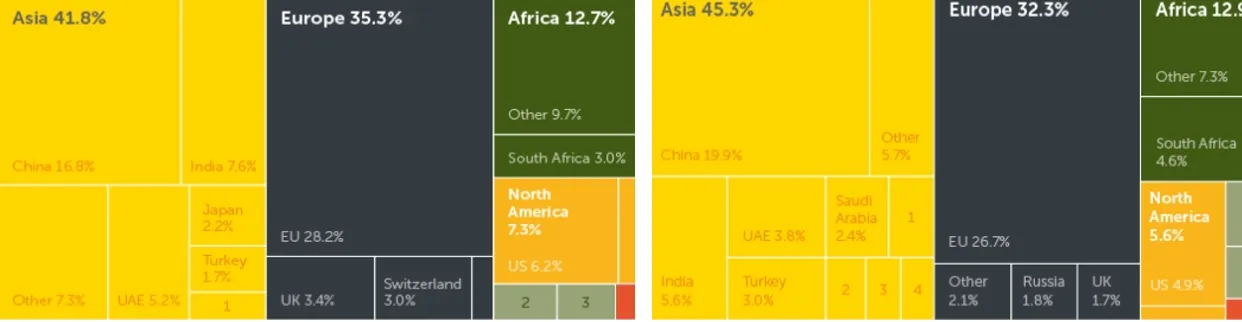
The EU is Not Africa’s Largest Trading Partner
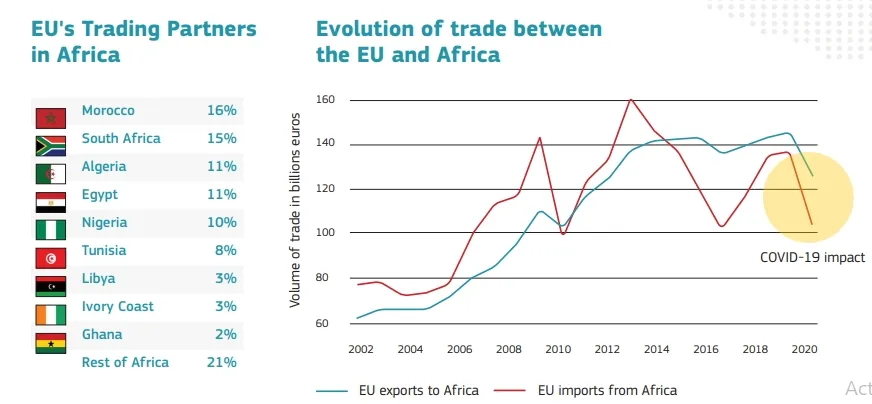 This trade concentration raises questions about the nature of Africa's economic relationship with the EU, particularly when the continent’s overall trade potential with Europe is not fully realized. The trade imbalance indicates that Africa’s broader economic needs and priorities are not adequately addressed within the EU's trade agreements, especially considering the limited scope of the agreements to less-developed and smaller African economies.
4.1 Context of EU and UK Trade with Africa
The European Union (EU) and the United Kingdom (UK) maintain three distinct trade agreements with African countries. These include the Economic Partnership Agreements (EPAs) with 14 countries, Association Agreements with North African countries (4 countries), and a range of unilateral trade agreements under the Generalized Scheme of Preferences (GSP). The GSP comprises the standard GSP arrangement, which includes countries like the Congo and Nigeria; GSP+ for countries such as Cape Verde; and the "Everything But Arms" (EBA) arrangement for Least Developed Countries (LDCs), covering 33 African nations.
The UK, which previously negotiated trade deals under the EU framework, has continued with similar arrangements post-Brexit. The UK’s EPAs mirror the EU’s, covering countries such as Kenya, Ghana, Cameroon, Ivory Coast, and the Southern African Customs Union (SACU), which includes Botswana, Eswatini, Lesotho, Namibia, South Africa, and Mozambique. The similarity between the UK and EU EPAs highlights the lack of substantial change in the trade approach towards Africa post Brexit.
The EU claim that EPAs contribute to the implementation of the Africa-Europe Alliance for Sustainable Investment and Jobs, which is central to the EU’s Comprehensive Strategy with Africa.
The UK references its own Development and Investment strategy, still in draft form, which is largely unrelated to the UK’s EPAs. However, this analysis suggests that the EU and UK’s strategic focus on investment, competition policy, government procurement, and trade facilitation within EPAs may nullify many of the provisions proposed in their respective development strategies.
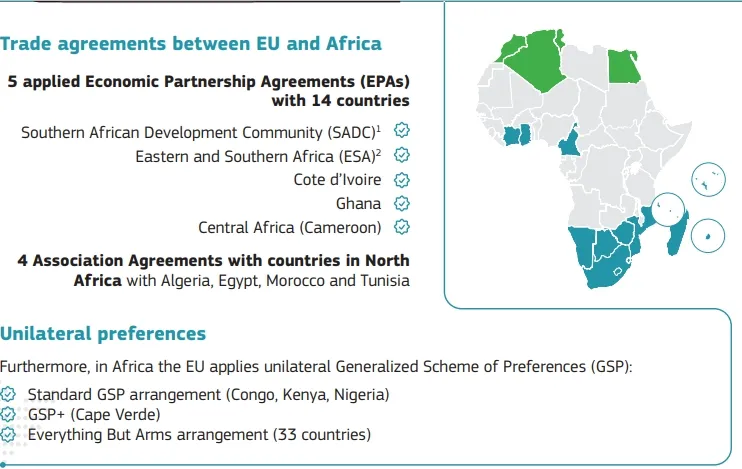
In this analysis, we focus on the Economic Partnership Agreements (EPAs), as they are the most consequential for Africa. EPAs not only encompass a wide range of agreements but also affect all African countries outside of North Africa. These agreements have significant implications for the structure and operation of regional trade agreements. Furthermore, the EPAs have far-reaching consequences for the African Continental Free Trade Area (AfCFTA), as they introduce numerous contradictions and overlaps between regional trade agreements and the AfCFTA framework
4.2 The Road to Losing the Battle on EPAs
“This is a major quadrennial event where all UN Member States negotiate guidance for UNCTAD, a UN institution working on trade and development. For the European Commission, it would have been a propitious place for a signature ceremony in order to project the EPA as a ‘trade and development’ agreement to the benefit of EAC. Yet, the agreement is antithetical to Tanzania’s as well as the region’s trade and development prospects”-Benjamin Mkapa, President of Tanzania, opposing a push by the EU to have Africa Heads of States host an unscheduled meeting to sign the EPA during the 14th Ordinary Session of United nations Conference on Trade and Development (today renamed UNTAD)
“We were not legally obliged to enter into the EPA process but we did so because we thought it could be a step to regional integration. I’m afraid it has worked out in an end game that could contribute to regional disintegration.” Rob Davies South Africa Minister of Trade and Industry, 2009-2019
In 2016, Benjamin Mkapa, the retired President of Tanzania, expressed Africa’s frustration with the EU’s pressure to sign the Economic Partnership Agreements. His open letter highlighted what many African leaders had long been feeling: the EPAs were an imposition rather than a mutually beneficial trade agreement. Two years earlier, the United Nations reported significant tensions between African Heads of State and the EU over the EPAs. At the 2014 African Union (AU) Heads of State Summit, senior EU officials attempted to bypass regional bloc discussions within SADC, EAC, and ECOWAS to secure the signing of the EPAs. However, this approach was met with resistance, with African leaders accusing the EU of attempting to divide the continent into smaller blocs in order to weaken collective bargaining power.
The confrontation escalated into accusations of blackmail and manipulation, with Nigeria and Mauritius threatening to withdraw from the EPA talks.
According to the UN report, an AU official called the EU’s threats and blackmail “an unprecedented power game rarely witnessed at an African heads of nations meeting.” Nigeria and Mauritius, angered by such arm-twisting, announced they might renege on their provisional acceptance of the Free Trade agreement. Nigeria went ahead to do exactly that and has refused to sign the EPAs to date.
Kenya, under significant pressure, was forced to sign the EPA in 2016, following the EU’s threat of imposing heavy taxes on Kenya’s key exports, particularly horticulture. Other East African Community (EAC) countries managed to avoid signing the EPAs, as they were classified as Least Developed Countries (LDCs), qualifying for the more lenient Everything But Arms (EBA) arrangement. However, this situation underscores the coercive nature of the EU’s approach to securing signatories for the EPAs.
The process of signing the EPAs has therefore been marked by a long and contentious struggle. And yet, despite widespread protests across the continent and a decade-long civil society campaign known as “STOP EPAs Campaign”, many African governments gradually acquiesced to EU pressure. Six Southern African Development Community (SADC) countries signed the EPAs in 2016, with Kenya following suit. The EU’s has already announced that two additional countries-Rwanda and Cape Verde-are on their way to signing the agreements. This is despite James Ndahiro, Rwanda’s then representative to the East African Legislative Assembly, expressing Rwanda’s strong objection on grounds that “outstanding issues, if not resolved and if included in the EPA framework, will bind the EAC to poor trading terms,”
Chukwuma Soludo, former governor of the Central Bank of Nigeria said of the STOP EPA Campaign
”Despite…the reported public protests in 20 countries against the (EPA) raw deal, it seems all but certain to be rammed through. In private whisperings, not many Africans or policymakers are happy with the deal but there is a certain sense of helplessness,”
Onkundi Mwencha, then Deputy Chairperson of the African Union (AU) Commission said:
“Our advantage is regional integration. Can EPA help us to integrate our markets? If anything it will stall us. I don’t think EPA is a priority for Africa,”
It is instructive to in 2007 the UK House of Commons Committee on International Development Committee objected to the issues that had been included in the EPAs at that time, and which now form part of the UK EPA.
So what is the contention with EPAs that makes Africa governments so emotional about a trade agreement, and why is the EU so singularly focused on getting it signed that it has spent two decades literally forcing governments to sign on to it?
43 Benefits and Losses of the EPAs
The EU and UK continue to present several benefits of the EPAs to African countries.
1. Compliance with WTO Requirements
One of the primary benefits of the EPAs is their alignment with World Trade Organization (WTO) regulations. Specifically, the agreements ensure that preferential treatment, when granted to one country, does not unfairly disadvantage others. Under WTO rules, such preferential treatment must be offered for a “reasonable” duration, typically up to ten years. This provision allows African countries to maintain their trade privileges while ensuring compliance with global trade standards, which can enhance the credibility of African markets in the international trading system.
2. Duty-Free, Quota-Free Access to the EU Market
The EPAs eliminate quotas and duties on exports from African countries to the EU, providing local producers with enhanced access to one of the world’s largest and most lucrative markets. This duty-free, quota-free access is expected to benefit a wide range of sectors, including agriculture, textiles, and manufacturing, by expanding export opportunities and stimulating local economies. The elimination of trade barriers can also enhance the competitiveness of African goods in Europe, driving economic growth and facilitating deeper integration into the global economy.
3. Boost to the Textile Industry and Other Key Sectors
One of the sectors poised to benefit significantly from the EPAs is the textile industry. With duty-free access to nearly 500 million consumers in the EU, African countries will be able to tap into a vast market, complementing the existing opportunities under the US’s African Growth and Opportunity Act (AGOA). This expanded market access is particularly important for countries that have strong textile industries, as it provides them with an opportunity to diversify and expand their export base.
4. Boost to Horticulture
In addition to textiles, the horticultural industry in countries like Kenya is also expected to gain from the agreement. The ability to access a larger, duty-free, and quota-free market for products such as flowers, fruits, and vegetables can enhance the profitability of local farmers. However, the extent of this benefit is somewhat diminished by the fact that European flower farms dominate the market, limiting the growth potential for African producers in this sector.
5. Support Measures for African Countries
The EU has introduced several support mechanisms aimed at mitigating the potential negative effects of the EPAs on African economies. These include a fund to compensate for the loss of revenue resulting from tariff removals and a “capacity building fund” designed to help countries strengthen their trade capabilities. These initiatives are intended to help African countries adjust to the changes introduced by the EPAs, ensuring that they can fully benefit from the agreements while minimizing the impact of trade liberalization on domestic industries. Among these measures is a commitment to implementing a "Development Matrix" to support African countries in adjusting to the EPAs. The estimated cost of this initiative is $70 billion, though EU contributions to date remain limited, standing at just $3.49 million—equivalent to a mere 0.005% of the required funding. This gap in funding raises concerns about the EU’s commitment to ensuring that the EPAs have a positive and sustainable impact on African economies.
While the EU cites Cameroon as a success story, where cushioning funds have helped mitigate some of the adverse effects of tariff reductions, the limited scale of current contributions calls into question whether the EU’s support mechanisms are sufficient to realize the full potential of the EPAs across the continent.
4.4 Contradictory Issues of Trade, Development and Migration
1. Undermining Regional Trade Agreements
The EPAs disrupt existing regional trade agreements among African countries, creating significant barriers to advancing both current sub regional trade agreements and negotiations under the African Continental Free Trade Area (AfCFTA).This undermines efforts to establish a cohesive and integrated continental market, weakening Africa’s ability to pursue meaningful regional economic cooperation.
Indiscriminate opening of African economies further jeopardize regional integration initiatives as the EU (i) enforces the tendency of narrowing down regional co-operation and integration processes to trade liberation, (ii) forces the scope and pace of that liberalisation, (iii) causes the break-up of regional configurations, and (iv) wants to be part of any region (EPA negotiations as foreseen by the EPA consultations and follow up.
By creating unequal conditions across African countries, EPAs weaken regional trade integration. Selective EPA benefits for LDCs and North African nations foster internal competition rather than unity. This fragmentation undermines Africa’s collective negotiating power and complicates efforts to establish cohesive trade policies.
Cross-border trade, particularly among farmers and small traders, suffers significantly. The lack of a unified approach to external trade relations dilutes Africa’s ability to secure favorable terms with global partners like the EU and China. EPAs require liberalization of 80% of imports from the EU. These duty-free imports would find their way in all SSA countries given the lax rules of origin so that the expectations that the ACFTA would increase intra-African trade would not materialize. Because the products imported duty free from the EU would be more competitive than most African products despite the deeper level of liberalization the CFTA is expected to make. The South Centre for example has shown that only 6% of Nigerian tariff lines are more competitive than EU products. Third World Network concludes ACFTA that comes in being is simply a giant African market place with little of African products to trade in. The ACFTA is simply facilitating the movement of products imported from Europe and other areas across Africa. The ACFTA is a lower level of integration than the customs union already in place in some regions, such as West Africa and EAC, with their common external tariffs
And that is not all.
The AU recognizes 8 Regional trading blocs (RECs)-ECOWAS-comprising 15 States), CEMAC-comprising 6 States, EAC-comprising 5 State, SADC-comprising 15 States, COMESA-comprising 19 States,UMA-comprising 5 States, IGAD-comprising 8 States, and the Community of Sahelo-Saharan States, comprising 28 States. There are already overlaps in membership to these regional grouping that have slowed down the region’s integration agenda. And yet the EU brings more confusion by creating new geopolitical configuration of the regional EPAs. In East Africa, for example, Tanzania belong to the LDC and so is covered by EBA. Kenya, on the other hand belongs to the Lower Middle Income Category and is an EAC EPA signatory. Tanzania is also a member of SADC, where countries such as South Africa are included in the SADC EPA.
2. Exacerbating Job Losses and Increasing Migration into Europe
As way back as 2004, Civil Society ,under the CONCORD Cotonou Working Group (CCWG) had warned that if the EU insisted on pursuing the EPAs based on Free Trade Areas (FTAs) as defined by the WTO, it will automatically imply the elimination (not the reduction) of duties and other restrictive regulations of commerce on essentially all trade. This would have a devastating effect on not just Africa’s agriculture and small businesses that provides employment for over 80% of its population, FTAs, as currently structured and demanded by EPAs signed so far, will flood Africa will cheap European goods and dumped agricultural products, further undermining the very objective of the EU-reducing migration by allowing African countries to create jobs at home.
In addition the EU sticks to a narrow interpretation of this WTO rule insisting that “essentially all” would mean “more than 90%” (this has since been revised to 80%). In other words EPAs as they are currently being implemented require the 14 African countries to almost completely open their markets to EU imports.
Taken together with the recent European policies such as those around Carbon Border Adjustment Mechanism, EU Regulation on Deforestation-free Products and other policies such as the Industrial Green Deal (Formerly Green Deal) and those on fertilizer,
3. Crippling Competition and Innovation
EPAs have exposed the 14 African countries to devastating EU competition, especially in combination with the narrow interpretation the EU has made and which is clear from the texts of the agreements. For example, the texts in rules of origin and Most Favoured Nations as well as the short period (5 years) given before discussions on investment, intellectual property and other broader issues can begin, show that the EU is keen to use EPAs to completely decimate the economies of the signatory countries. The EU has not only closed the door on any flexibility for the African countries, the transition period is too short, the coverage is too broad, the elimination of tariffs too ambitious and there is too little regard for the position of Least Developed Countries, small vulnerable economies and land locked economies.
Here is what article 3 of the EU EPA with Kenya and other EPAs) states
The Parties undertake to conclude the negotiations in the subject matters listed below, within five (5) years from the entry into force of this Agreement: (a) Trade in services; (b) Trade-related issues-Competition policy; Investment and private sector development; Trade, environment and sustainable development; Intellectual property rights; Transparency in public procurement; (c) Any other areas that the Parties may agree upon.
These clause, first brought up in the WTO negotiations, have been rejected by African countries over the years because they go beyond trade agreements and make demands that will kill domestic markets and regulations, opening the door for exploitation of Africa by European multinationals. Most European multinationals benefit from subsidies by their governments when it comes to investments and tenders under the so-called “blended finance” arrangements. Beyond this, with African companies being primarily SMEs and informal, subjecting them to European rules for tendering and procurement will systematically decimate them. Beyond this, the EU has always over the years invoked intellectual property rules to block Africa and killed innovation and industries on the continent. And by the EU including clause (c) (any other areas) in the agreement there is room to include many unrelated issues whose disputes will not be resolved because the WTO dispute resolution mechanism is paralyzed.
African producers -including those from least developed countries and other vulnerable economies- suffer from serious capacity problems and will struggle to compete with import surges of duty-free and often heavily subsidized European goods in areas where they already compete. There is little incentive for Africa producers to diversify into more ‘value-added’ products, or for investors to put money into developing new capacity, given uncertain domestic and regional markets for products competing with EU imports. This is already leading to a ‘glass-ceiling’ being placed on African countries’ development, an increased dependence on the production and export of primary products and possible deindustrialization with associated job losses as already witnessed in Ghana.
4. Going Against Evidence of Do NO Harm
The Sustainability Impact Assessment (SIA) commissioned by the EU warns that for West Africa, EPAs “might accelerate the collapse of the modern West African manufacturing sector”.
This is already beginning to happen in the exact place of the study- West Africa, as seen in the Annex to this Report. African countries that signed onto EPA earlier on are already facing substantial adjustment costs when opening for EU exports.
5. Ignoring Empirical Evidence Against EPA Gains
A detailed scientific forecast of EPA by German Research Organization Deutsches Institut für Entwicklungspolitik, projected into its full years of implementation show that over the long term there is no significant trade benefit of EPAs to Africa. The study, show that while there is likely to be instant export and import increment (since most of the items listed under quota free and duty free already enjoy this benefit) negative effects will be realized quite early, as already seen in Ghana.
When focusing on specific agreements and economic sectors, the forecast study shows that EPAs will lead to increased imports from the EU to some countries. More specifically, the estimation results suggest an increase in the total imports from the EU will be most visible in the SADC EPA partner countries, especially with the Critical Raw Materials from South Africa and gas from Mozambique. In the area of manufactures trade, the study forecasts a dramatic decreases in exports from the ESA and SADC countries to the EU, but increases in imports from the EU into SADC countries. For the EU’s agricultural exports, the forecast find statistically significant increases to SADC and ESA and the Pacific.
6. EPAs overreliance on Liberalization as the only “Carrot” to Grow African Economies
There is little evidence that trade liberalization is correlated with economic growth, poverty reduction, or economic development. Whilst no country has developed successfully by turning its back on international trade, none has developed by simply liberalizing its trade. Analysis of trade, economic growth and poverty reduction needs to go beyond trade liberalization to include inter alia: the relationships between trade and inequality, trade and employment, bargaining power in global production chains and the distribution of gains from trade, the effects of trends in, and variability of terms of trade on poverty, the effects of primary commodity dependence, and the relationship between export and import instability and vulnerability.”
The so-called “enlightened view” proposed by the EU argues that economic growth is dependent primarily upon integration into the global economy. Research however shows that trade and trade policy is central and economic growth is rarely sparked by imported blueprints and opening up the economy is hardly ever critical. Economies grow when policies are targeted to domestic investors and tailored to domestic institutional realities. Ironically this is what the EU has done with its many Non-Tariff Barrier policies, yet it does not want them done by African governments.
EPAs are also inordinately preoccupied with liberalization as a way to better integrate Africa into the world economy, and lead to Job creation. This is an argument pushed by the EU, pointing Africa to its large youth bulge and demand for jobs. The UN Trade Agency UNTAD has done extensive research which show that Trade liberalization of a country’s own market is not a condition for integration into the world economy at the outset
Trade liberalization of a country’s own market is not a necessary condition for integration into the world economy. UNTAD findings show that economic integration, especially of developing countries, including through export-led growth strategies, appears to have had great potential for job creation. Successful integration was part of every development success story of past decades. Evidence shows that in many cases, however, opening a country’s own market may be even counterproductive.
Many early industrializers, argues UNTAD, had high trade barriers during their early development stages. Thus, many jobs newly created in South-East Asia, for example, can be attributed to trade, but not to trade liberalization of their markets.
The WTO argues that the fact that trade liberalization in South-East Asia was associated with great strides in alleviating poverty is not sufficient to show that it caused those strides; too much else was going on. The (mixed) evidence that liberalization has gone with increasing poverty in Latin America shows that most reforms will create some losers (some even in the long run) and exacerbate poverty. On the contrary the policy reforms proposed as part of EPAs implementation (as seen in Ghana) actually creates more hardships to the bulk of small traders and farmers who form the backbone of these economies.
7. EPAs coming Before Institutional Reforms
The OECD, to which the EU is a member, states clearly that institutional reforms and support through clear AID for trade agreements is a much better way than the haphazard promises made by the EU and which are become unpredictable and far in between. They argue that institutional reforms and cushioning of weak economies must precede any push to sign onto Free Trade Agreements. This issue, interestingly, remains outstanding, and with recent proposals to cut Aid budget by the EU and its members such as Netherlands, Belgium and even its non-member UK (who has an EPA with Kenya) it is unclear how this will be achieved. There are also concerns over the unwillingness of the EU to include development matrix as party and parcel of the EPA. The Development Matrix indicates costs priority projects to address the supply side constraints associated with implementing the EPA. They are envisaged adjustment costs and other trade related infrastructure so as to enable the countries to take full advantage of the market access granted by the EU. The EU has declined this proposal and instead proposes different unreliable sources coming from its various donor instruments.
8. Pushing EU Trade with Africa at Expense of Trade within Africa
One of the issues with the EPAs is that by creating conditions that are conducive to some countries (such as LDCs and North African countries) while making it difficult for the rest of the countries to trade with the EU, the EU is effectively creating internal competition on what is a weak trade benefit for Africa. If one notes that of all the current and proposed EPA signatories, only 3 have major exports to the EU, it becomes clear that the idea is to kill among African countries while allowing the EU to either cheaply sell or dump its products in Africa African.
The EPA also raises serious concerns about the future of cross border farmers that form the bulk of the regions trade. By negotiating independently with the EU and UK, African countries have set a dangerous precedent that could lead to further fragmentation of regional trade policies. The lack of a unified approach to external trade relations not only weakens the Africa’s bargaining power but also undermines efforts to establish a comprehensive and cohesive regional market. This will make it increasingly difficult for the Africa to negotiate with other trading partners, including the European Union and China, on favourable terms.
9. Killing Industrialization by Giving Incentives for Export of Raw Materials and Agricultural
The EPAs have provided significant incentives to the export of raw materials, critical minerals and unprocessed agricultural products while blocking exports of value added and industrial goods. Studies above by shows that in the area of manufactures trade, there will in fact be a reduction of exports from the ESA and SADC countries to the EU. The will in fact be increase in imports by African partner countries from the EU due to the EPAs, mainly driven by agricultural imports. On the import side, increased quantities at cheaper prices will generate welfare gains but this will be wiped out by losses of customs revenues due to agreed tariff reductions. Equally importantly, prospects of industrialization need to be carefully evaluated in light of increased competition from foreign markets.
10. Introducing a Complex and Harmful Agreement when there are Existing Options
African governments have been compelled to enter into complex and detrimental agreements under the EPAs, despite the fact that the World Trade Organization (WTO) already offers provisions that would allow African nations to maintain their current trade agreements. The EPAs force countries to adopt a new framework that may not align with their long-term economic interests, undermining their autonomy in shaping trade policies.
11. Unenforceable Concessions: Several concessions within the EPAs are difficult, if not impossible, to enforce due to existing policies, non-tariff barriers within the European Union, and pushing countries to the WTO such as the failed dispute resolution, which is the very reason countries went for FTAs in the first place. These provisions create gaps between the promised benefits and the actual outcomes, limiting the expected economic gains for African countries and leaving them vulnerable to trade imbalances.
11. Overreliance on Liberalization as a Development Strategy
EPAs are heavily reliant on trade liberalization as the sole strategy for African economic growth. However, evidence suggests that liberalization alone does not correlate strongly with poverty reduction, economic development, or industrialization.
Successful economic integration requires policies tailored to domestic realities. Many early industrializers, including those in Southeast Asia, relied on protective trade barriers during their developmental stages. For example, high tariffs in the initial phases of industrialization fostered growth and job creation in these economies. Conversely, EPAs push for market liberalization without addressing the structural and institutional weaknesses of African economies.
Research by UNCTAD shows that liberalizing a country’s market at an early stage often leads to counterproductive outcomes, such as increased poverty and inequality. In Latin America, trade liberalization has exacerbated poverty, while in Ghana, EPA-related reforms have disproportionately burdened small traders and farmers.
Lack of Evidence Supporting EPA Benefits
A detailed forecast by the Deutsches Institut für Entwicklungspolitik highlights the negligible long-term trade benefits of EPAs for Africa. While initial export and import increases are anticipated, the agreements ultimately lead to adverse effects, including declining manufacturing exports and over-reliance on imports from the EU.
The study reveals that SADC countries will experience significant reductions in exports to the EU, particularly in manufactured goods, while facing an influx of EU agricultural imports. This trend undermines Africa’s industrialization efforts and entrenches dependency on raw material and agricultural exports.
Incentivizing Raw Material Exports Over Industrialization
EPAs encourage the export of raw materials and unprocessed agricultural products while discouraging the trade of value-added goods. This incentive structure perpetuates Africa’s dependence on primary exports and hinders industrial growth.
The welfare gains from cheaper imports are offset by the loss of customs revenues and the erosion of local industries. For instance, increased EU agricultural exports to SADC countries intensify competition against local farmers, while African manufacturers struggle to penetrate EU markets
Case In Point- East Africa
A study by the South Centre shows that the EAC is more competitive than the EU on only 10% of tariff lines .As a consequence, this would mean that the majority of products that are currently produced will be put at risk due to tariff elimination in the EPA, and the EU being more competitive, producers will lose market share to EU imports as well in
home markets and other EAC markets. The study further shows that 51.3% of tariff lines/products where there is current local production will be damaged (1,100 tariff lines out of 2,144) as these are lines where liberalisation will take place and the EU is more competitive on these lines than the EAC
Taking into account potential future production (tariff lines where there is no current production), 2,366 tariff lines will be liberalised making the possibility of having future production in these products questionable. In total, 68.8% of all tariff lines or products could be put at risk (current and future production).
Further, a short list of sectors where there is current production which could be jeopardised and tariff lines where there is at present regional trade which could be compromised by the EPA as the EU is more competitive includes: processed oil products; chemical products for agriculture; commodity chemicals; medicines, vaccines and antibiotics; intermediate industrial products; final industrial products; vehicle industry; agricultural products; and books, brochures and other printed material.
African exports to the EU are mainly raw materials especially crude oil raising the question of value addition and regional integration. The major trading partners with the EU from Africa are South Africa, Nigeria, Libya and Algeria. African countries still export raw materials to Europe and provide a ready market for European finished goods thirty years after signing the preferential treatment agreements.
In 1976, just after the first Lomé Convention was introduced, the ACP states accounted for 6.7% of the EU market, while by 2005 it accounted for only 3% (see Borrmann & Busse 2007: 403). ACP’s trade with the rest of the world has also fallen over the same period (Ochieng 2007: 377-8). In addition, about 68% of total ACP exports to the EU consists of agricultural goods and raw materials, with ten products accounting for some 74% of this (Borrmann & Busse 2007: 404). This is, of course, despite the trade preferences that the ACP countries have enjoyed over many decades. Thus, while trade with the EU continues to be important to ACP countries, there is evidence that it is in decline, at least proportionately, and that primary commodities continue to form a substantial part with little apparent progression to added value processed goods
4.5 Specific Concerns with Kenya-UK EPAs
Contravention of EAC Principles
Kenya did not adhere to the required Principles under the EAC Treaty, specifically Article 37 of the EAC Customs Union Protocol that lays out the need to engage collectively using the EAC mechanisms as opposed to a national approach.
While the Kenya-UK EPA consistently makes reference to the EAC and even purports that it is signed on behalf of Kenya and the EAC, it fails when examined against the above requirements of mutual cooperation.
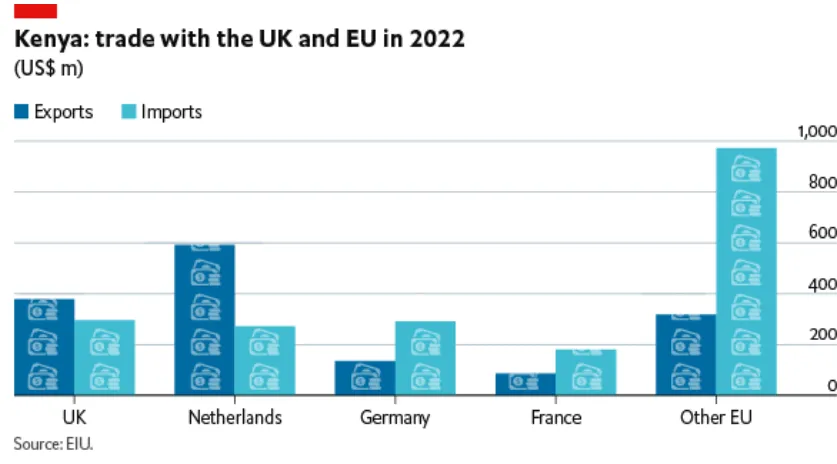
Undermining EAC Trade by Ignoring EAC Common External Tariff
Kenya ignored the role of the EAC Common External Tariff and threw further into confusion the huge gains made towards achieving a Common External Tariff, a milestone in realizing the Customs Union. The result is a genuine concern that goods originating from Kenya into the rest of the EAC are actually imports from the UK that do not obey the EAC’s Rules of Origin.
Under the EAC Customs Union, goods originating from within the EAC are accorded preferential tax treatment when exported to another Partner State within the block while goods originating from outside the block are generally not accorded similar treatment.
Should unscrupulous traders repackage goods imported from the UK into Kenya as ‘made in Kenya’ there is inherent risk that other innocent goods originating from Kenya will be treated with suspicion.
Case In Point
A Late Night Deal that Pushed Kenya Out of the EAC Treaty, and out of ACFTA
On 9th March 2021, deep into the night, Kenya’s National Assembly – one of the two chambers of her national Parliament – approved the ratification of an Economic Partnership Agreement with the United Kingdom of Great Britain and Northern Ireland.
The approval had been preceded by a brief debate focused on form rather than the substance of the agreement. While there had been credible opposition and criticism to the agreement by the civil society, trade organizations, farmers’ forums and other stakeholders, the attitude of the legislators and the bureaucrats involved in the process was that the agreement had to be ratified at all cost.
That Kenya left it until a few hours to the deadline for ratification before rolling out public sensitization exercises was another indicator that the government was keen to limit debate on the agreement pre-ratification.
It even went ahead to bypass established protocols of the EAC.
Kenya’s justification for going it alone – citing the principle of variable geometry in the EAC Treaty – is both illogical and ultimately disingenuous. While variable geometry recognizes that Partner States are at different stages of development and may need to implement certain policies at different speeds, it is not meant to allow one country to unilaterally negotiate external trade agreements on behalf of the entire region. The principle was designed to offer flexibility in implementation, not to sidestep the EAC’s collective decision-making process. Kenya’s nationalistic approach to the EPA with the UK undermines the very purpose of variable geometry, turning what should be a collective regional effort into a series of isolated national actions that contradict the EAC’s core values.
The Kenya-UK EPA represents a significant missed opportunity for the EAC to negotiate collectively with the UK, and by extension, to strengthen the region’s bargaining power on the global stage. By negotiating independently, Kenya has not only jeopardized the integrity of the EAC but also undermined the regional bloc’s future efforts in achieving comprehensive trade agreements with other external partners, including the UK.
4.6 Losses to Farmers with UK and EU EPAs
Delayed Access to International Markets
The UK and EU argues that the EPA will benefit Africa by providing long-term tariff-free access to the UK market, which would theoretically lower production costs and enhance Africa’s agricultural competitiveness. However, the agreement’s provisions on tariff reductions are spread over an extended period, with many products not seeing significant cuts until 2028 or 2032, and complete liberalization unlikely until 2046. For Africa’s farmers these delays could hinder the country’s ability to access vital international markets and improve its economic standing.
Too Many Exclusions of Agricultural Produce
Moreover, the agreement’s exclusion of over 1,400 mainly agricultural product lines, including crucial agricultural goods such as maize, dairy, and vegetables, from tariff reductions severely limits the benefits to Africa’s agricultural sector. The EU and UK’s insistence on this exclusion demonstrates a lack of commitment to supporting Kenya’s primary industries, which remain a cornerstone of its economy. While Africa has the option to apply protective safeguard measures, these measures are not a substitute for meaningful tariff reductions that could enable African businesses to better compete in global markets.
Killing Domestic Agricultural Market
All EPA agreements involve liberalisation (market opening) on average, of eighty percent (80 percent) of all imports of goods into African countries who are party to the agreement from the European Union. That means 80 percent of products from the EU will duty free, quota. This, many experts and institutions, including the Africa Union Commission, objected to for a number of reasons. The EU-Mexico FTA, according to the factual abstract prepared by the WTO Secretariat and available on the WTO’s regional trade agreement (RTA) database,[1] only requires Mexico to liberalise 54.1 percent of imports from the EU by value over 10 years. In the Comprehensive Economic Cooperation Agreement between India and Singapore that entered into force on 1 August 2005, India was to maintain duties on 24.7 percent of trade with Singapore at the end of the implementation period. So, the insistence on the part of the EU for 80 percent was unjustifiable. Eighty (80) percent market opening is problematic. This is in addition to the fact that the EU had not indicated a willingness to abolish its agricultural subsidies. This poses major unfair competition against African producers of products such as milk, poultry, pork, beef, cereals etc. (Karingi, et al., 2005). These subsidies and domestic support are not being removed at the WTO, or in the EPA negotiations. The sectors that are viable for value chain development in Africa are the agricultural value chains and the minerals value chains.
EU Agricultural imports into Africa have been on the increase. The most dramatic example is the EU trade in poultry meat to Nigeria, which is exported via Benin. It is estimated that over 90 percent of EU poultry meat exports to Benin are destined for the Nigerian market. This situation had arisen in response to the strict Nigerian controls on imports of poultry meat via official ports of entry. This practice had seen Benin emerge as a leading destination for EU poultry exports. The sole purpose of this trade was to circumvent Nigerian poultry sector import controls. From 2015 the Nigerian authorities endeavoured to clamp down on cross border smuggling from Benin of poultry meat, rice, and second-hand cars. This had a significant impact on EU poultry meat export volumes to Benin, which fell by 38.2% between 2014 and 2017, with European exports of poultry meat to Benin falling a further 21% in the first 5 months of 2018 compared to the corresponding period in 2017.
Again, use of imported inputs as the primary feedstock for the production of value-added food products, with minimal linkage to the local producers, is most developed in the West African dairy sector, where a range of EU dairy companies have developed trade and investment strategies to capitalise on growing demand for dairy products in West Africa. From 2013, with the abolition of EU milk production quotas that was scheduled for April 2015, a range of EU dairy companies began to acquire local dairy companies or created joint ventures with food distribution companies in Africa to expand the sale of consumer ready dairy products derived from EU sourced milk powders[2]. A notable feature of most (but not all) of these investments was that they were largely unconnected to local milk production.
Case In Point
How One Company Killed The Dairy Sector
In October 2013 Danone- French multinational food-products corporation based in Paris-acquired a majority interest in the West African dairy products company Fan Milk International (FMI), with the aim of building on FMI’s proven system of serving and developing markets for budget conscious consumers and those without access to refrigeration in Ghana, Nigeria, Togo, Burkina Faso, Cote d’Ivoire and Benin.
In the EAC, in July 2014 Danone entered a Joint Venture with Kenya’s leading dairy company Brookside Dairies. This was seen as a gateway to the East African region. In May 2015 this saw Brookside buy the dairy business of Sameer Agricultural and Livestock in Uganda. In May 2017 also Danone took over Brookside Dairy’s shareholding in its Tanzanian business[3] through Danone’s 100 percent-owned Dubai registered Brookside Holdings Limited. Since Danone entered a joint venture with Brookside Dairy, EU exports of milk powder to Kenya, Tanzania and Uganda have increased 235 percent, while exports of butter have increased 102% and exports of cheese have increased almost 67percent[4] .
Farmers Losing to EU/UK Dumping
The safeguards in the EPAs for the protection of small-holder farmers are weak. The Agreement on Agriculture of the WTO, adopted during the Round leading to the establishment of the WTO, provided for an automatic safeguard for agriculture-that is when there is an import surge, it is invoked automatically to safeguard local producers from the imports surge.
However, it was only provided to those countries which converted non-tariff barriers to tariffs in that Round. As such, only 16 developed countries and 22 developing countries can avail of this Special Safeguard Provision (SSG). In Africa, only a small number of countries have access to the SSG - Botswana, Morocco, Namibia, South Africa, Swaziland and Tunisia. The EU also has access to the SSG. In fact, the SSG covers 31 percent of the EU’s agricultural tariff lines (i.e. should prices drop, or a volume surge take place) on the selected 31 percent of products, the EU can slap on much higher tariffs. Since 1995, the EU has used the SSG frequently – up to 61 times in 1996, 60 times in 1997, and 44 times in 2001.
Access to Africa’s Primary Agricultural Produce and Minerals
The EPAs are instruments for gaining privileged access to raw materials. The prohibition of exports taxes in most EPA agreements states that ‘No new duties or taxes on exports or charges with equivalent effect shall be introduced, nor shall those currently applied in trade between the Parties be increased from the date of entry into force of this Agreement.’ It is instructive to state that there is no WTO rule that requires the inclusion of export taxes in an FTA between a developed economy like the EU and developing countries like African countries, with thirty-three of the least developed countries. The rationale for the EU insistence on this in the EPA negotiations has been based on ‘undistorted’ access to raw materials and in this is applicable to the current quest for green mineral resources. In fact, this was one of the rancorous and sticking points in the EPA struggle and the Africa Union once threatened to discontinue the EPA negotiations.
4.7 Conclusion: A Call for Collective Regional Action
The EU/UK EPAs are a stark reminder of the risks associated with unilateral trade negotiations in a region committed to integration. While the EU and UK may argue that the agreement provides benefits for Africa’s economy, the long-term costs of undermining regional cooperation far outweigh any short-term advantages. Africa must redouble its efforts to negotiate collective trade agreements, ensuring that all Partner States benefit from external trade relations and that the region’s economic unity remains intact. Only by working together can the continent secure a prosperous future in the global economy, avoiding the fragmentation and disarray that EPAs signing through independent approach threatens to cause.
Case In Point
Failure To Test
First UK-Kenya EPOA Dispute remains unresolved
Kenya’s Economic Partnership Agreements (EPAs) with the UK are facing a new challenge due to an import-tariff dispute. The UK lodged a formal complaint in January 2024 over Kenya's import duty on alcoholic beverages, such as wine and whisky, which rose from the agreed 25% to 35% in mid-2022 under the East African Community's (EAC) Common External Tariff (CET). The UK EPA, signed prior to the tariff increase, has a fixed 25% duty, while the EU EPA, signed in June 2023 after the adjustment, failed to reflect the higher duty.
This dispute highlights the difficulty Kenya faces in balancing its commitments to both the EAC’s CET and the EPAs, particularly as the CET is adjusted annually. Kenya’s aim in negotiating the EPAs was to ensure compatibility with the CET to prevent market distortions within the EAC. However, the disconnect between the EPAs and the CET is now causing friction, with the UK and EU likely to continue pursuing formal complaints under their respective deals’ dispute resolution procedures.
To address the issue, Kenya plans to establish a technical working committee and engage with relevant agencies, but a clear solution remains uncertain. One potential resolution could involve Kenya persuading the EAC to align the CET with the EPAs, or seeking a special dispensation to revert to the 25% tariff for the disputed products. However, it is unlikely that the UK and EU will accept the higher tariffs without further negotiation.
This tariff dispute presents an opportunity to test the EPAs' dispute-settlement mechanisms, which could be critical for resolving future disagreements and encouraging other EAC members to join the agreements.
Beyond EPAs: How the EU Uses Policies and Rules to Kill Africa’s Farmers
6.1 Introduction
The EU and UK boasts that EPAs offer express no-questions asked “duty free, quota free” access to Africa.
But anyone who believes this would be naïve.
Because what the EU has tried to offer with the EPAs (and they are already none) it has taken away through numerous policies that it has been passing over the years, the latest being the Critical Raw Minerals and the Green Deal (since renamed Clean Industrial Deal).
The EU argue that these are not blockages, they are just “standards” applicable to both its farmers and businesses as well as those bringing goods into the EU. In their view, they are just creating a “level playing field” by ensuring that everyone is judged by the same standard
What the EU is missing is the difference between Equality and Equity. The Maasai say that a giraffe and a warthog cannot be given the same length of stool to watch a wresting game across a wall.
But beyond that the EU, with its resources and capacity to meet strict regulations, should have made it a little easier for countries from which it gets its primary raw materials, to sell it in their territory. Beyond this, by making the rules and policies favourable to the EU, the EU is in effect allowing only their businesses to process and manufacture these goods both in Europe and in the countries with which it has signed the EPAs. A case in point is Kenya where EU rules have ensured that the only companies able and with the knowledge to produce, package and ship flowers to Europe are European companies.
6.2History of EU Policies on Agriculture
The history of EU’s policies and their effect on Africa’s ability to produce and export agricultural produce to this market is a long and tedious one.
To understand it African farmers need to follow the evolution of the EU’s Common Agricultural Policy (CAP) that was conceived in 1962 to provide affordable food for its population post-World War II. The CAP is a set of rules and funding that supports EU farmers and food security, but it also affects the global food system through trade and development policies. The CAP has undergone several reforms over the years, and the latest one for 2023-27 aims to make it more sustainable, fair, and performance-based
Under CAP, the EU became so efficient that surpluses piled up. The authorities subsequently introduced export refunds—paying international traders the difference between the EU’s high internal prices and lower world market prices.
Research by the think-tank ARC2020 and the German NGO Heinrich Böll Stiftung finds that the EU agricultural policy creates ripple effects around the globe, especially in Africa.
For example after markets inside Europe were awash with milk after the bloc abandoned its quota system in 2015, Dutch and German producers quickly sought out other export opportunities. And Africa became the dumping ground
As the source of livelihood for 70% of the African population, agriculture and the rural economy play a fundamental role in securing a peaceful, prosperous and integrated future for Africa
Here are a few of these Policies and blockages
5.2 The EU Regulation on Deforestation-Free Products (EUDR): Implications to EU Market Access for Africa
The EUDR aims at ensuring that no products produced through deforestation are exported to the EU market, the regulation applies to commodities like cattle, wood, cocoa, soy, palm oil, coffee, rubber, and some of their derived products, such as leather, chocolate, coffee capsules, tyres, or furniture ( European Union, 2023). Applying to both small and large quantities, an exporter to the EU has to first ascertain that these products do not originate from recently deforested land or have contributed to deforestation or forest degradation ( European Union, 2023). While it has been postponed for one year (till 2026), the EUDR initially applied to all products placed on the market from 30th December 2024, and 30th June 2025 for small businesses and would have been implemented through a stringent traceability mechanism under EU Customs procedures. It is important to note that the EUDR was unilaterally enacted and presented on a take-it or leave-it basis that African countries had to capitulate as the EU is the leading buyer of the key products of focus e.g., rubber, coffee, and cocoa among others.
In particular, concerns are being expressed by developing countries about the fact that the EUDR regulation will create significant barriers and exclusionary effects for producers in developing countries, with excluded farmers being pushed back into activities that are more detrimental to their socio-economic conditions or to environmental protection. According to UNCTAD (2024), the EURD does not sufficiently take into account the developmental priorities of developing countries. For example, the country-benchmarking system does not account for subnational risk differentiation or for differentiation across commodity sectors in its current form. It is not surprising that companies in both developed and developing countries also insist on the EUDR’s potentially dramatic impacts on smallholder farmers in developing countries, and are therefore demanding that the regulation be softened (UNCTAD, 2024).
Key concerns about the EUDR and potential implications to farmers in Africa
Supply Chain Complexity: For many African businesses, managing a supply chain that spans vast and diverse regions poses significant challenges. In countries where agricultural practices are often fragmented and supply chains are complex, collecting accurate data becomes a monumental task (TraceX, 2024). This complexity is exacerbated by the variety of stakeholders involved, from smallholder farmers to large export companies, each contributing to different stages of the supply chain.
Traceability challenges: Traceability, which is crucial for compliance with the EU Deforestation Regulation (EUDR), requires detailed tracking of products from their source to their final destination. However, in many African contexts, the infrastructure for such meticulous tracking is underdeveloped (TraceX, 2024). Businesses often struggle to obtain reliable data on the exact origin of their commodities, the conditions under which they were produced, and their journey through the supply chain (TraceX, 2024). For example, in Uganda, between farmers in Uganda and consumers in the EU, various actors are involved, including cooperatives, traders, exporters, processors and even the government. Due to these complex supply chains, traceability will be complex as well. Therefore, coffee traders need to trace their coffee beans precisely, all the way to the smallholder farmer. This lack of transparency makes it challenging to prove that products are deforestation-free and comply with EUDR standards
Local Legislation and Compliance: African businesses face the additional challenge of aligning with a complex web of local laws while adhering to the EU Deforestation Regulation. Each country has its own set of regulations concerning land use, environmental protection, and labor rights. For businesses operating across multiple countries, understanding and integrating these diverse legal requirements with EUDR compliance can be overwhelming. Local legislation may vary significantly, and businesses must stay abreast of changes in regulations that impact their operations. Integrating these local laws with EUDR requirements demands a nuanced approach. Companies need to develop internal systems that not only comply with EUDR but also respect and incorporate local regulations. This integration often requires expert legal and regulatory knowledge, which can be challenging to acquire and manage.
Infrastructure and Technology Gaps: One of the most pressing issues for African businesses is the limitation of digital infrastructure and technology. Many regions still lack the advanced digital tools necessary for efficient tracking, reporting, and compliance (TraceX, 2024). The absence of robust IT systems can hinder a company’s ability to collect and analyze data effectively, impacting their ability to meet EUDR requirements (TraceX, 2024). For instance, digital platforms for tracking the provenance of commodities, managing supply chain data, and ensuring compliance are not always available or affordable. Businesses may struggle with outdated or inadequate technology, which impedes their ability to implement effective traceability systems. Without the right tools, maintaining transparency and providing the necessary evidence to prove compliance with EUDR can be exceptionally challenging.
The ITC developed a tool showing the “exposure” of commodities trade flows to the EUDR for exporting countries (ITC, 2024). Below are how select countries in Africa may be affected by the EUDR:
- 61 per cent of Burundi’s coffee is exported to the European Union, and coffee accounts for 23 per cent of the country’s exports, yet the European Union imports only 0.1 per cent of its coffee from Burundi. The EUDR might result in a significant loss of export market for Burundi if its exporters cannot comply with the regulation and if insufficient collaboration and support mechanisms are deployed. Such effect is already manifesting in the Ethiopian coffee sector, with coffee traders turning away from Ethiopian producers due to the costs involved to make producers compliant with the regulation (Reuters, 2023)
- 56 per cent of Côte d’Ivoire’s cocoa is exported to the European Union, and cocoa represents 26 per cent of the country’s exports. However, the European Union is also highly dependent on Côte d’Ivoire, which accounts for 43 per cent of the European Union’s cocoa imports. Hence, conflicts of interests might arise as both parties might benefit from a poor enforcement of the regulation (Bastos Lima, & Schilling‐Vacaflor, 2024)
Source: SEATINI, 2024
Further impacts have been immediate There is already a drying-up of orders in recent months for coffee from Ethiopia, where some 5 million farming families rely on the crop. They warned that sourcing strategies being adopted by companies in advance of the law risk increasing small scale farmer poverty and raising prices for EU consumers, while also undermining the EUDR's impact on forest conservation
.These documented transactions should make it harder for intermediaries to bend the rules. Already companies selling to Europe are not interested in coffee from Ethiopia's Oromia Coffee Farmers' Cooperatives Union, according to a recent World Coffee Alliance webinar. Coffee generates 30-35% of Ethiopia's total export earnings, with almost a quarter sold to the EU Ivory Coast and Ghana Ivory Coast and Ghana, for example, produce nearly 70% of the world's cocoa, Half of Ivory Coast's crop, for example, is sold by local intermediaries and thus difficult to trace. Grown mostly for EU consumption, it cannot be completely redirected to Asia as chocolate is less popular there. The problem for Ivory Coast is that 20-30% of its cocoa is grown in protected forests by nearly one million people. Denying them their livelihood could cause social unrest, while relocating them is unfeasible without major funding and support. Ivory Coast tried to reclassify its protected forests, but the EU publicly called on the country to desist. Compliance costs throughout the supply chain will means two things- consumers within the EU pay more, or farmers get paid less and less. We know who will win this want
5.3 Green Deal Needs Africa to succeed, but Punishes Africa
The European Green Deal (since renamed Clean Industrial Deal), aims to reduce the environmental and carbon footprint in the way food is produced and consumed. The policy has caused the EU to be EU accused of thrusting a costly decarbonization on Africa and denying it the fossil fuel-powered economic growth that it itself enjoyed (and still does). Such policy incoherence has been dubbed by one observer ‘colonialism in green’. ties.
The EU is seeking through the Green Deal to compel other countries to adhere to new regulations if they want to continue to access its lucrative market.
Carbon Tax
One of the concerns around the EU’s “Green initiative” is the Carbon Border Adjustment Mechanism (CBAM), is a tax applied to certain imported goods, based on the amount of carbon dioxide (CO2) emissions released during their production. It is effectively a form of tariff on imports of high-carbon goods, including steel, aluminium and cement, levy higher taxes on its carbon-producing industries. Companies that import goods into the EU will be required to purchase certificates that represent the amount of emissions generated during the production of these goods
According to Carnegie Endowment the CBAM is motivated more by the need to disincentive EU businesses from relocating than the need to decrease global emissions.
In Africa, French Development Agency (AFD) reports that Egypt, Zimbabwe and Mozambique will be most impacted relatively to total exports are Armenia, Tokelau, Albania, Moldova and Zimbabwe
Mozambique is by far the most affected economy in relative terms, as almost 20 percent of its total exports are products covered by CBAM—or rather, to a major degree, a single good: aluminium.
This additional tax adds to a layer of policies imposed by the EU on imports.
Comparing EU and UK EPAs with Other Trade Agreements: How the EU and UK Compare to the US, China, Japan, South Korea and the UAE
This analysis has presented reasons that should to a rethink of the EPAs.
They are going to cause irreparable damage to Africa’s economies and livelihoods.
The questions is whether other Africa Trade Partners are presenting a better offer than the EU and the UK.
In this section we present informal trade arrangements that Africa has with other countries and regions.
The aim is to bring to our attention how other trade partners relate with the continent.
It is also intended to enable the EU and UK to consider what it can borrow from other trade arrangements that are not structured the way the EU and UK has done with the EPAs
6.1 US-Kenya Strategic Trade and Investment Partnership (STIP)-Negotiations Ongoing
The U.S. government also views Kenya as a strategic partner in the region. Kenya is a major beneficiary of U.S. security and foreign assistance, acts as a hub for U.S. security initiatives in the region, and hosts the largest U.S. embassy in sub-Saharan Africa (SSA).
Kenya is a relatively small trading partner for the United States (94th largest in 2023), but the United States is a major trading partner for Kenya (4th largest) and the fifth-largest single export market, accounting for 6% of Kenya’s exports. In contrast, Kenya’s largest overall trading partner, China, accounted for 18% of Kenya’s reported imports ($3.2 billion of $19 billion) and 3% of Kenya’s exports in 2023 ($207 million of Kenya’s reported $7.1 billion total). In 2023, the United States had a goods trade deficit with Kenya; U.S. exports stood at $443 million and imports at $895 million.
When the US begun Trade negotiations with Kenya (known Strategic and Investment Partnership (STIP) it was seeking to use the country as its hub for not just the US corporations working in neighbouring mineral rich countries, it was seeking to create a model that may be replicated with other African countries. the Kenya’s Tariffs.
The U.S. government identified certain nontariff barriers (NTBs) as ongoing concerns for U.S. businesses, including Kenya’s complex import requirements for agricultural products and inefficient customs procedures.
But just as the EU and UK EPAs that sought to include procurement and investment issues as part of the Trade Agreement, the US has also included issues around Data, Technology and Kenya government’s procurement laws that grants preference to Kenyan companies for procurements under roughly $340,000
Motivations for STIP
For the United States, a final STIP agreement could enhance U.S.-Kenya trade relations by addressing NTBs, and
Reducing NTBs could lower costs for U.S. businesses and help U.S. firms maintain their competitiveness in the Kenyan market, especially given Kenya’s new trade agreements with the United Kingdom (UK, effective since 2021) and the European Union (EU, ratified by both parties as of April 2024), both of which lower tariffs
Argued to be the model that will set the floor for USA engagement with Africa in the post-Africa’s Growth and Opportunity Act (AGOA) period, the so-called STIP negotiations began on July 8, 2020, and reached the eighth negotiating round as of September 2024. The STIP purports it will increase investment; promote sustainable and inclusive economic growth; benefit workers, consumers, and businesses (including micro, small, and medium-sized enterprises); and support African regional economic integration.
Emerging Concerns
However, there are already concerns that the STIP has the potential to undermine the rights of small holder farmers and traders. What is also revolutionary about the STIP is that the U.S, a developed and high-income country is proposing entering into a reciprocal free trade agreement with Kenya, a low middle income country.
Just like the EU and UK EPA the following key concerns are beginning to emerge in the STIP negotiations
Cost of Agricultural Trade Liberalization for Kenya and Kenyan Farmers
In a letter to the Principal Secretary of the Ministry of Investments, Trade and Industry for Kenya, Small Scale Farmers were concerned that the STIP may be used to undermine Kenya’s quotas to limit imports of agricultural products from the US which is are critical in stabilizing domestic agricultural prices in Kenya (Econews Africa, 2023). Under current negotiation proposals (most of it in secrecy), U.S. exports of farm products to Kenya would enjoy a huge tariff advantage if the agreement granted the demanded zero tariffs on agricultural products exported to Kenya. This would have serious negative implications for farmers in Kenya and in the EAC as a whole, including undermining food security.
The US is notorious for dumping, a process of offloading excess or heavily subsidized agricultural and other produce onto countries at very low prices or for free
Undermining Farmer Managed Seed Systems in Kenya: Until recently Kenya had maintained a ban on genetically engineered (GE) food and feed imports, blocking both U.S. Government food aid and U.S. agricultural exports derived from agricultural biotechnology (Econews Africa, 2023). The restriction affects U.S. exports of processed and unprocessed foods and feed ingredients, such as soy, corn, and distiller dried grains. The law also applied to trans-shipment.
But it appears that as the negotiations begun, the lifting of this ban was the first demands put on the table. The ban was lifted at almost the same period that negotiations were picking up and the issue is now left to courts to decide.
US agricultural corporations like CropLife and Monsanto have been pushing for the so-called science-based regulations in the STIP equivalent Indo-Pacific Economic Framework (IPEF) negotiations (Econews Africa, 2023). The broad liberalization scope under the agriculture pillar may lead to the flooding of Kenya’s market with genetically modified products like corn and soya bean, and other products like peas, lentils, dairy and beef products among others, hence undermining Kenyan smallholder farmers.
Likely Impact of U.S. Agricultural Subsidies on Kenyan small-scale farmers: For nearly 100 years now, the U.S. government has played a major role in aiding U.S. farms and farmers through subsidies, including direct payments, crop insurance, and loans. Excluding crop insurance payments, in the U.S., federal government payments to farms have steadily risen, from $1.5 billion in 1949 to $32.1 billion in 2000 (Congressional Research Service, 2019). In 2019 alone, U.S. farms received $22.6 billion in government payments and this represented about 20.4 per cent of the $111.1 billion in total net farm income (ibid). It is estimated that 39 percent of the 2.1 million farms in the U.S. receive subsidies (ibid). A significant percentage of U.S. farm subsidies go to crops that are likely to end up in the Kenyan market if agricultural trade under STIP is fully liberalized.
Comparison with EU/UK EPA
IT appears the US is following the EU and UK demands on Kenya, and perhaps later across Africa when it begins to roll out STPs across the continent.
6.2 The China-EAC Framework Agreement on Economy, Trade, Investment and Technical Cooperation
Signed in 2011, the China-EAC FATITC one of the few formal Framework Agreement focusing on the promotion of commodity trade, the exchange of visits by businesspeople from EAC and China, cooperation in investment, infrastructure development and human resource development, and training Sino-EAC investment and trade under the initiative (Aspen Institute, 2011).
The framework also created a Joint Committee on Economy, Trade, Investment, and Technical Cooperation (JCET) as the implementation framework for the Agreement (ibid). This agreement stemmed from the broader Sino-Afro relationship under the Forum on China-Africa Cooperation (FOCAC). At the third FOCAC meeting in 2006 and its successor in 2009, the Chinese government announced measures aimed directly at improving agricultural production including provisions for 10 – extended to a further 10 in 2009 – agricultural demonstration centres across the continent, the dispatching of hundreds of Chinese volunteers to the African rural areas, scholarships and training in various aspects of agriculture for Africans (Alden, 2013). Furthermore, the China Development Bank (CDB) is prioritizing agricultural projects in their disbursements of loans from the US$ 5 billion China Africa Development Fund.
Since 2018, China has committed to the opening of “green lanes” to fast-track the inspection and quarantine process for African agriculture exports to China (Zainab & Tang, 2024). China has also established a “green channel” for the export of African agricultural products to China and provided zero tariff treatment for 97percent of the products exported to China, many agricultural, from 33 developing countries in Africa, (Zhang & Kuangyuan , 2022).
Comparisons with EU/EK EPA
It is difficult to have a full comparison between a formal trade agreement and a cooperation framework.
Africa’s share of China’s agricultural trade is significantly small.
For example, while China’s agricultural imports were at $161 billion in 2020, Africa only accounted for 2.6% of the trade share (Miriri & Bavier, 2022). Furthermore, in 2023, China’s exports to Africa were worth $173 billion while imports from Africa were valued at $109 billion (Zainab & Tang, 2024). This trade deficit implies that there is a lot of unutilised Chinese market potential by African exporters.
An area worth mentioning is the role of Chinese E-Commerce Platforms in Supporting Africa’s Agricultural Trade
As opposed to US Platforms such as Amazon, Chinese E-Commerce platforms are increasingly scaling up two-way China-Africa trade in Agricultural products. Platforms such as Kilimall, Alibaba Group’s Tmall, JD.com, and Kikuu are providing a virtual doorway for African suppliers into the world’s largest E-Commerce market. Kilimall, for instance, is an E-Commerce platform started in Kenya in 2014, but has most of its supply chain in China). It provides e-Commerce transaction, mobile payment, and cross-border logistics services for over 10 million farmers and traders across Africa, mainly from Kenya, Nigeria, and Uganda (Zainab & Tang, 2024).
The Chinese market is national, but its provincial expression and the provincial level opportunities do not yet appear to be fully understood by African policymakers. For example, Zhejiang, a coastal province, which is home to the port of Yiwu, is one of the major distribution hubs for commodities in the world and the second largest port for African goods
Market Access Challenges to China
Stringent Standards Requirements: China has been known to be notorious for stringent agricultural products attempting to access its market. For coffee alone (categorized as roasted or not roasted or decaffeinated; coffee husks and skins; coffee substitutes containing coffee in any proportion) China has over 60 quality standards in the entire coffee value chain that African exporters must meet (Miriri & Bavier, 2022).
A processing history standard requires disclosure of information on all stages of production including recordkeeping, processing methods and/or equipment and materials used (Zainab & Tang, 2024)
This is why while Kenya has an export deal with China for fresh avocado exports, only ten avocado exporters have passed required standards.
China insists on doing its audits and, based on the past experience of some other African fruit producers, it can take up to a decade to get the green light.
China’s reluctant to address its various policies and standards is as considerable inhibitor
Competition with domestic Chinese Agriculture Investors in Africa
China’s foreign direct investments into African agriculture has been rising significantly.
And this involves setting up its own agricultural farms in Africa.
Private Chinese farmers have already set up farms in Uganda, Zambia, and South Africa, while larger agricultural firms are in negotiation stages with African governments to lease tracts of land for production (Alden, 2013).
At the same time, state-led financial incentives have encouraged Chinese provincial firms to get involved in Africa’s agricultural sector. For example, China State Farms Agribusiness Group has established 10 state farms in Africa and the China Aquatic Products Group has been involved in 23 aquaculture and fishery projects in Africa,
Limited Product Diversity
China's demand for African agricultural products is concentrated on a few items like avocados, sesame seeds, and chili peppers (Yike, 2021).
Other Non-Tariff Barriers
Despite China’s zero-tariff policies on many African products, non-tariff barriers such as regulatory requirements, slow clearance and unclear customs procedures hinder access.
Comparison with EU/UK EPA
What comes out from a review of Chinese Trade with Africa is that it is in many ways similar to the approach taken by the EU and UK, only that it is not as well structured and documented. China, just like the EU and UK, appear focused on raw material extraction and agricultural produce.
A key disparity are the extremely prohibitive non-tariff barriers, making it unlikely to be a major market for Africa’s farmers.
However, just like the EU and UK, Chinese Businesses and farmers are also actively involved in large scale farming across Africa. Chinese farms in Africa are engaged in agriculture for both export and servicing the local market. While this may be good news for consumers, due to lower prices for most consumption goods, it also implies greater competition with small-scale farmers in domestic markets who risk being edged out by the well-financed and heavily mechanised Chinese farmers.
Africa’s agricultural trade with China, just like with the EU and UK, is skewed in favour of raw produce rather than value-added goods.
This limits opportunities for smallholders to participate in more lucrative value-added supply chains, reducing their earnings and long-term economic empowerment.
6.3 Japan-Africa Trade relationship under the Tokyo International Conference on African Development (TICAD)
While Japan has no FTA with any African country, the Tokyo International Conference on African Development (TICAD) has been used as a critical node for economic cooperation between the two parties. TICAD has played a crucial role in promoting support and investment from Japan to Africa over its 30-year history. Since its inception in 1993, over US$100 billion has been provided in assistance through a mix of repayable and non-repayable financial aid, including Official Development Assistance (ODA), private investment, and development finance (UNDP, 2023). Through TICAD, Japan has been supporting other initiatives aimed at boosting agriculture production in Africa for export and food security. For example, during the 8th TICAD held in 2022 in Tunis, Japan committed to provide $300 million to support food production and train 200,000 people in the agricultural sector, through joint programmes with the African Development Bank (TICAD, 2022). Japan further pledged to provide capacity building for 150,000 people and double rice production (56 million tons) by 2030 through the Coalition for African Rice Development (CARD). Japan has also supported over 66,000 farmers to move away from subsistence farming to large scale commercial and agriculture through the Smallholder Horticulture Empowerment & Promotion (SHEP) (TICAD8, 2022).
Challenges for African Agricultural Products in Japan's Market and TICAD's Role
Stringent Standards and Regulations
Japan's market imposes high sanitary and phytosanitary (SPS) standards on agricultural imports. These include strict regulations on pesticide residues, food safety, and packaging, (UNDP, 2023).
Comparison with EU/UK EPAs.
Africa’s trade relationship with Japan is still in favour of the Japan, with concerns that TICAD is reproducing Africa’s model with Europe
Nearly all of Africa’s exports to Japan are raw materials and agricultural
TICAD could transform smallholder farming into a competitive sector. However, this is unlikely to happen soon due to the high barriers placed on Africa’s products.
In many ways it is comparable to the EU and UK EPA Rules of Origin other policies
6.4 South-Korea K-Rice Belt Initiative with Cameroon, Gambia, Ghana, Guinea (Bissau), Kenya, Senegal, and Uganda.
On July 10th, 2023, South Korea’s Ministry of Agriculture, Food, and Rural Affairs signed a memorandum of understanding (MOU) known as the “K-Rice Belt Initiative with Cameroon, Gambia, Ghana, Guinea (Bissau), Kenya, Senegal, and Uganda to launch a brand-new project to improve rice yields in those countries (Ursu, 2023). The new initiative is part of Seoul’s official development assistance (ODA) and is designed to help the countries build irrigation systems and provide technical assistance and equipment to improve rice cultivation and distribution (Ursu, 2023). South Korea allocated an initial $80 million for the initiative with the goal of harvesting approximately 2,000 tons of rice varieties in the eight African partner nations in the first year, rising to10,000 tons by the year 2027 (Ursu, 2023). With Kenya and Uganda serving as pilot sites for the Initiative, 2040 tonnes of rice have been produced so far.
Impacts on Smallholder Farmers and Traders
The K-Rice Belt Initiative presents significant opportunities for smallholder farmers in Africa, especially in participating countries. The initiative empowers smallholders to increase rice yields and diversify their farming practices.
The K-Rice Belt Initiative offers a transformed ecosystem for rice trade in Africa. Increased production through the initiative creates opportunities for traders to expand their operations, particularly in domestic and regional markets.
Comparison with the EU/UK EPA
South Africa’s approach to Africa Trade appears very similar to that of the EU and UK
When South Korea held its Africa-Korea summit in 2024, it became clear that the K-rice initiative was an entry point to the critical minerals resources in the continent.
The Hidden Intentions
Kenya and Uganda are rich in resources such as rare earth minerals, cobalt, and lithium, essential for South Korea’s tech and manufacturing industries. Indeed, Nigeria and South Korea have amended the 2006 MoU to enable collaboration on the exploration of large deposits of lithium (Okafor, 2023).
South Korea positions itself as a key partner in the continent’s development, potentially creating pathways for its companies to dominate other sectors, such as technology or energy. While this approach fosters mutual benefits, African governments must remain vigilant to ensure their interests are not overshadowed by external agendas.
6.5 UAE-Kenya Comprehensive Economic Partnership Agreement (CEPA)
In February 2024, the UAE and Kenya signed CEPA, an instrument that seeks to simplify trade procedures, enhance investor confidence, advance digital trade, and strengthen cooperation between the private and public sectors, among other measures. This is the third FTA between an African country with a Middle Eastern country.
The UAE has signed several CEPAs including with former foes Israel and Turkey and with Asian giants India and Indonesia. The Gulf state sealed its first CEPA with African nations in 2023 with the island of Mauritius and the Republic of Congo-Brazzaville.
It is key to note that the UAE is Kenya’s 7th largest export market and 3rd overall trading partner, which makes it a strategic market for Kenya (Ministry of Trade Kenya, 2024). Both sides agreed to undertake further consultations and establish technical working committees.
Fourteen (14) areas have been identified as focus areas under CEPA. They cover trade in goods; market access; rules of origin; food and agriculture (SPS); technical barriers to trade; customs procedures and trade facilitation; digital trade; investment; trade in services; economic and development cooperation; small and medium enterprises; trade remedies; legal and institutional issues; and intellectual property rights (Ministry of Trade Kenya, 2024).
Conclusions, Recommendations and Call to Action
Early this year the Economist Magazine interviewed hundreds of Executives to find out if they understood the extent to which trade agreements and other external policies impacted their businesses.
The results confirm the greatest challenge facing the continent-a lack of awareness and knowledge of not just the interconnected of trade and business across regions, but just how much trade is influenced by international trade agreements to which Africa is a signatory.
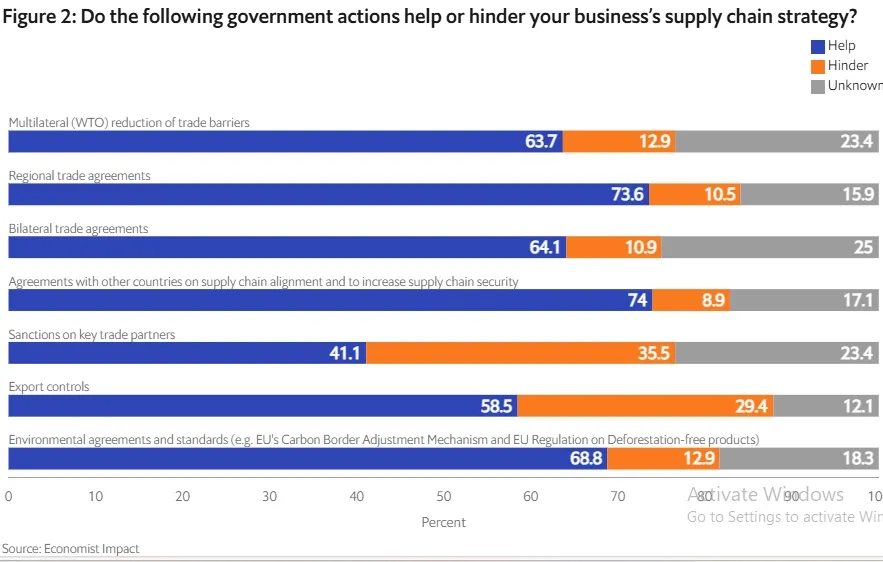
This analysis has brought out some key concerns that needs reflections
First it is clear that Trade agreements do not originate from new thinking.
Instead they reflect attempts to replicate ideas and strategies that have succeeded in the past.
That is why EPAs are eerily similar to the 1885 GA in Berlin.
This requires that we study and consider trade agreements within their broader historical context.
Secondly the persistence of the two major European powers that have great influence over Africa-the EU and UK, was indeed not just about accomplishing their goal of securing raw materials for their own industries, but a strategy to wear out and finally divide the continent. The concept of divide and conquer is alive, and it is becoming clear that attempts are unity-both in trade and politics- will face severe resistance from those that benefit from the divisions.
This calls for African countries to invest more in securing any gains at unity and collective voice. By dividing the EAC, for example, the EU and UK have succeeded in nearly dismantling not just the trade agreements that have been the backbone of the region, but other progress such as those on monetary and political union are now facing a serious threat.
Trade agreements alone are not the instruments of control. The non-tariff barriers deserve our greatest attention just as much as the Trade Agreements. Africa should direct just as much efforts to challenging EUDR as they do to EPAs, because both are instruments that serve to undermine fair trade.
There are also significant opportunities for African farmers to trade with one another.
Africa has 33% of the world’s remaining arable land and 66% of the world’s fresh waters.
These are critical assets that the continent should not just exploit to the full, but ensure are preserved for the benefit of its own society. The pre-occupation with exports of primary goods such as agricultural products will continue to play into the hands of those who would like to see Africa remain poor. A typical bag of Maize in Kenya, for example, costs $21 while the cheapest car from Germany costs $ 30,000. A Maize farmer relying on exports to Europe of maize that is none processed will need 1,428 bags of maize to just buy a single car from Germany.
If a wheat farmer is to buy a Combine Harvester from Italy to prepare his wheat for export, he will need 7500 bags of wheat. Africa must resist the temptation to enter into agreements that give up raw materials in exchange for equipment with which we produce raw materials. The fight to challenge and defeat the EPAs is, for Africa, about its very existence.
There are already several agreements that have not only been signed, but ratified. This does not mean that there are no opportunities to stop them. Many of these Trade Agreements, including the 14 EPAs with the EU and the EPAs with the UK, have provisions for amendment and review. Africa should not consider the current state a lost battle.
Addressing Internal Barriers To Trade
There are three major categories of obstacles to intra-African trade, namely, weak productive capacities and limited economic diversification, which constricts the range of intermediate and final goods that can be traded and potentially inhibits the fuller development of regional value chains; tariff-related trade costs, associated with the slow implementation of the tariff liberalization schedules underpinning free trade agreements; and high non-tariff-related trade costs that hamper the competitiveness of firms and economies in Africa.
However, it is key to note that trade agreements that solely emphasizes the removal of tariff and non-tariff barriers, on its own, cannot deliver on the stated goals of promoting sustainable development for the continent, but should be accompanied by the building of productive capacities, the acceleration of structural transformation and the unleashing of the potential of the private sector. Indeed, developmental trade agreements (a development-based approach to FTAs) in Africa is necessary to ensure sustainability in the continent’s regional integration process, in order for it to culminate in the creation of an African economic community. Africa needs deeper integration that goes beyond preferential tariff liberalization alone. In addition to this, critical requirements will include fostering domestic entrepreneurship, domestic resource mobilization, political stability and peace, and establishing appropriate institutional structures and mechanisms to ensure an equitable distribution of socioeconomic costs and benefits across all 54 countries in Africa in a way that is politically acceptable to all.
On the ACFTA
The AfCFTA offers an ambitious market opening of 90 percent, one of the highest openings globally within the context of a free trade area.
This has its benefits.
But there is also the danger of big players displacing weaker ones because the scope for protecting local producers is limited.
There is also a weak interface of the AfCFTA framework agreement with the other policies and initiatives that already exist and those that need to be put in place to build productive capacities in the domestic economies, and to ensure that domestic producers, traders, workers, farmers, and other operators within Africa’s economies are the main beneficiaries and engines of Africa's transformation under the AfCFTA. Some of those policies and initiatives already in place include continent-wide policies such as the African Mining Vision (AMV), the Comprehensive African Agriculture Development Programme (CAADP), the Accelerated Industrial Development for Africa (AIDA) and the Action Plan to Boosting Inter-African Trade (BIAT) as well other continent wide and regional level policies related to infrastructure such as energy, transport, finance among others.
Africa also has a week infrastructure base for the movement of goods across the continent. There are three pillars of integration namely the productive capacity, the trade infrastructure and the tariffs liberalisation. Programmes for the pillars of production capacity such as Boosting Intra-Africa Trade, the Accelerated Industrial Development (AIDA) and Programme for Infrastructural Development in Africa (PIDA), have seen very little progress.
In addition to the above the internal initiatives are undermined by external agreements such as the EPAs, the US STIP and other MOUs with regions and countries. The AfCFTA unfortunately, has internalised the EPAs against expert advice to put a moratorium on all external agreements until Africa’s internal agreements were concluded. In this sense the EPA, really poses a grave danger; as it undermines everything that a country needs to have a trade agreement that is truly developmental in a number of ways. All the EPAs are seeking the same purpose namely i) market access for Europe’s manufactured products and services among others and ii) seeking a pole position in securing raw materials from Africa for Europe’s manufacturing sector.
Summary Conclusions
- Trade Agreements as Instruments of Control:
Trade agreements between Africa and stronger economies, such as the EU and UK, have historically favored external interests over African development. These agreements often perpetuate Africa's reliance on raw material exports while failing to support value addition or industrialization, leaving the continent economically vulnerable. - Impact on Farmers and Agriculture:
African farmers are disproportionately disadvantaged under agreements like EPAs. Delays in tariff reductions, the exclusion of key agricultural products, and unequal market liberalization create barriers to growth. Subsidized EU imports overwhelm local markets, undermining agricultural sustainability and reducing the competitiveness of African farmers. - Missed Opportunities for Regional Trade:
Intra-African trade agreements, such as ACFTA and regional bloc arrangements, offer better opportunities for growth, including value addition and cross-border agricultural trade. However, these potential gains are undermined by external trade agreements like EPAs, which prioritize liberalization over Africa's industrialization and regional integration. - Persistent Imbalances in Global Trade:
Africa's dependence on extractive industries has been reinforced by trade agreements that fail to foster diversification. This systemic imbalance limits the continent’s economic transformation while exacerbating migration and poverty.
Specific Recommendations on boosting Smallholder farmer’s participation in Trade Agreements
ACFTA and Regional Trading Blocs (RECs)
Address the weak productive capacities: Addressing supply-side constraints and weak productive capacities is a policy imperative in Africa to boost intraregional trade through the development of regional value chains. Such chains can be a critical vehicle for spreading the economic benefits of African trade (e.g. jobs in the formal sector and gains from manufacturing) to a wider set of countries, if they participate in such value chains and gain opportunities to upgrade technologically and move up within the value chains (UNCTAD, 2019). The potential for converting primary commodities in Africa, including agricultural materials, into industrially processed finished products within regional value chains remains largely untapped. This should be addressed by scaling up the implementation of the Action Plan for Boosting Intra-African Trade of the African Union includes a productive capacities cluster with the objective of creating “regional and continental value chains/complementarity, to increase local production/trade in goods produced in Africa”.
Eliminate Tariff-related trade costs: Whereas advances in trade liberalization are being made across all regional economic communities, the liberalization of tariffs within Africa regional communities has been slow, due in part to human and institutional capacity constraints in trade policy implementation, and also to a lack of operationalization of regional economic community agreements. According to the Abuja treaty, all regional economic communities should have established a common external tariff within customs unions and fully functional free trade agreements by end-2017. This has not yet occurred. For example, among all communities, ECCAS has the lowest share of intraregional trade in its total trade in Africa and would need to reduce on average 66 per cent of its tariff lines on intra-ECCAS tariffs to zero. In the other communities, the proportion of tariff lines on intraregional tariffs that have yet to be reduced to zero are 90 per cent in ECOWAS, 85 per cent in SADC, 78 per cent in IGAD, 51 per cent in AMU, 45 per cent in COMESA (UNCTAD, 2019).
Increase production capacities at national level: Zero liberalization of tariffs among regional economic community members or among countries in Africa will not automatically result in increased intra-regional economic community and intra- African trade. Some member countries, as exporters, may not fully utilize the preferential tariff lines under which tariffs have been reduced, because their export supply capacities in these lines are weak.
Going Forward: Proposals for Advocacy and Coalition Building
There are three scenarios that are likely to play out over the next coming years for Africa.
8.1 Scenarios
Scenario 1: EPAs Become the Primary Trade Agreement for Africa’s 48 Countries
While this may have seemed unlikely a few years ago because the long period that African governments were able to resist the EPAs, this appears to likely scenario.
In just 3 years three countries have either signed or ratified, or been bulldozed into doing so by both the EU and the UK. Kenya held out since 2014. But in just one year it not only ratified, but begun the process of implementation of two EPAs. Rwanda and Cape Verde are also in the process of acceding to the EPAs, despite qualifying for alternative and more favourable trade agreements
Under these scenario it is clear that Stakeholders, especially civic actors, will need to challenge to push the EPAs across multiple countries as well as in the UK and EU.
In practice this scenario will require resuscitating the “STOP EPAs” campaign that ran for a decade and was led by a broad coalition from both Africa and European Civic actors.
The Key actions required under this scenario are as follows
1. Assess and Review the STOP EPAS campaign with a view to finding out if a similar campaign can be put together.
2. Challenge the EPAs on the basis of their contradiction and undermining of key Global and EU policies including the Agenda 2030, Pact For the Future and Migration.
3. Target countries that are vulnerable and likely to succumb to EU and UK Pressure, and support their voices at Global Platforms.
3. Create a citizen-driven advocacy targeting the Diaspora at European countries.
Scenario 2: Only Current EPAs remain and there is a halt or considerable slowdown to Future EPAs
Under these scenario there are significant provisions within current EPAs to engage and even consider their amendments.
There are several Dialogue Spaces opportunities for dialogue within both the EU and UK EPA for engagement
- Article 60 of the UK EPA creates a mechanism known as Dialogue on Agriculture and Rural Development Policy. This is a space for bringing up concerns and issues related to Agriculture in the EPA
- The Department of International Partnership responsible for Farming Systems and Agriculture is also open for dialogue on issues around Agriculture in the EU EPAs .EAC firms and businesses as part of creating increased benefit from the EU EPA by mainstreaming MSMEs into mainstream businesses
- Article 86 (a) creates an East Africa Private Sector Dialogue while Article 86 (c) explicit states that there will be deliberate efforts to promote
- Article 102 establishes the EPA Fund, although the UK is not obligated to work through it or put funds into it.
- Article 104 creates an EPA Council at Ministerial Level. The Council will oversee the Implementation of the EPAs and is the main oversight body
- The Council is supported by the EPA Senior Officials Forum created by Article 106 and composed of Permanent Secretaries and “Senior UK Officials”
- Article 108 creates the EPA Consultative Committee open to all Stakeholders, including civic actors.
Public Interest Litigation
It is possible to support an African government to present a series of limitations and dispute issues under Article 109 to 125. Although Article 126 bars any aggrieved party from going to the WTO dispute mechanism before exhausting that within the Agreement it is possible to escalate issues of dispute to the WTO. This is a guaranteed failure because the WTO dispute mechanism has been paralyzed by the refusal by the US to approve judges for the appellant body. But it is significant profile and public awareness, and an embarrassment to the EU and UK to be dragged to the Dispute mechanisms by multiple countries.
Article 142 allows for any party to the agreement to raise amendments to the EPA. This is a window that African civic actors in partnership with member states.
Scenario 3: EPAs are stopped
This will only be an outcome of scenario 1 advocacy, or by radical shifts in government in the EU or UK. It is also possible by lobbying EU parliamentarians to raise concerns and objections.
8.2 Proposed Coalition Action Plans and Scenarios Above
In addition to the responses under each of the above scenarios there are also key advocacy strategies that can be employed by the Coalition.
The first strategy is to use this Report as an advocacy Tool.
This requires several options
1. Multiple Launches and significant events and spaces
There are several such spaces
Inauguration of the AUC Chair in 2025
Meeting of the Ministerial Session of the Follow up to the Samoa Agreement scheduled for 2025
The Various Meetings of the Africa Caribbean and Pacific Countries scheduled for 2025
Joint Launch with European and UK Political Party Think Tanks
Key events such as G 20 meeting in South Africa in 2025
2. Media Communication- This will be an effective strategy to ensure an understanding among citizen across Africa of what is at stake
8.3 Coalition Members
The Following Organizations have expressed an Interest to be Part of the Coalition
Europe/Global
- Solidar- A citizen mobilization Organization known for its public campaigns with across Europe
- Foundation for European Progressive Studies (FEPS)- The Think Tank for the Current EU Parliamentary Majority- Democrats and Labour
- Wilde Ganzen- Supporting partners across East Africa
- EU High Level Group on Policy Innovation
- CNV- The Think Tanks for International Trade Unions.
- Global Federation of Employers
- EU CORD- Network of Religious Organizations in Europe
- New Direction
Africa
- Action Aid
- Oxfam Africa
- Third Word Network
- TRALAC
- Mozambique Association for Promotion of Modern Cooperatives
- IUTC (Global)
- Policy Forum (Tanzania)
- Third World Network (Ghana)
- The Biodiversity and Biosafety Association of Kenya (BIBA Kenya)
- Centre for Consumer Action, Research & Training (CUTS/ CART)
- Nawi Africa Macroeconomic Collective
- Southern and Eastern Africa Trade Information and Negotiations Institute (SEATINI)
- Alliance For Food Sovereignty in Africa
- Policy Forum- Tanzania
- Africa Coalition on Food Sovereignty in Africa
- Akina Mama wa Afrika
Annexes
Annex 1: Concessions Among the Regional Economic Communities/Member states: Opportunities and Risks for Small Scale Farmers
Some of the Agricultural products Liberalized and Excluded under AfCFTA RECs | Category A (90percent )-non-sensitive products | Category B (7percent )-sensitive Products | Category C (3percent )- Exclusion list |
EAC[5] | Live cattle, Live sheep and goats, live poultry, pork, mutton, goat meat, Natural honey, Bulbs, tubers, tuberous roots, potatoes (including seed), tomatoes, Onions, shallots, garlic, Cabbages, cauliflowers, Carrots and turnips, peas, beans, mushrooms, Sweet corn, chicken peas, cowpeas, kidney beans, Manioc (cassava), sweet potatoes, yam, nuts (hazel, coconut, cashew, cola, chestnut), Bananas, including plantains, Dates, figs, pineapples, avocados, guavas, mangoes (fresh or dried), papaws, apples, coffee, tea, Starch (maize, cassava, wheat, potato), ground nuts, palm nut & kernels, cocoa beans, Couscous, Food supplements, baobab (dry and powder) | Still under negotiation | Still under negotiation |
CEMAC[6] | Beef, pork, lamb, goat meat, fresh chicken meat, malt extract, pasta, tapioca & prepared, foods containing, cereals, preserved sardines & anchovies, cereal flours, sugar, tea, coffee, garlic, butter, processed cheese, gouda & cheddar, skimmed & full-fat milk & cream | Still being negotiated | Still being negotiated |
ECOWAS[7] | Live cattle, Live sheep and goats, live poultry, Beef, pork, chicken, mutton, goat meat, fish (live & frozen, excluding fish fillets), Buttermilk, Powder milk, Grated or powdered cheese, Peas, Mushrooms, Sweet corn, Manioc (Cassava), Sweet Potatoes, Yams, Fresh and dried bananas and plantains, Dates, Avocadoes, Coffee (roasted or not, or decaffeinated), Tea, Pepper (dried or crushed), Ginger, Wheat, Barley, Maize (corn) of seed or flour, Rice (of grain or flour), Sorghum (of seed or flour), Millet (of seed or flour), Soya beans, Sunflower seeds, and Ground nuts among others. | Still being negotiated | Still being negotiated |
Table 3. Source: Author's compilation
Annex 2 Key Provisions in the EAC-EU EPA and Implications
Article | Interpretation | Implications for the EAC |
Rendezvous (Article 3) | The Parties undertake to conclude the negotiations in areas of services, investment, government procurement, trade and sustainable development, intellectual property rights and competition policy and conclude within five years upon entry into force of the EPA. This commitment is neither required by the Cotonou Agreement nor for WTO-compatibility, | This commitment would have further shrunk EAC partner states’ policy space needed for promoting sustainable development. For example:
|
Exports Duties and Taxes (Article 14) | This Article prohibits either parties to introduce any new duties or increase existing ones in connection with the exportation of goods to either Party. | The logic of export taxes is to encourage producers to enter into value-added processing, hence encouraging diversification and the upgradation of production capacities. While the Article allows EAC Partner States to impose, after notifying the EU, a temporary duty or tax in connection with the exportation of goods, the time granted for such an imposition (48 months) is so limited to enable EAC partner states effectively nurture their industries and enhance her competiveness. Moreover, at the Word Trade Organisation (WTO), export taxes are completely legal. Also, there is ample evidence that all today’s rich countries got rich through using nationalistic policies (e.g. tariffs and restrictions on foreign trade) in order to nurture their infant industries, and only liberalized after they had attained a level of competitiveness. It should also be noted that the underlying reasons for the EU’s desire for disciplines in EPAs on export taxes are evident from its Raw Materials Initiative. However, raw materials security for the EU should not be at the cost of the EAC’s development aspirations. |
More Favourable Treatment (MFN) resulting from a Free Trade Agreement (Article 15). | Under this article, the EAC is obliged to extend to the EU any more favorable treatment resulting from a preferential trade agreement with a major trading economy/country | This circumscribes EAC’s external trade relations and will undermine the prospects of South- South trade which the EAC is aspiring to promote. In addition, the clause is contrary to the spirit of the WTO’s Enabling Clause that promotes Special and Differential Treatment for developing countries and South- South cooperation. |
Domestic policy measures (Article 68): | Falling under the Agriculture chapter, this article states that the EU shall not grant export subsidies for all agricultural products to EAC Partner States, as from the entry into force of the EPA | This prohibition shall be reviewed by the EPA Council after 48 months. This means that after 48 months, EAC economies will be more exposed to EU’s dumping of subsidised agricultural products to the detriment of agricultural producers in the EAC. In order for the EAC to be able to nurture her Agriculture sector, there should be no review of the prohibition of export subsidies for all EU agricultural products to EAC Partner States. |
Standstill (Article 12) | The Parties agree not to increase their applied customs duties for products subject to liberalisation under the EPA. | The zero rating of products and the Standstill clause (Article 12) effectively constrain the policy space for the region to achieve this aspiration. It should also be noted that the 25 years provided for the completion of liberalization process may appear long in the life of an individual but it is actually a short period in the life of a nation. |
Multilateral safeguards (Article 49) | Both parties are allowed to impose multilateral and bilateral safeguards for protection against import surges | The safeguards provided are very cumbersome to invoke as a party has to prove import surges and injury, and establish a causal relationship between the surges and injury to the whole industry. The country must also have in place an investigative mechanism which is difficult to establish. This is why developing countries have not invoked these remedies in the WTO and are also demanding for a special safeguard mechanism for agriculture which is user friendly |
Bilateral safeguards (Article 50) |
Annex 3: Beyond EPAs: EU Policies Affecting Farmers in Africa
1. European Union Deforestation-Free Supply Chains (Regulation (EU) 2023/1115)
(Suspended For 12 months until 2026)
What it is
This is a law that bans imports into the European Union of agricultural products originating from land deforested, or that had been gazette as a Forest, since December 31, 2020.
What Products are affected?
The products include-but not limited to-soy, beef, palm oil, wood, cocoa, coffee, rubber, charcoal, as well as derived products such as leather, chocolate, and furniture.
Who is Responsible for Due Diligence?
It places the responsibility on companies selling goods to the EU to provide a due diligence statement and “verifiable” evidence proving their products were not grown on deforested land post-2020, under the risk of substantial fines.
What is involved in practice:
1. Companies to digitally map their supply chains down to the plot where the raw materials were grown, which could potentially involve tracing millions of small farms in remote regions. The consequence is exclusion of farmers who lack the technology and resources for this remapping.
2. Companies often don't deal directly with farmers, they must now get middle men to also comply and have an oversight mechanism
Impact on Farmers
While on the surface this appears like a desire to combat deforestation the fact that the EU and its OECD partners hold both the technology and the determinants of what qualifies as “deforestation” places farmers outside Europe at a significant disadvantage
Immediate Consequence
Already importers of coffee to the EU are starting to scale back purchases from small farmers in Africa because complying with (EUDR), is both expensive and cumbersome.
In Ethiopia companies selling to Europe are not interested in coffee from Oromia Coffee Farmers' Cooperatives Union, according to a recent World Coffee Alliance webinar. There is already a drying-up of orders in recent months for coffee from other parts of Ethiopia as well, where some 5 million farming families rely on the crop. Coffee generates 30-35% of Ethiopia's total export earnings, with almost a quarter sold to the EU
In Ivory Coast and Ghana, which produce nearly 70% of the world's cocoa, compliance costs throughout the supply chain are have already raised their supply costs. Half of Ivory Coast's crop, for example, is sold by local intermediaries and thus difficult to trace. Grown mostly for EU consumption, it cannot be completely redirected to Asia as chocolate is less popular there.
The problem for Ivory Coast is that 20-30% of its cocoa is grown in protected forests by nearly one million people. Denying them their livelihood could cause social unrest, while relocating them is unfeasible without major funding and support.
Ivory Coast tried to reclassify its protected forests, but the EU publicly called on the country to desist
Potential Consequences
Technology and Intellectual Property Costs
The law is forcing countries to acquire gadgets such as phones, and ensure mandatory connectivity for mapping purposes
Escalating Conflicts
There is potential for escalation of disputes because most of Africa land is communal, with no titles and not traced to an individual or group of farmers. This law will now force farmers to not only subdivide land for purposes of titles, it has the potential to exacerbate conflicts in areas where there are already disputes over land ownership
2. EU and Organic Food/Ban on Use of Agricultural Chemicals
The EU set out an ambitious goal to triple the amount of land farmed organically in the EU by 2030, as outlined in the EU’s flagship food policy, the Farm to Fork (F2F) strategy, and a new organic action plan,
What is it?
This rule is a contradiction of sorts. It allows European companies to manufacture and export fertilizer, but does not allow food grown with fertilizer or certain chemicals to be imported to the EU market.
Who is affected?
This policy has severe implications for farmers, especially those in the Tropics and must use chemicals to deal with weed and rely on synthetic fertilizer to enhance their yields
Kenya, for example could lose more than (€1.2 billion) if the ban on the use of agricultural chemicals comes into force, argues the Tegemeo Institute of Research and Policy, based at Egerton University
3. Sustainable Aviation Fuels Guide 090418 Regulation No. 12 CORSIA
Technically this is not an EU Regulation.
But it is the EU that has championed the Regulation, and has stated that it will make the law a requirement as of May 2026.
What it is
As part of the International Civil Aviation Organization strategy to reduce carbon emissions it has developed Regulation No. 12 CORSIA. This is a new regulation with profound effect on airline operators.
What it means
From 2026 the European Union will start requiring airlines flying to Europe to blend Jet A1 (airline fuel) with sustainable aviation fuel (SAF). Other jurisdictions are also in the process of implementing these mandates. In 2028 every international airline will be required by ICAO to implement Carbon reduction measures.
From 2028 all airlines will be required to report their carbon footprint under CORSIA program (carbon offsetting reduction scheme for international aviation)….our CORSIA regulations bringing to effect annex16 part 4 of the Chicago Convention, are before the AG. ….as much as there are 5 pathways to reduce carbon, the only one that is within our reach is biofuels.
How it works
To reduce carbon footprint, airlines are required to reduce and completely replace fossil fuels….that is the Jet A1. ….this ICAO recommended practice pushed by Europe and resisted by China, is soon going to be a standard regulation.
Implications for farmers and Food Security in Africa
This regulation will have three primary consequences
First, Africa will be forced to put more land to cereals and other agricultural produce specifically to enable them generate enough qualities for their airlines
This is going to seriously affect cereals production and supply. In addition to creating competition between cereals for consumption and fuel for Biofuel, it will will have a significant impact on process of cereals, severely affecting the continent
Studies have identified a nexus between biofuel production intensification and food price hikes in the international market
It is also worth noting that the alternative to fossil fuel (bio-fuel) is expensive to produce and requires technology that does not reside on the continent.
It therefore means that cereals export to Europe will increase dramatically, significantly impacting the supply of this commodities.
Annex 4 South -South Trade: Understanding the Limitations
Historical and Structural Challenges: South-to-South trade remains low due to historical and structural impediments rooted in colonial legacies and economic dependency. Many countries in the Global South—Latin America, Africa, and parts of Asia—were historically structured as exporters of raw materials to developed nations. Colonial systems established trade networks that favored North-to-South trade, leaving South-to-South networks underdeveloped. Post-independence, these economies continued to prioritize exports to high-income Northern markets due to better-established infrastructure, trade agreements, and higher prices for primary goods. For example, African countries often export cocoa, coffee, and minerals to Europe instead of trading them within the continent. Similarly, Latin American nations like Brazil and Argentina export agricultural produce to the U.S. and Europe rather than their neighbors. The lack of diversification in production capacities among Southern economies also leads to limited complementarity of goods, reducing incentives for inter-South trade.
Poor Infrastructure and Connectivity: Inadequate infrastructure significantly hampers South-to-South trade. Poor transportation networks, inefficient ports, and insufficient logistics systems make it costlier to trade between Southern countries compared to trading with Northern partners. For instance, shipping goods between African nations often requires routing through European ports due to limited direct links, driving up costs and delays. Similarly, the weak road and rail networks in parts of Asia and Africa inhibit the flow of goods. Intra-regional trade agreements in the Global South, such as the African Continental Free Trade Area (AfCFTA), aim to address these bottlenecks. However, without robust infrastructure investments, these agreements struggle to facilitate seamless trade. Digital infrastructure disparities further exacerbate the problem, as many Southern countries lack advanced e-commerce systems that enable competitive cross-border transactions.
Trade Barriers and Protectionism: South-to-South trade also suffers from high trade barriers and protectionist policies. Many countries in the Global South impose high tariffs, non-tariff barriers, and stringent customs procedures to protect nascent industries, which inadvertently stifle regional trade. For example, tariffs within Africa are often higher than those between Africa and Europe or Asia. Bureaucratic red tape at border points also slows down trade, discouraging traders from pursuing inter-South business opportunities. Additionally, regional trading blocs in the South, such as the Southern African Development Community (SADC) and the Association of Southeast Asian Nations (ASEAN), often have overlapping or conflicting policies that complicate trade harmonization. These factors reduce the ease of doing business within the South and push traders toward Northern markets with clearer regulations and incentives
Lack of Financial and Institutional Support: Limited financial and institutional support for South-to-South trade is another significant barrier. Many Southern countries face challenges such as limited access to trade financing, weak banking systems, and a lack of robust institutions to support cross-border trade. For instance, the scarcity of trade credit facilities makes it difficult for small and medium-sized enterprises (SMEs)—which dominate Southern economies—to engage in regional trade. Institutions such as the African Export-Import Bank (Afreximbank) and the Asian Infrastructure Investment Bank (AIIB) are making efforts to bridge these gaps, but their reach remains insufficient. Moreover, currency instability and the absence of efficient currency exchange mechanisms deter trade, as transactions often require U.S. dollars or euros, increasing costs. Weak governance and corruption further exacerbate these issues, as inefficient border management systems lead to delays and additional expenses. For example, trade between East African countries like Kenya and Tanzania often faces bureaucratic hurdles despite shared regional memberships
Annex 5: Shifting the Tide: Influencing and shifting How Africa Trades
To understand how Africa trades, it is important to illuminate the current context of intra-Africa trade. In interpreting shares of intra-African trade in total trade, there are three aspects to consider. First, there is evidence to suggest that intra-African trade may be subject to double counting, amounting to 7 per cent of intra- regional economic community exports and 9 per cent of intra-regional economic community imports, owing to overlapping memberships (UNCTAD, 2019). Second, intra-African trade is likely to be underestimated due to the prevalence of informal trade. Third, increases in intra-African trade may not necessarily be welfare-improving if most intraregional trade displaces cheaper extra-regional trade (i.e. the trade diversion effect). For intra-African trade to be welfare-improving, the trade creation resulting from increased intra-African trade must be greater than trade diversion.
Intra-Africa trade has been rising though at a slower pace. In 2022, the value of intra-African trade increased to about US$185.1billion from US$169.9 billion in 2021 after two years of declines (Afreximbank, 2024). In 2023, intra-African trade remained on the upward trajectory, increasing to US$189.3 billion (Afreximbank, 2024). Southern Africa recorded the most impressive growth in trade with other countries around the African region, accounting for 41 percent of intra-African trade in 2023, slightly down from 43 percent in 2022 (Afreximbank, 2024). West Africa emerged as the second largest contributor to trade within Africa, accounting for 25.6 percent of its trade within the continent in 2023, slightly up from 24.1 percent in 2022 (Afreximbank, 2024). Furthermore, in 2023, intra-EAC trade growing by 13.1percent to US$12.1 billion which largely falls below the target of 40percent by 2030 (EAC Secretariat, 2024). In 2023, South Africa was the largest intra-African trading nation, with its share of the continent trade reaching 20.7 percent, followed by Côte d’Ivoire, Egypt, and Nigeria, accounting for 8.4 percent, 4.8 percent, and 4.6 percent, respectively (Afreximbank, 2024).
From the above statistics, one can deduce that the level of intra-regional economic community trade in Africa differs between communities, reflecting economic factors such as differences in stages of industrial and economic development and degrees of complementarity in production structures; differences in the state of political relations among member countries; and varying levels of political commitment towards the implementation of the agreements underpinning the regional economic communities. Progress towards the regional integration of Africa has been uneven to date, with some countries fairly well integrated at the regional and/ or subregional level and others much less so. Countries that have more diversified exports tend to have higher shares of intra-African exports than countries that have less diversified exports (UNCTAD, 2019). Therefore, diversifying the range of goods produced within countries in Africa creates greater possibilities for intraregional trade.
It is also key to note that intra-African trade is more intensive in [agricultural and non-agricultural] manufactures than trade between Africa and the rest of the world as the latter is dominated by primary commodities (UNCTAD, 2019). This provides an impetus for promoting agro-industrialisation on the continent as provided under the CAADP Malabo Declaration on Accelerated Agricultural Growth and Transformation for Shared Prosperity and Improved Livelihoods. Thus, trade agreements like the AfCFTA can potentially boost intra-African trade by increasing the economic viability of industrialization on the continent and accelerating structural transformation, with commensurate positive effects on product diversification. However, the development of regional value chains in Africa will depend on the implementation of national and regional industrial policies that promote diversification in the range of goods produced, both intermediate and final. Indeed, integrating smallholder farmers in regional, AfCFTA and other markets will require addressing the core limitations to their competitive participation.
There are three major categories of obstacles to intra-African trade, namely, weak productive capacities and limited economic diversification, which constricts the range of intermediate and final goods that can be traded and potentially inhibits the fuller development of regional value chains; tariff-related trade costs, associated with the slow implementation of the tariff liberalization schedules underpinning free trade agreements; and high non-tariff-related trade costs that hamper the competitiveness of firms and economies in Africa. However, it is key to note that trade agreements that solely emphasizes the removal of tariff and non-tariff barriers, on its own, cannot deliver on the stated goals of promoting sustainable development for the continent, but should be accompanied by the building of productive capacities, the acceleration of structural transformation and the unleashing of the potential of the private sector. Indeed, developmental trade agreements (a development-based approach to FTAs) in Africa is necessary to ensure sustainability in the continent’s regional integration process, in order for it to culminate in the creation of an African economic community. Africa needs deeper integration that goes beyond preferential tariff liberalization alone. In addition to this, critical requirements will include fostering domestic entrepreneurship, domestic resource mobilization, political stability and peace, and establishing appropriate institutional structures and mechanisms to ensure an equitable distribution of socioeconomic costs and benefits across all 54 countries in Africa in a way that is politically acceptable to all.
Annex 6: Policy Advocacy Influencing Strategy: Implications for Coalition Building at National, Regional and Global levels
Addressing the above identified limitations to small-holder farmers’ competitive utilization of the aforementioned markets will require robust policy advocacy and coalition building. Policy advocacy plays a pivotal role in shaping equitable trade environments and improving livelihoods. In this context, it ensures that trade agreements and processes are crafted in inclusive manner by prioritizing the often-marginalized actors like smallholder farmers through addressing the challenges they face to competitively engage in markets. More specifically, for smallholder farmers and workers in Africa, advocacy is essential to address structural challenges such as limited market access, inequitable policies, and systemic exclusion from decision-making processes. This chapter explores detailed strategies for policy advocacy, the nuances of coalition building, and actionable examples that illustrate their application in advancing trade equity for these groups.
Conceptual Framework and Strategic Objectives
Policy advocacy is the structured process of influencing public policies to create favorable outcomes for marginalized or disadvantaged groups. In the context of smallholder farmers and workers in Africa, the overarching objectives could include creating just market systems by addressing trade inequities; securing policy reforms to promote sustainable practices; and enhancing the agency of smallholders and workers in decision-making. To achieve these goals, policy advocacy often involves a multi-faceted approach, including evidence-based research, strategic communication, and coalition building. Research plays a critical role by providing credible data and analysis to support policy recommendations. For instance, identifying barriers such as limited access to markets, unfair trade terms, or climate vulnerabilities can form the basis for targeted interventions.
Strategic communication ensures that the voices of smallholders and workers are amplified. By crafting compelling narratives, stakeholders can shift public perception, garner media attention, and pressure policymakers to prioritize inclusive trade policies. This is particularly important in countering the dominance of powerful agribusiness lobbies, which often overshadow the needs of smaller players in the global trade system. Coalition building is another essential strategy. By uniting diverse stakeholders such as farmer cooperatives, trade unions, civil society organizations, and even sympathetic policymakers, advocates can pool resources, share expertise, and present a unified front. A well-coordinated coalition increases the likelihood of sustained impact by ensuring that advocacy efforts resonate across multiple platforms and stakeholders. Ultimately, successful policy advocacy requires a long-term vision and a commitment to equity and sustainability. By addressing systemic inequities and empowering smallholder farmers and workers, policy advocacy can help create a more just and resilient agricultural system that benefits not only Africa but the global community.
The Stakeholders and their interrelationships
Three political agencies and their mutual interaction shape the parameters of societal change in Africa. At one pole are small-scale farmers, small producers, workers, domestic producers, industry and businesses, traders, local communities, and other vulnerable, oppressed and/or marginalized socio- economic constituencies. These make up the major groupings of society whose conditions of life and work have been shaped within the structural dynamics of Africa’s economies and negatively affected by decades of economic deregulation. Within these, the position of women has been aggravated by relations of gender imbalance and resultant gender inequality and inequity.
At the other pole are the business and economic interests of the advanced industrial North and their allies among Africa’s elites. Corporate entities, principally transnational corporations, seek unregulated access to the resources and economies of Africa. Their significant influence over governments of the advanced industrial North has translated into policies, which are then promoted through the international institutions of economic policy decision-making over which northern government wield disproportionate influence. These institutions operate at the national and continental level in Africa along with their allies, the few social-economic groups which have made relative gains from ongoing policies of deregulation. In between these two are the third pole: African governments. While governments derive their ultimate legitimacy from the extent to which they meet the needs and aspirations of society as a whole, the smaller group of corporate business interests and elites exercise disproportionate influence over these governments and their policy choices. This is due to their control over economic resources and better access to the machinery of government.
As citizens, the poor, marginalised and vulnerable have inalienable rights to the fulfilment of their needs and aspirations. This asymmetrical organisation of socio- economic and political power, however, ensures that the social resources and means for meeting these needs and aspirations are disproportionately appropriated by those sections of society with privileged access to government. Addressing this power imbalance and influence in favour of the first group constitutes the strategic challenge for social change. Fundamental to accomplishing this change is the self-organisation of the marginalised social and economic groups, through collective efforts, with support in the humanity and solidarity of others, in line with the principles of equality and equity.
Core Strategies for Policy Advocacy Influencing
Effective advocacy requires combining evidence, communication, and multi-stakeholder approaches to achieve systemic change. The following several strategies can be considered.
Evidence-Based Advocacy: One of the key ingredients for evidence-based advocacy is to have data-driven policy proposals. Effective advocacy begins with gathering evidence that highlights disparities in the trade system. For instance, documenting how export taxes on agricultural produce disproportionately affect smallholder farmers can form the basis for policy dialogue. This is important because over the past, the African Union (AU) has leveraged agricultural trade data in the Malabo Declaration to lobby for increased investment in agriculture, influencing policy commitments from member states (African Union, 2024). During the documentation, it is important to use personal stories and local case studies to provide relatable narratives. For example, documenting the voices of Igire Coffee in Rwanda and how it has worked with [its out growers] small-scale farmers to trade under the AfCFTA Guided Trade Initiative (Walakira & Mushiri, 2023) can serve as a powerful example to support the expansion of Rwanda’s national AfCFTA Implementation strategy. Furthermore, to achieve reliable data on impactful stories, Fair Trade partners should leverage research collaborations with academic institutions to enhance credibility. For example, the collaboration between Southern and Eastern Africa Trade Information and Negotiations Institute (SEATINI) and Ministry of Trade in Uganda and EAC Secretariat has been instrumental in formulating negotiating positions in trade negotiations like EPAs, WTO and AfCFTA (SEATINI, 2021).
Stakeholder Engagement: Achieving pro-farmer trade agreements and processes necessitates proactive mobilization of state and non-state actors to engage in these processes. This will require stakeholder mapping and prioritization. A stakeholder analysis ensures the identification of key actors, such as policymakers, NGOs, donor agencies, and private sector players, whose interests influence policy outcomes. For example, by mobilizing organic farmers to showcase their successes, the Alliance for Food Sovereignty (AFSA) has been able to support agroecological farmers to lobby for more stringent policy to protect and diversify agriculture in Kenya (AFSA, 2024). What is key to note is that involving smallholder farmers in policy dialogues ensures their concerns are authentically represented. This participatory model was effectively used during the formulation of Tanzania's Agricultural Sector Development Strategy II (AFSA, 2024). Inclusive stakeholder engagement strategy has worked well in sustaining the Oxfam Make Trade Fair [Say no to EPAs] even when the project ended, and can be emulated.
Oxfam's Make Trade Fair campaign which officially ended in 2009 began in 2002. The campaign aimed to address global trade injustices and advocated for changes to international trade rules to benefit small-scale farmers, workers, and producers in developing countries. In Africa, the campaign supported and mobilized CSOs, Trade Unions, Farmers Organisations and think tanks to mobilize against the Economic Partnership Agreement (EPAs) under the #SayNoToEPAs campaign. It supported knowledge publication and dissemination, including coalition building from grass-root to continental level to effectively engage EPA negotiators. Even with the end of the campaign, CSO networks which it supported e.g. Africa Trade Network (ATN) and East Africa Trade Network (EATN) have continued to proactively lobby against problematic EPA provisions and have evolved to work on Investment and Tax treaties. This can be emulated by Fair Trade partners. |
Understanding the Engagement structures at global, regional and national level to aid effective CSOs participation
- Negotiating groups in the WTO: Within the WTO, the physical presence of country trade policy negotiators in Geneva at the WTO carries opportunity for effectiveness and quality of legal and institutional participation of different stakeholders. But in order to even strengthen their voice and promote coherence in negotiating positions, a number of countries have formed coalitions in the WTO. These groups often speak with one voice using a single coordinator or negotiating team. Key of the groups where the global south countries belong include: African, Caribbean and Pacific countries (ACP) group; African group; Asian developing members; Asia-Pacific Economic Cooperation forum (APEC); G-90 (African Group + ACP + Least-Developed Countries); Least-Developed Countries (LDCs) group; Cotton-4 (West African coalition seeking cuts in cotton subsidies and tariffs); and Pacific Group among others. While engagement in these groups is by governments or those on government delegation, CSOs need to lobby their governments for inclusion on the negotiating delegation. An example of CSOs currently under the Government Official Negotiating delegation include Southern and Eastern Africa Trade Information and Negotiation Institute (SEATINI) both in Uganda and Zimbabwe, Third World Network Africa-Ghana; Zimbabwe Coalition of Churches; IT for Change-India among others. lobbying for this place is critical to ensure effective participation by CSOs in the WTO Negotiations.
- WTO Public Forum: Another critical process where CSOs can engage is the WTO Public Forum which holds every year. The Public Forum is the WTO's largest annual outreach event. It provides a unique platform for heads of states, parliamentarians, business people, students, academics and civil society to come together and debate a wide range of trade and development topics. CSOs can apply each year to attend and organize side sessions, workshops, exhibitions, share their research among others. While the Public Forum is not a negotiating Forum, it provides a building block for what WTO members eventually agree on during Ministerial Conferences.
- WTO Ministerial Conference: The Ministerial Conference is the topmost body of the WTO under the governance structure set up by the “Agreement establishing the WTO”. The Ministerial Conference usually meets every two years and brings together all members of the WTO, all of which are countries or customs unions. The Ministerial Conference can take decisions on all matters under any of the multilateral trade agreements. Twelve Ministerial Conferences have been held since the establishment of the WTO. Accredited CSOs are always allowed to participate in the Ministerial Conference, hold demonstrations, workshops, exhibitions and engage with negotiators on a daily basis, through their NGO Center.
- National and Regional level negotiating structures: There are varying engagement structures at national level in different countries and regions. However, one thing stands out, there is still limited consultation with CSOs on trade and investment related policies and processes. The table below shows select and RECs countries and their mechanisms for CSOs engagement.
Country/ Region | Mechanism of CSOs engagement |
Uganda | At the national level, individual countries have put in place several negotiation mechanisms that consist of a committee of multi stakeholders. In Uganda, for example, the Ministry of Trade, Industry and Cooperatives which handles Multilateral Trade and Investment negotiations has the National Trade Sector Advisory Council (NTSAC). Positions papers developed within this committee, form the country position. The NTSAC brings together both public sector, private sector, trade unions, civil society, Ministries, departments and Agencies to discuss trade and trade related policy issues. However, it is constrained by; lack of capacity; limited funding and limited scope of its mandate given that it was set up to focus on WTO matters only. |
Kenya | In Kenya, several consultative committees have been established. Firstly, the National Committee on the WTO which was formed in 1995 right after Kenya became signatory to the WTO in 1994. It is the main consultative forum that brings together all stakeholders from the public sector, private sector, and the civil society to discuss trade policy issues related to the WTO. The Joint Industrial and Commercial Consultative Committee (JICCC) and the Department of External Trade play a significant role in coordinating the discussions among the stakeholders; after which, the ministry draws up a cabinet memorandum seeking cabinet approval. However civil society engagement in this process was only through a separate forum, the National Development Trade Policy Forum (NDTPF). |
Tanzania | In Tanzania, the Trade Integration National Steering Committee which is chaired by the Ministry of Industry, Trade and Marketing (MITM) is responsible for providing overall strategic guidance to trade sector development and trade policy making within the framework of the Tanzania Trade Integration Strategy (TTIS). A TTIS Implementation Team led by a Team Leader and placed within MITM’s Department for Policy and Planning under the leadership of the Director for Policy and Planning is responsible for ensuring overall day-to-day coordination of the TTIS implementation effort, providing substantive support to the National Steering Committee, and monitoring the efforts of the MITM. The TTIS National Steering Committee (NSC) provides overall guidance to the implementation of the TTIS. |
East African Community (EAC) | The EAC consists of a number of engagement structures in the areas of trade and investment i.e. the EAC Secretariat; the East African Legislative Assembly under the Committee on Communication, Trade and Investment; the Sectoral Council on Trade, Industry, Finance and Investment (SCTIFI); the EAC Secretary Generals Forum; and the EAC Summit. At the national level, the EAC is represented by the Ministries of EAC Affairs. |
Southern African Development Community (SADC) | Although SADC’s engagement with CSOs tends to be fraught with difficulties, SADC does have a number of entry points for CSO engagement with SADC at both the regional and national levels. At the regional level, SADC works primarily through two channels: The Southern Africa Development Community Council of Non-Governmental Organisations (SADC-CNGO) and the SADC Civil Society Forum; and at the national level, SADC engages with the SADC national committees (SNC). The SADC-CNGO is recognised by the SADC Secretariat as its link with civil society in SADC, however there are several parallel CSO formations independent from the SADC-CNGO such as the Southern African Treatment Access Movement (SATAMU) and the Southern African Poverty Network that also serve this function |
AU Economic, Social & Cultural Council (ECOSOCC) | AU ECOSOCC was established in July 2004 as an advisory organ composed of different social and professional groups of AU Member States. The purpose of ECOSOCC is to provide an opportunity for African Civil Society Organisations (CSOs) to play an active role in contributing to the AU’s principles, policies and programmes. |
- Strategic Messaging: To craft policy proposals that cause impact, advocacy requires framing messages that resonate with different audiences. For policymakers, emphasizing economic growth potential might be persuasive, while for civil society, focusing on social equity and environmental sustainability may be more effective. For example, in Ghana, advocates framed the conversation around cocoa pricing as essential for poverty alleviation, gaining support from local and international actors (AFSA, 2024). To get the message across, the role of the media cannot be overstated. This is because advocacy campaigns often utilize traditional and digital media to reach broader audiences. For example, advocacy efforts for coffee farmers in Ethiopia gained international attention through social media campaigns highlighting the disparity between coffee export revenues and farmer earnings (AFSA, 2024).
- Building Long-Term Relationships with Policymakers: To achieve long term relationships with policy makers, Fair Trade partners should invest resources in organizing Policy Dialogues and Consultative Platforms. Advocacy initiatives should prioritize platforms where policymakers regularly engage with stakeholders. For example, the Pan African Farmers Organization (PAFO) has established regular dialogue mechanisms with the AU, influencing agricultural policy at a continental scale. In order to proactively engage policy makers under these platforms, stakeholders should develop policy briefs and position papers. Concise and evidence-backed documents are essential tools for advocacy. For instance, the Southern African Confederation of Agricultural Unions (SACAU) has successfully used policy briefs to advocate for better access to agricultural finance (African Union, 2024).
- Monitoring and Accountability: In order to track policy implementation, advocacy efforts must extend beyond policy formulation to monitoring and assessing the implementation process. Tools like scorecards have been used by organizations such as Transparency International and Civil Society Budget Advocacy Group (CSBAG) in Uganda to track government compliance with agricultural spending commitments. This should be strengthened by a strong feedback mechanism such as community hearings to ensure that policies remain responsive to the needs of beneficiaries. Moreover, involvement of communities in M&E helps communities to identify themselves with the campaign, own it and ensures sustainability beyond project phase. For example, to increase visibility of Fair Trade partners’ work by improving relations with the media, using relevant digital platforms to reach and engage with stakeholders, integrating documentation processes in programme implementation and facilitating targeted communication approaches. This will lead to a functional monitoring and evaluation framework for all Programmes and at organizational level for assessment of progress towards the achievement of strategic plan objectives.
Coalition building: The Strength of Unified Advocacy
Coalition building is the strategic alliance of diverse stakeholders to amplify advocacy efforts. It is particularly crucial in the fragmented agricultural sectors of Africa, where challenges often transcend local or national boundaries. Coalitions play a key role in advocacy because they amplify influence (For example, the Eastern and Southern Africa Small Scale Farmers Forum (ESAFF) uses coalitions to influence regional trade policies; and Oxfam’s GROW Campaign incorporates voices from rural women farmers, ensuring intersectional representation); and encourage resource optimization amidst the shrinking funding landscape. Indeed, by pooling resources, coalitions overcome the financial and logistical challenges that often impede individual advocacy efforts. Ultimately, this ensures that technical, financial, and grassroots expertise are combined to make stakeholder proposals more robust.
Coalition building also involves offering technical assistance and advocacy, and contributing to the design and implementation of enabling policies and instruments to mainstream gender across our respective work areas. We will collect gender-disaggregated data through our monitoring and evaluation systems, and support initiatives to build gender-responsive budgeting capacity. Finally, to enhance effective participation in trade and trade related processes at all levels, Fair Trade partners should use the rights-based approach which seeks accountability from the state and from policy makers, with regard to basic rights and also seeks to mobilize the communities and civil society against the violation of their rights. This approach will be used to empower the marginalized groups to actively participate in various policy processes that impact on their livelihoods.
- How to Build and Sustain Coalitions: The first step is to identify partners. Partners can include farmer organizations, NGOs, academic institutions, and private companies. For example, the Global Alliance for Improved Nutrition (GAIN) collaborates with local governments and businesses to address malnutrition. The African Biodiversity Network (ABN) has developed a dedicated and active coalition of CSOs advocating for adoption of policies and mechanisms to promote agroecology on the African continent. After formation of a coalition, collaborative activities like joint policy briefs, workshops, or advocacy campaigns should be designed to strengthen relationships and visibility.
Recommendations for Future Advocacy and Coalitions
While coalition building is vital in developing and sustaining policy advocacy, there are challenges often associated with it, and need to be addressed. For example, the capacity gaps associated with coalitions risk members not being creative, and thus requires training programs to enhance coalition members' skills in advocacy and negotiation. Moreover, in the era of digitalization, outside and inside advocacy strategy is key in lobbying policy makers especially in key negotiations foras and rounds. Thus, digital platforms should be leveraged to streamline coordination and amplify outreach.
Overall Strategies
Information generation and dissemination | This will involve generation of knowledge on trade, fiscal and related policy processes and practices based on the principles of social justice through research and policy review. The knowledge generated will be used to strengthen capacity of stakeholders for effective engagement. |
Capacity building | Capacity building of key stakeholders will be conducted in form of training and information sharing to enhance their voices in trade, fiscal and related policy processes. |
Media engagement | Emphasis should be put on working with different media houses both print and electronic as mechanisms to put issues in the public domain to stimulate public debate. Media engagement will also involve enhancing capacity of the media for better articulation and reporting of trade, fiscal and related issues. |
Alliance building and networking | Collaboration with alliances with like-minded CSOs and institutions at local, national, regional and global levels should be enhanced for robust engagement at different levels. Alliances with other strategic partners including government and non-governmental agencies as well as national, regional and global institutions that work on trade, investment, food security and Agriculture should also be strengthened. |
Policy advocacy | Fair Trade should support its partners to undertake advocacy and campaigns at local, national, regional and global level aimed at influencing people centered trade, fiscal and related policies and legal frameworks. |
Awareness raising | Fair Trade should support its partners raise awareness of stakeholders so that they are able to demand for their rights from duty bearers at all levels |
Annex 7: State of EPA Negotiations between EU and African RECs
REC | Status of EPA Negotiations |
Economic Community of West African States (ECOWAS)[8] | At the moment there is no regional agreement. Negotiations of the regional EPA covering 16 countries in West Africa were concluded on 30th June 2014. Nigeria refused to sign. de facto blocking the adoption of the regional EPA. Côte d’Ivoire and Ghana signed a solo EPA on 3rd September 2016 and 15th December 2016 respectively. (European Commission, 2024). Ultimately, Ghana started tariff liberalisation in 2020 and implemented the first tariff cuts in July 2021, while for Ivory Coast, effective liberalisation started officially on 6th December 2019 (ibid). |
East African Community (EAC)[9] | The negotiations for the regional EPA were concluded on 16th October 2014. On 1 September 2016, Kenya and Rwanda signed the Economic Partnership Agreement between the East African Community and the EU. All EAC members need to sign and ratify the EPA to be implemented. The EAC Summit of 28th February 2021 concluded that while some EAC members are not ready to sign and ratify the EPA, those members, who wish to implement the EPA should be able to commence engagements with the EU with a view to starting the EAC EU EPA implementation under the principle of variable geometry”. Subsequently, on 17th February 2022, the EU and Kenya launched talks on the bilateral implementation by Kenya of the EU-EAC EPA with sustainability provisions (European Commission, 2024). The political conclusion of the negotiations took place on 19th June 2023 in Nairobi and the agreement was signed on 18th December 2023 also in Nairobi, with the European Parliament gave its consent on 29th February 2024, and Kenya’s Parliament ratifying it on 24th April 2024 (ibid). On 1st July 2024, the EU-Kenya EPA entered into force (Schul, 2024). While bilaterally negotiated between the EU and Kenya, other EAC Partner States are allowed to accede to the agreement through writing to the EU and Kenya (European Commission, 2023). There are concerns over the EU-Kenya EPA’s impact on the EAC’s Common External Tariff (CET) whereby Kenya offers a 25percent import tariff on wines and spirits under the EPA, which is lower than the 35percent tariff agreed upon under the EAC CET (Economist Intelligence, 2024). |
Southern African Development Community (SADC)[10] | On 15th July 2014, the EPA negotiations were concluded in South Africa. The agreement was signed by the EU and the SADC EPA group on 10th June 2016. t (European Commission, 2024). Pending ratification by all EU Member States, the agreement came provisionally into force on 10 October 2016 (ibid). On 26 July 2022, the EU-SADC EPA Joint Council adopted the decision on Angola’s Accession to the EU SADC EPA, enabling Angola to start negotiations for accession to the EU-SADC EPA (ibid). Another notable observation is the division within SADC concerning negotiations. Out of the 16 Member States that makeup the SADC, only 6 (South Africa, Botswana, Lesotho, Namibia, Swaziland, and Mozambique) negotiated the EPA. Angola is the latest on the road to join the EPA following the EU-SADC EPA Joint Council adopted the decision on Angola’s Accession to the EU SADC EPA, enabling Angola to start negotiations for accession to the EU-SADC EPA. Other counties like Malawi and Zambia are not part of the EPA, Tanzania has negotiated under the EAC, while the DRC is supposed to negotiate under Central Africa. |
Central Africa | Only Cameroon signed the EPA between the EU and Central Africa as the only country in the region on 15 January 2009. In July 2014, the Parliament of Cameroon approved the ratification of the Agreement and on 4 August 2014, the agreement entered into provisional application. Tariff liberalisation started in 2016 and entered in its 5th phase in 2021. |
Eastern and Southern Africa-(ESA5)[11] | ESA5 have signed and ratified the regional EPA. Mauritius, Seychelles, Zimbabwe and Madagascar signed it in 2009, and the ESA EPA has been provisionally applied since 14 May 2012. In 2017, these four countries indicated to the EU their interest to engage in a more comprehensive EPA. Mauritius and Seychelles started liberalising tariffs on EU imports in 2013 and Madagascar and Zimbabwe started liberalising in 2016 and 2017 respectively. Following the ratification and provisional application of the EPA by Comoros in February 2019, the negotiations on the deepening of the ESA5 EPA started in October 2019. The issues under negotiations include a wide range of issues, such as agriculture, technical barriers to trade (TBT), customs and trade facilitation (C&TF), Sanitary and Phytosanitary Standards (SPS) and Rules of Origin (RoO), as well as new issues such as trade in services, investment liberalisation and digital trade, capital movements, payments and transfers and temporary safeguard measures, government procurement, intellectual property rights, a Trade and Sustainable Development (TSD) chapter, consultative bodies for civil society and parliaments, and Economic and Development Cooperation (EDC). |
North Africa | The EU is negotiating a Deep and Comprehensive Free Trade Area (DCFTA) with several North African Countries including Morocco and Tunisia. Negotiations have already commenced to add new chapters on investment, services and intellectual property rights. |
Annex 8: Agricultural related Products whose production that EPA liberalization could potentially jeopardize
REC | Products that EPA Liberalization could jeopardize |
EAC |
|
ECOWAS |
|
SADC |
|
Central Africa |
|
ESA |
|
Table 1. Source: South Centre
Annex 9: China-EAC Trade by key Commodities
Country | Exports to China | Imports from China |
Burundi | Coffee, Cotton | Cotton rags, bicycles, metal products, agricultural tools and building materials |
Kenya | Black tea, avocadoes, coffee and leather goods | Household electric appliance, industrial and agricultural tools, textile products, products for daily use, construction materials and pharmaceuticals |
Rwanda | minerals, hides and skins, tea, coffee and pyrethrum, | electronics products, machinery and light industry products |
South Sudan | Oil | vehicles, machinery, electrical appliances, pharmaceuticals, plastics, beverages, raw Sugar and cereal flours |
Tanzania | dry seafood, raw leather, log, coarse copper, wooden handicrafts | rubber tires, motorcycles, tractors, and iron structures |
Uganda | Coffee, sesame, hides, oils and seeds | machinery and electrical equipment |
Table 1. Source: Umuhoza, A. and Wang, J. (2021)
About This Study
How Africa’s Trade Agreements with the EU and UK are Killing Farmers and Africa’s Economies, And How Africa can Reclaim Its Agenda 2063 Dream
Authors: Sylvester Bagooyo, Afrika Chiza
General Editor: Paul Okumu
Published by:
Fairtrade Africa, Nairobi, Kenya
https://fairtradeafrica.net/
Secretariat & Middle East and Northern Africa Network(MENA) Westcom Point, Block C, 6th Floor, Mahigu Mairu Road, Off Rhapta Road Westlands,
Also at Nairobi, Addis Ababa, Yamoussoukro, Blantyre and Cape Town,
This paper was Edited by Paul Okumu on behalf of Africa Platform for Fairtrade Africa, and authored by Sylvester Bagooyo of Third World Network and Afrika Kiiiza of University of Hamburg
It is published under Fairtrade Africa Project
Citation
How Africa’s Trade Agreements with the EU and UK are Killing Farmers and Africa’s Economies, And How Africa can Reclaim Its Agenda 2063 Dream, Fairtrade Africa, 2024
Disclaimer: The views expressed in this publication represent the opinions of the author, and do not necessarily reflect the views of Fairtrade or its Partners.
Cover Photo: ChatGPT Image generator
© 2024.Fairtrade Africa, Nairobi
Published under Creative Commons.
The material in this publication may be reproduced in whole or in part and in any form for education or non-profit uses, without special permission from the copyright holders, provided acknowledgment of the source is made. The publishers would
appreciate receiving a copy of any publication, which uses this publication as a source. No use of this publication may be made for resale or other commercial purposes without prior written permission of the copyright holders.
January 2025
Acknowledgements
This Report was produced by the support of Fairtrade Africa, for which we are truly grateful.
The motivation and urgency came from a ground breaking Primer on Africa’s Trade and Commerce edited by David Luke, from the London School of Economics. We would like to appreciate for offering his ideas during the Process of writing this study during Afrikadag meeting in November 2024
We are grateful to Sylvester Bagooro and his colleague Africa Kiiza who wrote prepared the bulk of this report and took over at a time when it was almost clear this work was not going to get done
Finally sincere appreciation to many civic actor from around the world who offered support and ideas that have shaped this report.
References
European Union. (2023). REGULATION (EU) 2023/1115 OF THE EUROPEAN PARLIAMENT AND OF THE COUNCIL. Official Journal of the European Union, 1-42.
AfDB. (2023, January 18). Second international summit on food production in Africa to open in Dakar. Retrieved from African Development Bank (AfDB): https://www.afdb.org/en/news-and-events/press-releases/second-international-summit-food-production-africa-open-dakar-58210
Afreximbank. (2024). African Trade and Economic Outlook 2024: A Resilient Africa Delivering Growth in a Turbulent World. Cairo: Afreximbank.
African Union. (2018). Agreement Establishing the African Continental Free Trade Area. Addis Ababa: African Union Commission. Retrieved from https://au.int/sites/default/files/treaties/36437-treaty-consolidated_text_on_cfta_-_en.pdf
African Union. (2024). Fourth Comprehensive Africa Agriculture Development Programme (CAADP) Biennial Review Report. Addis Ababa: African Union.
AFSA. (2022, February 20). Agroecology for Social Justice. Retrieved from Alliance for Food Sovereignty in Africa (AFSA): https://afsafrica.org/on-world-social-justice-day-afsa-calls-for-a-speedy-transition-to-agroecology/
AFSA. (2024). AGROECOLOGY AND MARKETS-– STORIES FROM THE FIELD: How wide are the agroecology ripples? Kampala: AFSA.
Alden, C. (2013, January 1). China and the Long March into African Agriculture. Retrieved from Cahiers Agricultures: https://www.researchgate.net/publication/278195979
Anyanzwa, J. (2023, December 25). EAC external trade grows as member states imposes more barriers. Retrieved from The East African: https://www.theeastafrican.co.ke/tea/business/eac-external-trade-grows-as-partners-erect-more-barriers-4472870
Aspen Institute. (2011, November 17). PRESS RELEASE: EAC and China Sign Framework Agreement to Boost Trade, Investment. Retrieved from Aspen Institute: https://www.aspeninstitute.org/wp-content/uploads/files/content/images/ghd/China_EAC_Press_Release_11.17.2011.pdf
AUC & OECD. (2023). Africa's Development Dynamics 2023: Investing in Sustainable Development. Paris: OECD Publishing. doi:https://doi.org/10.1787/3269532b-en
AUDA-NEPAD. (2022, January 10). African Union High Level Panel on Emerging Technologies (APET). Retrieved from AUDA-NEPAD: https://www.nepad.org/microsite/african-union-high-level-panel-emerging-technologies-apet
Bastos Lima, , G. M., & Schilling‐Vacaflor, A. (2024). Supply chain divergence challenges a ‘Brussels effect’ from Europe’s human rights and environmental due diligence laws. Global Policy, 1758-5899.13326, 20-65. doi:https://doi.org/10.1111/1758-5899.13326
Boysen, O. (2024). The AfCFTA tariff offers: Current state and firstrevelations about members' stances towardsopenness and protectionism. The World EconomyVolume 47, Issue 8, 3279-3647. doi:10.1111/twec.13580
Burri , M. (2023). Digital Trade Rulemaking in Free Trade Agreements. In D. Collins, & M. Geist , Handbook on Digital Trade (pp. 1-21). Cheltenham: SSRN.
Choruma, D. J., Dirwai, T. L., Mutenje, M. J., Mustafa, M., Chimonyo, V. G., Jacobs-Mata, I., & Mabhaudhi, T. (2024). Digitalisation in agriculture: A scoping review of technologies in practice, challenges, and opportunities for smallholder farmers in sub-saharan africa. Journal of Agriculture and Food Research 18 (2024) 101286, 1-10. doi:https://doi.org/10.1016/j.jafr.2024.101286
Christopher, J. (2023, March 19). Tanzania among top food exporters in Africa, says BOT. Retrieved from The CITIZEN: https://www.thecitizen.co.tz/tanzania/news/national/tanzania-among-top-food-exporters-in-africa-says-bot-4163674
COMESA. (2024). Tripartite Free Trade Area Officially Starts . Lusaka: COMESA.
Congressional Research Service. (2019). Dominican Republic-Central America – United States Free Trade Agreement. Washington DC: USTR.
DEVEX. (2024, May 3). Individual Consultant: Technical Assistance to the (AfCFTA) Secretariat Supporting the Implementation of Agri-Food Trade under the AfCFTA. Retrieved from DEVEX: https://www.devex.com/jobs/individual-consultant-technical-assistance-to-the-afcfta-secretariat-supporting-the-implementation-of-agri-food-trade-under-the-afcfta-1235316
EAC Secretariat. (2024, October 13). EABC CEOs - EAC Secretary General meeting renews call to boost intra-EAC trade to 40percent by 2030 and Rwanda's trade and investment ties with counterparts. Retrieved from EAC Secretariat: https://www.eac.int/press-releases/157-trade/3189-eabc-ceos-eac-secretary-general-meeting-renews-call-to-boost-intra-eac-trade-to-40-by-2030-and-rwanda-s-trade-and-investment-ties-with-counterparts
EAC, USAID & TMA. (2023). EXPORT TRADE POTENTIAL OF THE EAST AFRICAN COMMUNITY UNDER THE AFRICA CONTINENTAL FREE TRADE AREA (AFCFTA). Arusha: EAC.
Econews Africa. (2023, May 30). Submission of Memorandum by Econews Africa. Retrieved from Bilaterals. Org: https://www.bilaterals.org/IMG/pdf/memorandum_of_agriculture_in_the_stip_-3.pdf
Economist Intelligence. (2024, February 5). Kenyan trade deals with UK and EU face tariff dispute. Retrieved from Economist Intelligence: https://www.eiu.com/n/kenyan-trade-deals-with-uk-and-eu-face-tariff-dispute/
European Commission. (2022, August 3). Panel rules in favour of EU on Southern African Customs Union’s safeguard on EU poultry cuts. Retrieved from European Commission: https://policy.trade.ec.europa.eu/news/panel-rules-favour-eu-southern-african-customs-unions-safeguard-eu-poultry-cuts-2022-08-03_en
European Commission. (2023, December 8). Legislative Acts and other Instruments: EU-Kenya EPA. Retrieved from European Commission: https://data.consilium.europa.eu/doc/document/ST-13573-2023-INIT/en/pdf
European Commission. (2024, July 10). EU trade relations with West Africa. Facts, figures and latest developments. Retrieved from European Commission: https://policy.trade.ec.europa.eu/eu-trade-relationships-country-and-region/countries-and-regions/west-africa_en
European Commission. (2024, August 10). Overview of the Economic Partnership Agreements. Retrieved from European Commission: https://circabc.europa.eu/rest/download/10ca1b54-d672-430b-aed4-8b25b4b9c2ee
FAO. (2020). Intra-Africa Trade in Food and Agriculture: Issues, Challenges and Prospects in the Context of the African Continental Free Trade Area (AfCFTA). Rome: FAO. Retrieved from https://openknowledge.fao.org/server/api/core/bitstreams/56c8b951-5624-4f37-9c8c-c04c8685a4a3/content
FAO. (2022). West and Central Africa: Markets situation for 2022 first quarter (May—2022). Rome: FAO. Retrieved from https://reliefweb.int/report/chad/west-and-central-africa-markets-situation-2022-first-quarter-may-2022
FAO. (2023). Mapping territorial markets in the United Republic of Tanzania. Rome: Food and Agriculture Organization (FAO). Retrieved from https://doi.org/10.4060/cb9435en
FEWS NET. (2022). East Africa: Maize Regional Supply and Market Outlook. Washington D.C: Famine Early Warning Systems Network (FEWS NET). Retrieved from https://fews.net/sites/default/files/documents/reports/EA_RSMO_2022.pdf
Fitzpatrick , I. (2015, March 10). Agroecology can feed Africa - not Agribusiness. Retrieved from The Ecologist: https://theecologist.org/2015/mar/10/agroecology-can-feed-africa-not-agribusiness
Gérout, G., & Larvor, A. C. (2024). Tariffs and Human Rights: A Pilot Analysis of the AfCFTA Tariff Schedules. Geneva: Friedrich-Ebert-Stiftung (FES). Retrieved from https://library.fes.de/pdf-files/international/20965.pdf
Hussein, F. (2024, March 05). Africa's seed market value surges to $4 billion on investments in plant breeding. Retrieved from The Eastleigh Voice: https://eastleighvoice.co.ke/africa/22882/africas-seed-market-value-surges-to-4-billion-on-investments-in-plant-breeding
ITA. (2023, June 06). Nigeria - Country Commercial Guide: Prohibited and Restricted Imports. Retrieved from International Trade Administration (ITA): https://www.trade.gov/country-commercial-guides/nigeria-prohibited-and-restricted-imports
ITC. (2022, November 20). Discover African Continental Free Trade Area (AfCFTA). Retrieved from International Trade Centre: Market Access Map: https://www.macmap.org/en/learn/afcfta
ITC. (2024, January 10). ITC Global State of Trade, November 2023: The EU Regulation on Deforestation-free Products: Which trade flows could be affected? Retrieved from ITC: https://tradebriefs.intracen.org/2023/11/spotlight
Kareem, O. I., & Wieck, C. (2021). Mapping agricultural trade within the ECOWAS: structure and flow of agricultural products, barriers to trade, financing gaps and policy options. Stuttgart: Institute of Agricultural Policy and Markets Universität Hohenheim. Retrieved from http://opus.uni-hohenheim.de/volltexte/2022/1987/pdf/HHA32_eng.pdf
Karingi, S., Lang, R., Oulmane, N., Perez, R., Jallab, M. S., & Hammouda, H. B. (2005). Economic and Welfare Impacts of the EU-Africa EPAs. Addis Ababa: ECA.
KASA, ATPC & UNECA. (2024). The guided trade initiative: documenting and assessing the early experiences of trading under the AFCFTA. Addis Ababa: Konrad-Adenauer-Stiftung-KASA. Retrieved from https://repository.uneca.org/bitstream/handle/10855/50169/THEpercent 20GUIDEDpercent 20TRADEpercent 20INITIATIVE_FINAL.pdf?sequence=1&isAllowed=y
Kassa, W., & Zeufack, A. (2020, January 23). Nigeria’s border closure: a road block or a speed bump on the road to a successful AfCFTA? Retrieved from World Bank: https://blogs.worldbank.org/en/africacan/nigerias-border-closure-road-block-or-speed-bump-road-successful-afcfta
Longley, C., Ferris, S., O’Connor, A., Maina, M., Rubyogo, J. C., & Templer, N. (2021). Uganda seed sector profile. A Feed the Future Global Supporting Seed Systems for Development activity (S34D) Report. Baltimore, Maryland: Catholic Relief Services. Retrieved from https://pdf.usaid.gov/pdf_docs/PA00Z8M6.pdf
Luke, D. (2023). How Africa Trades. London: LSE Press. doi:10.31389/lsepress.hat
Ministry of Trade Kenya. (2024, February 26). THE ECONOMIC PARTNERSHIP AGREEMENT BETWEEN KENYA AND THE UNITED ARAB EMIRATES. Retrieved from Ministry of Trade Kenya: https://trade.go.ke/sites/default/files/KENYA-UAEpercent 20PATNERSHIP.pdf
Miriri, D., & Bavier, J. (2022, June 28). Insight: Africa's dream of feeding China hits hard reality. Retrieved from Reuters: https://www.reuters.com/world/africa/africas-dream-feeding-china-hits-hard-reality-2022-06-28/
Momoh, M. (2024, March 09). Tomato Processing Factory, Largest In West Africa Commissioned In Nigeria. Retrieved from African Perceptions: https://africanperceptions.org/en/2024/03/tomato-processing-factory-largest-in-west-africa-commissioned-in-nigeria/
Murphy, S., & Hansen-Kuhn, K. (2017). Counting the Costs of Agricultural Dumping. Washington DC: The Institute for Agriculture and Trade Policy.
New Vision. (2021, October 9). How Uganda tilted her trade with Middle East. Retrieved from New Vision: https://www.newvision.co.ug/category/love/how-uganda-tilted-her-trade-with-middle-east-116848
Nyabiage, J. (2022, August 29). Japan pledges US$30 billion for Africa as it seeks to counter Chinese influence. Retrieved from South China Morning Post: https://www.scmp.com/news/china/diplomacy/article/3190478/japan-pledges-us30-billion-africa-it-seeks-counter-chinese
Okafor, C. (2023, September 22). South Korea eyes one of Nigeria’s precious minerals. Retrieved from Business Insider Africa: https://africa.businessinsider.com/local/markets/south-korea-eyes-one-of-nigerias-precious-minerals/3cgndr2
OKAFOR, C. (2024, May 6). A look into South Korea’s rice gift to Africa. Retrieved from Business Insider Africa: https://africa.businessinsider.com/author/chinedu-okafor
Onyango, C. (2023). Why the COMESA-EAC-SADC Tripartite Free Trade Area is Ideal for Strengthening African Continental Integration. Lusaka: COMESA.
PSFU. (2023). CRITICAL AREAS THAT NEED FUNDING IN FY 2024/25 TO BOOST PRODUCTION FOR THE PRIVATE SECTOR’S MARKET ACCESS AND COMPETITIVENESS . Kampala: PSFU.
Reuters. (2023, December 19). Coffee firms turning away from Africa as EU deforestation law looms. Retrieved from Reuters: https://www.reuters.com/markets/commodities/coffee-firms-turning-away-africa-eu-deforestation-law-looms-2023-12-19/
Rodrik, D. (2013). Structural change, fundamentals, and growth: An overview. Princeton: Institute for Advanced Study.
Schul, G. (2024, July 2). EU-Kenya trade deal comes into force. Retrieved from Gaston Schul: https://www.gaston-schul.com/resources/article/eu-kenya-trade-deal-comes-into-force/
SEATINI. (2021). Strategic Plan 2021-2025: Promoting Social Justice (Haki ya Jamii). Kampala: SEATINI.
Shand, H., Wetter, K. J., & Chowdhry, K. (2022). Food Barons 2022: Crisis Profiteering, Digitalization and Shifting Power. Montréal: ETC Group. Retrieved from https://www.etcgroup.org/files/files/food-barons-2022-full_sectors-final_16_sept.pdf
Simola, A., Boysen, O., Ferrari, E., Nechifor, V., & Boulanger, P. (2021). Potential effects of the African Continental Free Trade Area (AfCFTA) on African agri-food sectors and food security. Brussels: European Commission.
Songwe, V. (2019, January 11). Intra-African trade: A path to economic diversification and inclusion. Retrieved from The Brookings Institution: https://www.brookings.edu/articles/intra-african-trade-a-path-to-economic-diversification-and-inclusion/
South Centre. (2010, November 1). SUB-SAHARAN AFRICA’S EXPORT TRENDS AND THE EPAS. Retrieved from South Centre: https://www.southcentre.int/wp-content/uploads/2013/08/AN_EPA28_Sub-Sahran-Africas-Export-Trends-and-EPAs_EN.pdf
The Independent. (2019, April 3). Middle East overtakes EAC as Uganda’s top export destination. Retrieved from The Independent: https://www.independent.co.ug/middle-east-overtakes-eac-as-ugandas-top-export-destination/
TICAD. (2022, August 27). Japan PM announces $30 billion in funding for Africa over next three years. Retrieved from TICAD: https://www.ticad8.tn/post/44/japan-pm-announces-30-billion-in-funding-for-africa-over-next-three-years
TICAD8. (2022, August 18). TICAD8: Japan’s Contributions for Africa. Retrieved from TICAD: https://www.mofa.go.jp/files/100387226.pdf
Tondel, F. (2017). Understanding the political economy of the EAC in the agricultural sector : Private sector ambitions facing political headwinds. Maastricht: ECDPM.
TraceX. (2024, August 23). Understanding EUDR compliance for African businesses. Retrieved from TraceX: https://tracextech.com/eudr-compliance-for-african-businesses/
Tralac. (2021). Senegal Trade & Tariff Update. Cape Town: Trade Law Centre (Tralac). Retrieved from https://www.tralac.org/documents/publications/trade-data-analysis/4570-senegal-trade-update-infographic-2021/file.html
UNCTAD. (2011). Commodities and Development Report. Geneva: UNCTAD.
UNCTAD. (2019). Economic Development in Africa Reort 2019: Made in Africa – Rules of Origin for Enhanced Intra-African Trade. Geneva: UNCTAD.
UNCTAD. (2024). Voluntary sustainability standards and sustainable development due diligence: The evolving landscape of sustainable trade. Geneva: United Nations. Retrieved from https://unctad.org/system/files/official-document/ditctab2024d3_en.pdf
UNDP. (2023, November 10). Celebrating 30 years of TICAD and looking to the future. Retrieved from UNDP: https://www.undp.org/africa/ticad/stories/celebrating-30-years-ticad-and-looking-future
UNDP. (2024). The Simplified Guide for Small and Medium Enterprise (SMEs) in Tanzania. Arusha: UNDP.
UNECA. (2023). Economic Report on Africa 2023: Building Africa’s Resilience to Global Economic Shocks. Addis Ababa: UNECA.
Ursu, S. (2023, July 18). South Korea launches “K-Rice Belt” initiative with 8 African countries. Retrieved from Development Aid: https://www.developmentaid.org/news-stream/author/sam-ursu
USTR. (2022). National Trade Estimate Report on Foreign Trade Barriers. Washington DC: USTR. Retrieved from https://ustr.gov/sites/default/files/2022percent 20Nationalpercent 20Tradepercent 20Estimatepercent 20Reportpercent 20onpercent 20Foreignpercent 20Trad
Walakira, G., & Mushiri, S. (2023). THE GUIDED TRADE INITIATIVE: DOCUMENTING AND ASSESSING THE EARLY EXPERIENCES OF TRADING UNDER THE AFCFTA. Addis Ababa: onrad-Adenauer-Stiftung,.
WEF. (2024). An Action Plan to Accelerate Global Business and Investment in Africa. Geneva: World Economic Forum (WEF). Retrieved from https://www3.weforum.org/docs/WEF_An_Action_Plan_to_Accelerate_Global_Business_and_Investment_in_Africa_2024.pdf
World Bank. (2018). Breaking Down the Barriers to Regional Agricultural Trade in Central Africa. Washington DC: World Bank . Retrieved from https://documents1.worldbank.org/curated/en/233071535650013216/pdf/127883-REPORT-CEMAC-Agriculture.pdf
Yike, F. (2021, May 21). How Can African Countries Export More Agriculture to China? Retrieved from Development Reimagined: https://developmentreimagined.com/how-can-african-countries-export-more-agriculture-to-china/
Zainab, U., & Tang, X. (2024, May 30). How Is China’s Economic Transition Affecting Its Relations With Africa? Retrieved from Carnegie Endowment for International Peace: https://carnegieendowment.org/research/2024/05/how-is-chinas-economic-transition-affecting-its-relations-with-africa?lang=en
Zhang , Y., & Kuangyuan , P. (2022). Factors Influencing Agricultural Products Trade between China and Africa. Sustainability 2022, 14(9), 5589, 1-18. doi:https://doi.org/10.3390/su14095589
Notes
http://rtais.wto.org/UI/PublicMaintainRTAHome.aspx ↑
See annex III ‘Recent Technical Innovations and EU Corporate Investment in African Dairy Sector Development’ for the details of investments made by individual EU dairy companies. ↑
Formerly the state-owned Tanzania Dairies ↑
TWN-Africa Study on The African Continental Free Trade Area, Brexit and EPA Implementation: Opportunities and Challenges Arising from the Brexit Process For Revising Economic Partnership Agreements with the EU in the Agro-Food Sector ↑
EAC. (2022). EAC PROVISIONAL SCHEDULE OF TARIFF CONCESSIONS FOR THE AFRICAN CONTINENTAL FREE TRADE AREA (AfCFTA): CATEGORY A PRODUCTS; https://www.kra.go.ke/images/publications/EAC-PROVISIONAL-SCHEDULE-OF-TARIFF-CONCESSIONS-FOR-THE-AFRICAN-CONTINENTAL-FREE-TRADE-AREA-AfCFTA-CATEGORY-A-PRODUCTS.pdf ↑
ZLECAf - Calendrier de Libéralisation du Tarif des Marchandises ↑
https://amchamghana.org/download/ecowas-afcfta-tariff-concession-schedule/ ↑
The 15 ECOWAS Member States include: Benin, Burkina Faso, Cabo Verde, Cote d'Ivoire, The Gambia, Ghana, Guinea, Guinea-Bissau, Liberia, Mali, Niger, Nigeria, Senegal, Sierra Leone, and Togo. ↑
The 6 Member States of EAC include: Burundi, Kenya, Rwanda, South Sudan, Tanzania and Uganda ↑
The 16 Member States of SADC include: Angola, Botswana, Comoros, Democratic Republic of Congo, Eswatini, Lesotho, Madagascar, Malawi, Mauritius, Mozambique, Namibia, Seychelles, South Africa, Tanzania, Zambia and Zimbabwe ↑
ESA 5 States include: Comoros, Madagascar, Mauritius, Seychelles and Zimbabwe ↑