Trade agreements are not a new concept for Africa. For centuries, the continent engaged in various trade arrangements, such as those with the Omani Arabs along East Africa’s coast and the powerful kingdoms of Mali, Benin, Oyo, and the Ibo in West Africa. The Africa Capacity Building Foundation (ACBF) has catalogued a detailed history of Trade among African nations and with other nations, going as way back as the 13th Century. According to these research trade networks in West Africa were so well-established by 1471 that the Portuguese struggled to break into them. These historic trade patterns highlight Africa’s deep-rooted role in global commerce, long before colonial powers imposed their influence.
However, the nature of trade agreements in Africa dramatically shifted following the colonization of the continent. The forced and often imbalanced trade agreements, done through coercion, brute force, violence and manipulation of Africa’s Kings and Queens, were not only devastating in their immediate and long term extractive nature, but they put in Europe an appetite for, and easy strategy to access Africa’s resources and raw materials. Interestingly this mindset continues to shape its relationship with the continent.
These agreements were constructed around foreign-imposed norms and rules, over which African nations had little to no control or input.
One hundred and forty seven years later, these norms and rules persist and are at the heart of three key institutions that control and oversight any trade agreement: the Bretton Woods institutions, which control the global financial architecture; the World Trade Organization (formerly the General Agreement on Tariffs and Trade (GATT); and the Organization for Economic Co-operation and Development (OECD) , which plays a central role in supporting policy and social development necessary for trade to flourish. The former two institutions, directly and indirectly through their cooperative arrangements with the UN, were established long before African countries were invited to the negotiating table. The latter was until recently the domain of the inner circle of global development and economic powers. The three are responsible for establishing global norms, what we often refer to as “international standards on trade.
When referencing “international standards on trade,” it is crucial to understand that these standards were set by entities that have long excluded Africa from meaningful participation in shaping the rules. African countries have had difficult experiences with these institutions. Yet the norms and global systems are such that it is impossible to trade without being part of these systems.
The collapse of negotiations within the WTO, particularly after the failure of its dispute resolution system, led to trade crisis for the weaker economies, which exacerbated systemic protectionism and triggered trade wars. This turmoil became a key driver for the rise of Free Trade Agreements (FTAs). Between 2000 and 2025, over 360 FTAs came into force globally. While these trade agreements offer opportunities, they come with significant challenges where a region and country’s economy is not sufficiently diversified.
Africa, whose trade with the world continues to be structured around extractivism largely remains reliant on revenues from extractive industries. Only a few nations, such as Rwanda, Senegal, and Sudan, made strides toward export diversification. As a result, Africa’s export profile remained concentrated in a limited number of commodities. This lack of diversification continues to hold back broader economic development, as exports from Central and Northern Africa become increasingly dependent on just a few sectors.
The failure to diversify Africa’s economy underscores the limitations of current trade agreements, which often reinforce Africa’s role as a supplier of raw materials rather than fostering value-added industries that could propel long-term economic transformation.
Over the decades Inter-Africa Trade, especially in agricultural produce has undergone rapid transformation, presenting significant opportunities for the continent’s economic growth and industrialization. A detailed analysis of Africa’s export statistics highlights a notable shift in the importance of regional markets compared to traditional export destinations like the European Union (EU).
Agricultural exports within Africa are growing at a much faster rate. For certain sub-regions, such as the East African Community (EAC), and countries like Zambia, Senegal, and Kenya, intra-African trade has already surpassed exports to the EU in importance (South Centre, 2010).
This trade continues to be fueled by agriculture, which remains Africa’s economic backbone.
While the top 3 traded goods (accounting for 50% of Africa’s exports outside the continent) are non agricultural products, almost all of Inter-Africa trade exports is from manufactured and processed agricultural produce.
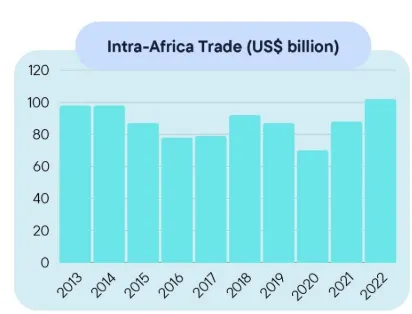 -
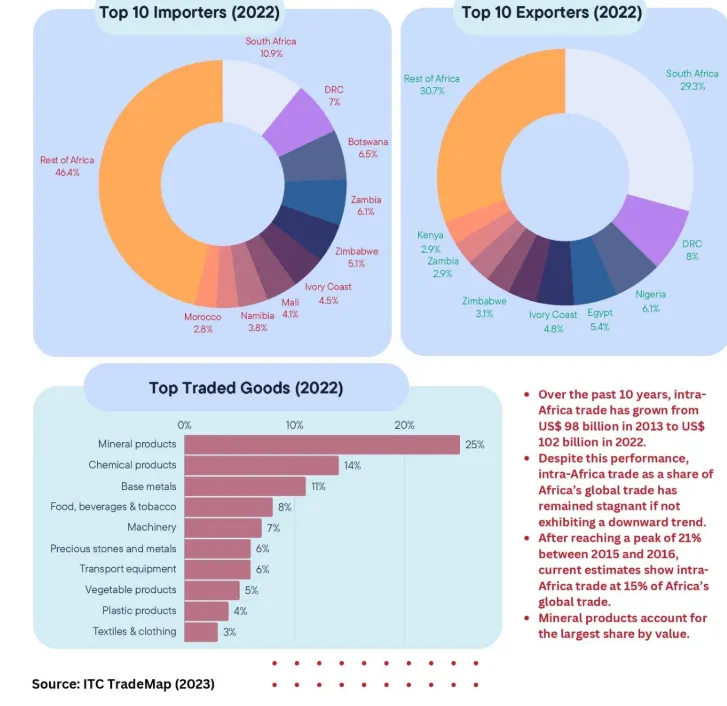
In fact, Africa is a much larger market for Sub Saharan Africa’s (SSA) manufactured agricultural exports than Europe. This trend underscores a critical opportunity for SSA countries aiming to move up the industrial value chain and diversify their trade. Unlike the EU market, where SSA exports primarily consist of raw materials and energy products—90% of SSA’s exports to Europe from 2004 to 2008 fell into this category, excluding South African exports—the intra-African market demands more manufactured goods, providing a platform for industrialization.
1.4 Small holder Agriculture: The Backbone of Inter-Africa Trade
Smallholder family farmers dominate this trade. They representing 80% of all farms and produce up to 90% of food in some countries. Over 33 million smallholder farmers provide more than 70% of the food consumed across the continent, contributing to two-thirds of Africa’s workforce and approximately 35% of the region’s Gross Domestic Product (GDP) (AFSA, 2022; AfDB, 2023).
1.5 Smallholder Farming and Trade in Africa
Agricultural exports are crucial to many African economies, contributing significantly to GDP and serving as a major source of employment. The sector accounts for 20–50% of GDP in sub-Saharan Africa and dominates exports in many countries. Key export crops include cotton, tobacco, coffee, cocoa, tea, and horticultural products like fruits and flowers. Pulses from East and Southern Africa are also critical for export, particularly to the Indian subcontinent.
For some countries, agriculture is the backbone of the economy. Ethiopia, for instance, derives over 70% of its export revenue from agriculture. However, the emphasis on exports often comes at the expense of domestic food security, as governments prioritize cash crops over staple food production.
The relative importance of agriculture for export varies depending on the country's revenues from oil, metals and minerals.
In Ethiopia, for example, agriculture accounts for more than 70% of exports.2 If export targets are not met in terms of the contribution to African countries tend to focus on exports rather than food security.
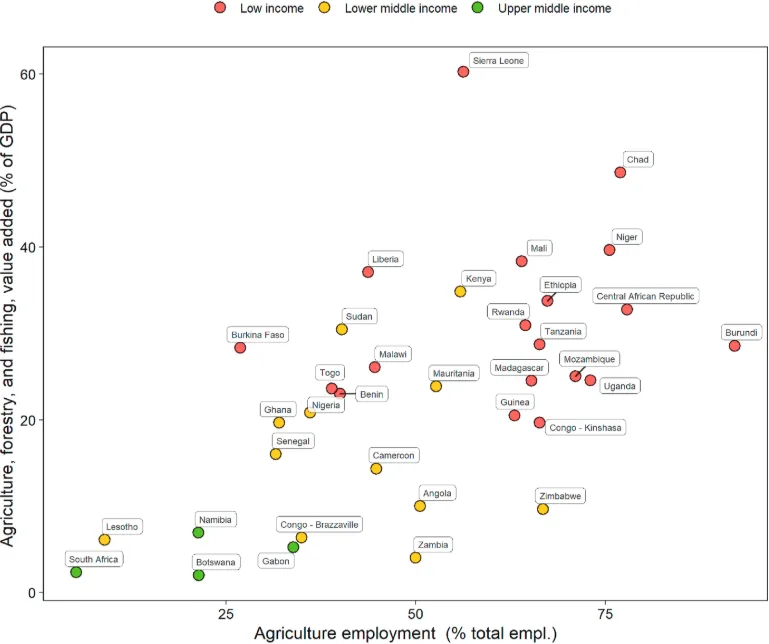
The proportion of GDP earned from agriculture, forestry and fishing plotted against employment in agriculture for countries of sub-Saharan Africa ( (Data sources: Y-axis – World Bank Data, World Bank national accounts data, and OECD National Accounts data files, /; X-axis – ILOSTATS, Labor Force Survey and other country specific sources)
It is therefore surprising that Africa’s agricultural productivity growth has largely stemmed from land expansion rather than increased productivity Although agricultural production has increased substantially in sub-Saharan Africa over the past decades, this has largely been due to cultivation of more land rather than increases in land productivity (Sanchez, 2002).. A notable exception is Ethiopia, where productivity has surged since the adoption of its Agricultural Growth Plan, though some critics question the reliability of these statistics.
1.6 Africa’s Green Revolution: Ambitions and Challenges
The 2004 Kofi Annan’s clarion call for an African Green Revolution to address hunger, malnutrition, poverty, soil health, and infrastructure deficits sought to boost agricultural productivity while embracing Africa’s diverse agro ecological conditions. Central to this approach was the principle of sustainable intensification—enhancing productivity without further expanding cultivated land, while ensuring environmental sustainability (Garnett et al., 2013).
However, the Alliance for a Green Revolution in Africa, an organization formed by Koffi Annan to address the challenges he raised in his clarion call, has seen limited success other than creating markets for large corporations as revealed by its own evaluation report. Localized achievements have failed to translate into continent-wide impact. Diverse farming systems, high population density, and limited capital availability remain barriers to widespread agricultural transformation (Jayne et al., 2014a).
1.7 Challenges to Integrating Farmers into International Trade
While African governments focus on expanding export markets, smallholder farmers face significant barriers to participation in global and regional trade. Poor rural infrastructure, limited access to inputs, and inadequate market access hinder their productivity and profitability. For instance, high transport costs, particularly for landlocked countries, inflate the prices of agricultural inputs, making farming less viable for smallholders.
Research highlights that farming primarily supports rural livelihoods rather than acting as an engine for economic growth. Smallholders, constrained by limited land and poor profitability, are unlikely to intensify their production, reducing their contribution to national food self-sufficiency. A 15-year longitudinal study in Mali’s Guinea Savanna, for example, found little change in agricultural practices, likening the situation to stagnation rather than progress.
1.8 Barriers to Intra-African Agricultural Trade
Intra-African trade in agricultural produce remains underdeveloped due to trade barriers like tariffs and non-tariff barriers (NTBs). For instance, in 2021, Senegal’s food exports to other African countries grew by 9%, but high tariffs limited further expansion. Similarly, while Tanzania exported nearly $1 billion worth of maize in 2022, NTBs imposed by neighboring countries such as Kenya and Zambia hindered market access. These barriers prevent smallholder farmers from fully benefiting from regional trade opportunities.
The Rise of Industrial Agriculture
One notable shift seen in African agriculture is the shift towards industrial models, marked by the monopolization of land, markets, and inputs by large corporations. Initiatives like the Memorandum of Understanding (MoU) between the Alliance for a Green Revolution in Africa (AGRA) and the African Continental Free Trade Area (ACFTA) Secretariat prioritize large-scale, industrialized farming at the expense of smallholder farmers.
Under this model, only farmers capable of scaling their operations are integrated into corporate value chains, leaving the majority excluded. This transition not only marginalizes smallholders but also undermines Africa’s agricultural sustainability. Industrial farming practices—such as monocultures, excessive chemical use, and short-term yield-focused strategies—degrade the environment and weaken ecosystem services.
Policy Misalignments and Environmental Risks
Agricultural policies aimed at combating hunger and malnutrition often replicate industrialized farming models without considering Africa’s unique environmental and socio-economic contexts (Leakey, Mabhaudhi, and Gurib-Fakim, 2021). This misalignment has stagnated productivity, leaving African nations increasingly reliant on food imports. If current trends continue, the projected growth of Africa’s agricultural market from $280 billion in 2023 to $1 trillion by 2030 (AfDB, 2023) will disproportionately benefit corporate entities while sidelining smallholder farmers.
1.9 Incorporating Farmers into International Trade
While the focus of governments across Africa is on how to expand export markets for Africa’s farmers, research shows that Rather than viewing intensification of agriculture as the engine for economic growth, farming should primarily be understood for its role in the livelihoods of rural households. Increasing and diversifying production is certainly important for household food and nutrition security. But given land constraints and the poor profitability of farming, smallholders are unlikely to intensify their production, which limits their ability to contribute to their own, or national food self-sufficiency.
The lack of change witnessed in a longitudinal study encompassing a 15-year period in the Guinea Savanna of Mali was likened to ‘stagnation’ rather than intensification or extensification. Further, rural infrastructure is often poor, which contributes to lack of access to agricultural inputs and to markets for produce. Many African countries are land-locked meaning that the costs of transport to import agricultural inputs are high
The Future of Agriculture in Global Trade
Agriculture has been shown to play key roles in global trade only if the following conditions are met:
- Policies to support modernisation of agriculture and the use of new technologies
- Consolidation of fragmented fields into viable economic farm units
- Policies to encourage small, unviable farms to quit farming
- Tariffs and price support to provide a living income for farmers
- Special measures to support farmers
- Large injection of funds from governments.
These conditions cannot apply to a continent where farming is largely family owned, land is present in small sizes and policies remain focused on extracting taxes from farmers while injecting little or no resources to support farmers