A lot of attention has been paid to the opportunities available to African businesses in the international markets such as the EU, UK, United State and China.
This is misleading because in fact Africa’s trade, especially across borders, is significantly higher than trade outside the continent.
The main reason why this kind of trade rarely makes it to our radar is because it is informal, carried out by small traders and does not feature in the big data of organizations such as the WTO and UNTAD.
Over 83% of Africans obtain their livelihood from this forms of trade.
It is therefore important that we look at opportunities for trade within Africa before seeking to find out what exists beyond.
The first opportunity is cross border trade, primarily carried out under rules and trade agreements of the various regional economic blocs.
There are over 20 regional trade agreements among African countries, although the AU only recognizes eight-Southern African Development Community (SADC), Economic Community of West African States(ECOWAS), Arab Maghreb Union, the Common Market for Eastern and Southern Africa (COMESA), the Economic Community of Central African States (ECCAS), the Economic Community of the Great Lakes Countries (ECGLC), East African Community (EAC), and the Community of Sahel-Saharan States (CEN-SAD). The latest one is a much broader tripartite alliance that brings together multiple trade areas across the continent.
Below is an analysis of the core intra Africa trade Agreements
2.2 COMESA-EAC-SADC Tripartite Free Trade Area (TFTA)
The COMESA-EAC-SADC Tripartite Free Trade Area (TFTA), established in 2015, encompasses 29 countries, representing 53% of the African Union membership, more than 60% of the continent's GDP (estimated at $1.88 trillion), and a population of 800 million (Onyango, 2023). On July 25, 2024, the TFTA officially came into force following the ratification by 14 out of the 29 member states. This agreement serves as a cornerstone for Africa’s broader continental integration efforts, facilitating deeper economic ties between countries.
According to the Tripartite Task Force (TTF) “the Tripartite framework is based on three pillars: Market Integration, which involves trade liberalisation through the creation of a Free Trade Area and arrangements for the movement of business persons; Infrastructure Development, which focuses on enhancing connectivity and reducing business costs; and Industrial Development, which aims to create a supportive environment by improving regulatory and legal frameworks, adding value, diversifying industries, increasing productivity and competitiveness, and implementing programmes for structural change. COMESA Secretariat leads the Market Integration Pillar, SADC the Industrialisation Pillar and EAC the Infrastructure Pillar.”
One of the key objectives of the TFTA is to enhance regional and continental integration, promoting smoother trade flows and cooperation among African nations. While the ratification process has been slower than expected, significant progress has been made in establishing the rules, structures, and negotiation modalities. In fact, the African Continental Free Trade Area (AfCFTA) has drawn valuable lessons from the tripartite frameworks to guide its negotiations, especially in areas like trade in goods, principles, and tariff schedules.
The TFTA presents a more ambitious tariff liberalization schedule compared to the AfCFTA.
While the AfCFTA aims for 90% tariff liberalization for non-sensitive products, with 7% for sensitive products and 3% on the exclusion list, the TFTA’s goal is 100% tariff liberalization (with some security exemptions). Under this agreement, 60% -85% of tariff lines will be liberalized immediately upon implementation, with the remaining 15% to 40% of tariff lines to be negotiated over 5-8 years (Onyango, 2023).
One of the core sectors of interest under the TFTA is food security, with the agreement aiming to liberalize staple foods like maize, beans, and pulses. By facilitating the free movement of these products across the region, the TFTA aims to allow countries with surplus production to assist those facing food shortages, thereby boosting food security within the bloc (COMESA, 2024). This also creates market opportunities for businesses, particularly for those in the East African Community (EAC). For example, South Africa stands out as the top destination for EAC exports within the TFTA, accounting for 35.3% of the region’s exports. Other significant markets include Egypt (27%), Zambia (16.5%), Ethiopia (7.7%), and Sudan (4.7%) (EAC, USAID & TMA, 2023).
However, the TFTA also protects certain sensitive products such as dairy, sugar, and tobacco, which are shielded from immediate tariff liberalization. Countries heavily dependent on these industries, like Kenya’s dairy sector and Zambia’s sugar production, often lobby for these products to remain protected to avoid disruption from more competitive imports. This tariff protection provides critical support for local economies that rely on such sectors.
The agreement has also seen tariff offers exchanged between Customs Unions, particularly the Southern Africa Customs Union (SACU) and the EAC, which have agreed to liberalize about 90% of their tariff books immediately upon the commencement of the TFTA (Onyango, 2023). Other member states, such as Madagascar, Mauritius, Malawi, Seychelles, Zimbabwe, and Zambia, have based their tariff offers on the level of liberalization they have already achieved within their respective Regional Economic Communities (RECs), such as COMESA and SADC. These countries are expected to continue their high levels of tariff liberalization within the tripartite framework.
Ultimately, the TFTA holds considerable promise for fostering greater trade integration, providing businesses with access to new markets, and enhancing food security within the region, while carefully balancing the needs of sensitive sectors
Trade Opportunities with TFTA
- Expanding Regional Market Access for Diverse Crops: The TFTA opens opportunities for businesses to trade a broader range of products across twenty-seven member states, supporting businesses and farmers with unique or high-demand crops. In Kenya, for instance, smallholder tea farmers can reach markets in Southern African countries like South Africa or Zambia, which have a growing demand for tea (Onyango, 2023). The broader market access provided by the TFTA helps diversify income sources and stabilize prices for farmers who might otherwise face price dips in oversaturated local markets (ibid). This large market scope is particularly valuable for smallholders producing high-value crops, as it encourages investment in quality improvements.
- Sensitive Product Protections and Competition Challenges: Under the TFTA, certain sensitive products, such as dairy, sugar, and poultry, retain protective tariffs, which shield smallholder farmers from competition with larger producers in the bloc. In Malawi, smallholder sugarcane farmers benefit from protected prices, ensuring a stable income despite fluctuations in international sugar markets (WEF, 2024). However, larger producers within the TFTA, such as those in South Africa, still have the advantage of economies of scale, which can overshadow small-scale production. For instance, South African poultry producers can still outcompete smaller farmers in less developed TFTA member states despite regional protections, as they have access to better inputs and processing facilities (European Commission, 2022). This dynamic creates market pressure on smallholders, highlighting the need for support policies that address both protective tariffs and the unequal resource access among TFTA countries.
Logistical challenges, such as high transport costs across long distances, still remain a major stumbling block for TFTA and can reduce the profitability of this expanded access, making infrastructure development a crucial priority.
EAC’s Export potential in TFTA (for top 10 partner countries)
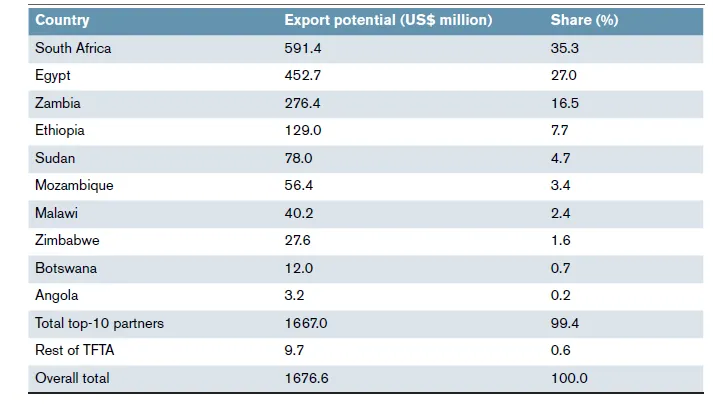
Table 4. Source: EAC, USAID & TMA, 2023
2.3 The East Africa Community (EAC)
The EAC aims to enhance trade within East African countries (Kenya, Uganda, Tanzania, Rwanda, Burundi, DRC and South Sudan) through reduced tariffs. Liberalized agricultural products often include staple foods such as maize, beans, millet, and other cereals that are essential for food security across member states (Anyanzwa, 2023). The EAC's Common External Tariff (CET) exempts most of these essential goods from high tariffs, making them affordable and accessible within the region. However, certain products, like sugar, dairy, and poultry, are protected to safeguard domestic producers from cheaper imports (Tondel, 2017). These products face higher tariffs under the CET to limit competition from outside the EAC. For instance, the EAC imposes a 60percent tariff on sugar imports from non-member countries, as the sugar sector is vital to economies like Kenya’s (Anyanzwa, 2023).
Implications on small-scale farmers
Facilitating Trade for Staple Foods and Reducing Price Volatility
Within the EAC, tariff liberalization for staple foods supports smallholder farmers by reducing price volatility across the region, allowing countries to trade essentials such as maize and beans during shortages. For instance, during periods of drought in Kenya, farmers in Uganda or Tanzania can export their surplus maize and beans tariff-free, addressing food insecurity while ensuring farmers benefit from regional demand (FEWS NET, 2022). This helps stabilize prices for smallholders, who can plan their production and sales with greater predictability. For EAC smallholders, this free movement of staple crops offers an essential buffer against price crashes during bumper harvests, as cross-border trade can alleviate oversupply. However, this benefit largely hinges on regional political cooperation and effective enforcement of tariff agreements, as occasional non-tariff barriers or border closures disrupt this arrangement.
Protection of Sensitive Sectors and Income Stability
The EAC’s protection of sensitive agricultural sectors, such as sugar, dairy, and poultry, offers income stability for smallholder farmers in these industries. For example, Kenyan smallholder dairy farmers benefit from high tariffs on dairy imports from non-EAC countries, which protect them from competition with large-scale global producers (Gérout & Larvor, 2024). This allows local farmers to sell milk and dairy products at competitive prices within the EAC, where demand is strong. While protectionism maintains their income stability, it may also limit growth opportunities by restricting their access to competitive input prices and innovations in the global market. Still, for subsistence-based dairy farmers in Kenya, these protective measures create a necessary shield against income instability, ensuring they can compete domestically and within the EAC.
Limited Access to Cheaper Inputs from Global Markets
Protective tariffs in the EAC can also limit smallholder farmers’ access to affordable agricultural inputs from outside the region, impacting productivity and growth potential. For instance, tariffs on imported fertilizers and seeds are high to protect regional industries, yet they increase costs for smallholders with limited capital (Longley, et al., 2021). Farmers in Uganda, for example, face higher prices for essential inputs, limiting crop yields and reducing their ability to compete in the EAC’s expanded market (ibid). While local input industries may benefit, small-scale farmers encounter a trade-off between price stability for their products and the ability to enhance productivity through cost-effective inputs. This challenge highlights a need for policy adjustments that balance local industry support with affordable access to global inputs, promoting both farmer stability and growth.
2.4 Common Market for Eastern and Southern Africa (COMESA)
The Common Market for Eastern and Southern Africa (COMESA) is a broader trade bloc that includes twenty-one member states and aims to reduce intra-regional tariffs, creating a large, unified market for agricultural and other products. COMESA’s FTA liberalizes staple foods and primary products, such as grains, pulses, and certain vegetables, which small-scale farmers typically produce. By removing tariffs on these goods, COMESA aims to reduce food prices and enhance market access for small-scale farmers, especially in high-demand countries within the bloc (Tondel, 2017). However, sensitive products like wheat, sugar, and poultry are subject to restrictions to shield domestic producers (Tondel, 2017). For instance, countries with substantial sugar industries (like Zambia and Malawi) lobby for protective measures against cheaper sugar imports. Additionally, countries producing wheat restrict imports to stabilize local prices (ibid).
Boosting Regional Market Access and Income Opportunities
COMESA’s tariff liberalization for staple crops has notably expanded market access for smallholder farmers in the region, enabling them to trade surplus produce across borders with minimal tariffs. For example, Ugandan maize farmers easily sell to markets in Kenya or Sudan, benefiting from demand in countries experiencing maize shortages (FAO, 2020). Reduced tariffs make it possible for small-scale farmers to bypass local market saturation and avoid price drops due to oversupply. This expanded regional market, coupled with fewer restrictions, can enhance income by ensuring farmers reach new buyers. However, a lack of infrastructure for transportation and storage limits their ability to capitalize fully on this liberalization, especially in more remote rural areas (FAO, 2020). Despite these challenges, for farmers in crop-abundant regions like western Uganda, COMESA’s liberalized policies provide vital income avenues that may not exist locally.
Challenges with Input Costs Due to Tariff Protections
While COMESA’s tariff-free policies on certain crops benefit farmers, protective tariffs on specific agricultural inputs, like fertilizers or pesticides, pose challenges for smallholders. For instance, the protected fertilizer industry in Zambia means imported fertilizers from non-COMESA countries are expensive, putting a strain on local small-scale producers who rely on these inputs for crop yields (Onyango, 2023). Although tariff protection aims to promote local manufacturing, it raises costs for smallholders unable to access domestically produced fertilizers affordably. High input prices mean that smallholder farmers in countries like Zambia often cannot achieve the yields necessary to capitalize on expanded regional trade opportunities (Onyango, 2023). Consequently, this limits their competitiveness against better-resourced commercial farms within COMESA, as high production costs make it difficult for them to price crops competitively in regional markets.
Protective Tariffs and Competition from Large Producers
COMESA’s protective tariffs on products like sugar and poultry have a dual effect on smallholder farmers. In countries like Kenya and Malawi, small-scale sugarcane and poultry farmers benefit from the protection against cheaper imports, as it stabilizes domestic prices and sustains their incomes. For instance, Kenyan poultry farmers are shielded from competition with low-cost poultry imports, particularly from South Africa and other larger producers within Africa (FAO, 2020). However, in some cases, these protections benefit large-scale producers more than smallholders, as larger firms have the resources to take full advantage of domestic market stability. This creates an uneven playing field within COMESA, where smallholders are often overshadowed by large-scale producers who can more readily meet the demand in protected sectors, limiting smallholders’ potential market share and growth prospects despite the tariff protections.
Across the EAC, COMESA, and TFTA, small-scale farmers generally benefit from liberalized trade in staple products, enabling them to access broader markets and improve their incomes. The protective tariffs help shield them from low-cost competition in sensitive sectors, though this also limits their access to more affordable input. Consequently, while liberalization opens doors to larger markets, tariff protection remains critical for sectors where domestic producers, particularly smallholders, face intense competition from large-scale regional or global producers. Understanding these dynamics helps policymakers balance support for small-scale farmers’ market access with the need for protective tariffs in strategic sectors.
2.5 ECOWAS Trade Liberalisation Scheme (ETLS)
The Economic Community of West African States (ECOWAS) Trade Liberalisation Scheme (ETLS) was adopted by the Community as a means of promoting market integration and the development of the ECOWAS sub-region as an economic space, improve the intra-regional trade and move away from dependence on raw materials. It also seeks to contribute to the progress and development of the African Continent. The ECOWAS Treaty, signed in 1975 and revised in 1993, set out the broad ambit under which the terms of trade scheme were formalized through protocols and regulations to govern the Community trade specifically the free movement of goods, persons and services. Now most agricultural products have been put into the fourth or fifth band of 35 percent (maximum) under the Common External Tariffs (CET) of the Economic Community of West African States. This means that countries in the ECOWAS region can only raise its agricultural tariffs to this maximum afforded by the CET and the constraints of other regional and bilateral agreements.
In accordance with the provisions of article 38 of the ECOWAS Revised Treaty, the following are regarded as originating from the community: products wholly obtained in one or several Member States under, products obtained in one or several Member States and containing non- originating raw materials, provided that these raw materials have undergone sufficient processing or transformation in the Community under, originating products made of materials wholly obtained or sufficiently transformed in two or many Member States are regarded as products originating from the Member State where the last processing or transformation took place as long as the processing or transformation carried out goes beyond those covered.