3.1 Introduction
The African Continental Free Trade Area (ACFTA) represents a strategic response to Africa's development challenges, designed to accelerate the continent’s economic integration. This agreement seeks to address barriers to trade and foster a more connected, prosperous Africa, in line with the objectives outlined in the African Economic Community (AEC), as established by the 1991 Abuja Treaty.
UNECA assessment of June 2012 claims a huge rise in intra-African trade: "It would add up to USD 34.6 billion (52.3 per cent) to the baseline in 2022. Imports of African countries from the rest of the world would come down by USD 10.2 billion, well compensated by the significant projected increase in intra-African trade... While the share of intra-African trade would increase from 10.2% in 2010 to 15.5% in 2022 after the establishment of a CFTA, it would more than double over the twelve years period (increasing from 10.2% in 2010 to 21.9% in 2022) when trade facilitation measures are considered. Similarly, real income for Africa improves by nearly 1 per cent whatever the trade policy considered"
History of the ACFTA
The initiative to establish the ACFTA emerged from the African Union (AU) Summit in 2012 with the aim of creating a unified market across Africa, encompassing 1.3 billion people and a combined GDP of approximately USD 3.4 trillion.
It had the following key objectives
- Establish a single continental market for goods and services, with free movement of business professionals and investments
- Accelerating the establishment of the Continental Customs Union and the African customs union.
- Expand intra-African trade through better harmonization and coordination of trade liberalization and facilitation across Regional Economic Communities (RECs) and across Africa.
- Resolve the challenges of multiple and overlapping memberships and expedite the integration processes.
- Enhance competitiveness at the industry and enterprise level by exploiting opportunities for scale production, continental market access and better reallocation of resources.
The ACFTA has several protocols including those covering Trade in Goods, Trade in Services, Investment, Intellectual Property Rights, Competition Policy, Digital Trade, and specific protocols for Women and Youth. Additionally, the framework includes provisions for the Free Movement of Persons and Dispute Settlement
The ACFTA came into force in 2019 while negotiations are ongoing on several pending protocols.
The journey to ACFTA
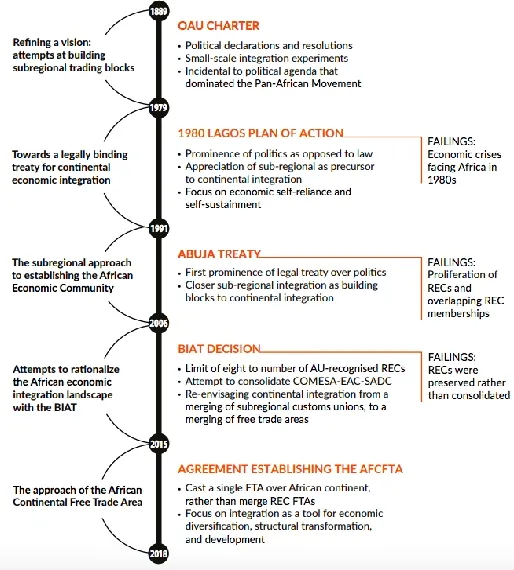
Source: Assessing Regional Integration in Africa IX,2019 United Nations Economic Commission for Africa, African Union, African
Development Bank, and United Nations Conference on Trade and Development. Adapted from Gerout, MacLeod and Desta, 2019
(The AfCFTA was envisaged as implemented in two phases, with the final phase coming to an end in 2020. This has not been achieved however. It is nevertheless to details the two phases to demonstrate the care that was to be taken to ensure that weaker economies, especially those of the Least Developed Countries, do not suffer significantly shocks or rushed liberalization.
Phase I provides a framework for the liberalisation of trade in goods and services, and a mechanism for dispute settlement. For trade in goods, the agreement sets the path for eliminating tariffs on 90 percent of product categories. Countries can implement tariff reductions over a longer period in the case of sensitive goods, or maintain existing tariffs— where the products are excluded—for the remaining 10 percent of product categories (tariff lines). The protocol on trade in goods includes annexes on tariff concessions, rules of origin, customs cooperation, trade facilitation, non-tariff barriers, technical barriers to trade, sanitary and phytosanitary measures, and transit and trade remedies. Phase II was to cover competition policy, investment, and intellectual property rights.)
3.2 ACFTA Implementation and Support Measures
The ACFTA includes several support mechanisms aimed at easing the transition for businesses, especially SMEs and small-scale farmers. These initiatives include:
- SME Financing Facility: This fund aims to support SMEs, particularly those led by women and youth, providing them with access to finance to compete effectively within the ACFTA framework.
- African Trade Gateway: This digital platform offers vital information on customs procedures, market trends, and payment systems, improving access to information and enhancing trade opportunities.
- ACFTA Adjustment Fund: This fund is designed to help member states and the private sector adapt to the changes brought about by ACFTA, covering the anticipated disruptions from tariff reductions and changes in industrial sectors.
- Pan-African Payment and Settlement System (PAPSS): This system facilitates efficient and secure cross-border payments, promoting financial inclusion and reducing the costs associated with currency exchange and money transfers.
3.3 Overall Benefits for smallholder farmers and Businesses
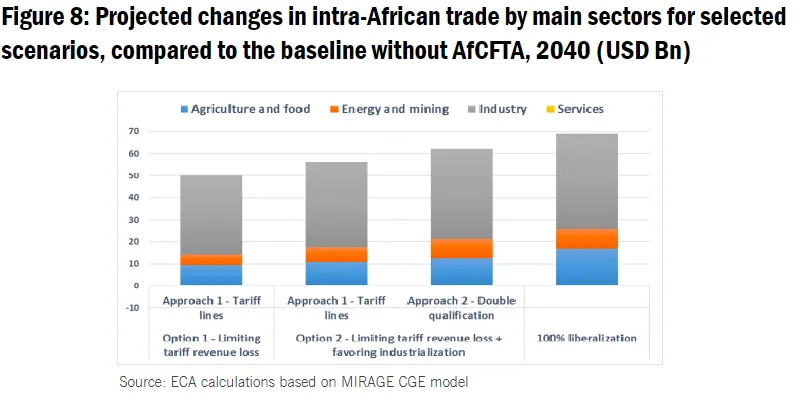
The United Nations Trade and Development Agency (UNTAD) has estimated the quantitative effects of the ACFTA according to 2 long-term scenarios: a full Free Trade Agreement (FTA) and Special Product Categorization (SPC). (6)
A full Free Trade Agreement (FTA) eliminating all tariffs in the ACFTA could generate gains of US$ 16.1 billion, at the cost of US$ 4.1 billion in trade revenue losses (representing 9.1% of current tariff revenues). GDP and employment are expected to grow by 0.97% and 1.17% respectively. Intra-African trade growth is estimated at 33% and the continent’s trade deficit is expected to drop by 50.9%. (6)
Special Product Categorization (SPC) permanently exempts sensitive products from liberalization. In a scenario in which the sector with the highest current tariff revenue would be exempted from liberalization, UNTAD estimate a gain of US$ 10.7 billion in the long term. Tariff revenue losses are expected at US$ 3.2 billion (representing 7.2% of current tariff revenues). GDP and employment growth are expected to grow by 0.66% and 0.82% respectively. Intra-African trade is expected to grow by 24%, while, Africa’s trade deficit only shrinks by 3.8%. (6)
More specifically the ACFTA has benefits in the following areas
Market Access and Farmer Opportunities Under ACFTA
The ACFTA has Tariff structures that divides market liberalization into three categories.
These tariff structure and transition periods are designed to balance market access with protection for key sectors, but careful monitoring and adaptation are essential to mitigate the risks and ensure sustainable agricultural development across Africa.
Category A includes 90% of tariff lines for each member state or regional economic community (REC), particularly those in customs unions. These goods are set for liberalization in equal annual installments, with the goal of reaching zero tariffs by the fifth year for developing countries, including South Africa, Kenya, Ghana, and Nigeria. For least developed countries (LDCs), the tariff reduction period extends to 10 years, ensuring that goods from these nations enter duty-free by the end of this period.
Category B covers sensitive products that countries and regions identify as crucial to their economic development and require temporary protection. These products will be liberalized over the next 10 years for developing countries and 13 years for LDCs. This extended liberalization period allows countries to gradually adjust to competition from other African markets.
Category C involves products that are excluded from liberalization altogether, subject to review every five years. These products remain protected by tariffs to shield domestic producers from external competition as long as the ACFTA is in force.
The ACFTA presents both opportunities and risks for small-scale farmers, and this is best reviewed by looking at the Protocol on Trade in Goods and Services. This Protocol is of particular relevance as most agricultural products fall under it. The goal of the protocol is to promote intra-Africa trade by reducing tariffs and creating a more accessible market for African goods.
On the one hand it opens new markets for African agricultural products.
Liberalization can stimulate job creation, income growth, and improved food security, particularly for rural women, informal traders, youth, and peasant farmer
There are benefits in Improved market access in cases like that of the East African Community (EAC) which has liberalized the trade of several agricultural products, opening opportunities for imports from countries like Nigeria, Ghana, and Niger, which are major producers of these crops. For instance, Nigeria produces approximately 71% of Africa's yams (215 million tons), while Ghana accounts for 45% of plantain and banana production (32 million tons) on the continent (AUC & OECD, 2023). Under the ACFTA’s liberalization, these countries can export their surplus products to the EAC, enhancing their market reach.
The liberalization of food products such as tea, coffee, and other agricultural goods by regional economic communities (RECs) like CEMAC and ECOWAS offers new export opportunities for smallholder farmers in the EAC. Over recent years, the EAC has become a significant exporter of vegetables and food products, with export values averaging US$1.6 billion for vegetables and US$894 million for food products between 2018 and 2022 (EAC, USAID & TMA, 2023). Among the EAC's most promising export sectors under the ACFTA is tea, which alone holds an export potential of US$364.9 million, representing 19.6% of the region’s total potential, with strong demand from markets such as Egypt, Sudan, South Africa, Nigeria, Ghana, and others (ibid). Coffee, valued at US$125.7 million, is another key export product with high demand across the continent, particularly in markets such as Morocco, South Africa, Eswatini, Botswana, and Zambia (EAC, USAID & TMA, 2023).
Other important agricultural exports from the EAC include rice (US$61.1 million), vegetables (US$55.8 million), processed food (US$50.2 million), and sugar (US$41.4 million) (ibid). The demand for these products in various African countries creates significant opportunities for smallholder farmers who can participate in the regional trade networks. The removal of tariffs under the ACFTA provides easier market access, potentially leading to increased income for farmers and greater integration into regional value chains.
3.4 ACFTA and Food Sovereignty
The liberalization of cereals and tubers, such as cassava, by CEMAC-often conducted through cross-border territorial markets, is vital for promoting food sovereignty. Many food-insecure regions in Africa rely heavily on these markets for their staple food supplies (FAO, 2023). For example, Nigeria and Ghana, both of which are major cassava producers, could leverage their competitive advantage to become the primary exporters of cassava to neighboring countries like Burkina Faso, Niger, and the Gambia (Kareem & Wieck, 2021). Similarly, Tanzania, as a major producer of maize, cassava, and rice in the EAC, stands to benefit from the liberalization of these products, expanding its role as the largest supplier within the region (FAO, 2023).
By facilitating unhindered trade in these essential food products, the ACFTA could increase food security across the continent while offering significant economic opportunities for smallholder farmers. The tariff removal and the broader liberalization policies are likely to open new markets for these products, ultimately promoting agricultural growth and regional integration.
3.5 ACFTA and Value Addition
Beyond trade in goods the ACFTA also offers opportunities for value addition in agricultural products, with liberalization providing more access to raw materials and intermediate goods. For example, Kenya’s maize millers have long relied on territorial markets along the Namanga, Busia, and Malaba borders to source maize from Tanzania and Uganda for milling and distribution across Kenya and neighboring countries like South Sudan (FEWS NET, 2022). With the AfCFTA's flexible Rules of Origin (RoO), smallholder farmers who produce raw materials can be integrated into agro-industrial supply chains, promoting regional value addition.
3.6 ACFTA And Manufacturing
The example of Nigeria’s tomato processing industry is also noteworthy. Nigeria recently launched the largest tomato processing factory in West Africa, which relies on tomatoes from both domestic producers and neighboring countries such as Ghana, Burkina Faso, and Cameroon (Momoh, 2024). Similarly, in CEMAC, the Marché Mondial in Cameroon’s Abang-Minko region plays a crucial role in supporting local tomato paste and potato chips production by providing a platform for both raw material sales and finished product distribution (World Bank, 2018). Such initiatives highlight the potential for agro-industrial growth under the ACFTA, with smallholder farmers contributing to the supply of raw materials for processing industries.
Countries with well-established manufacturing sectors, such as Nigeria, South Africa, Kenya, and Egypt, are likely to leverage the ACFTA to further invest in agro-processing across the continent. The AfCFTA's cumulative provisions under the Protocol on Rules of Origin (RoO) offer the possibility of accessing cheaper raw materials and intermediate inputs, which are essential for the development of agro-industrial sectors. For example, while South Africa produces a small quantity of organic baobab powder, it imports significant quantities from Tanzania, Malawi, Mozambique, and other countries to produce cosmetics based on this ingredient (WEF, 2024). Similarly, Heineken’s CREATE project in Ethiopia sources 60% of its agricultural raw materials, including sorghum and millet, locally within the continent (WEF, 2024).
The flexibility provided by the AfCFTA's RoO enables the creation of cross-border regional value chains, particularly in agro-industrial sectors. However, this is contingent upon smallholder farmers being included in the value chain. Without their active participation, the benefits of regional industrialization could be limited.
3.7 ACTA Safeguards For Farmers
The ACFTA allows State Parties to apply anti-dumping measures under certain circumstances, creating policy space for countries to protect their domestic agricultural sectors from unfair competition. According to Article 17 of the ACFTA Protocol on Trade in Goods, countries can impose anti-dumping measures when products from another State Party threaten to harm a domestic industry (African Union, 2018). This provision is crucial for safeguarding smallholder farmers against the dumping of cheap agricultural products that could undermine local production.
Nigeria, for instance, has used temporary bans on imports of rice, beef, pork, and tomato paste from other ECOWAS member states to protect local producers (ITA, 2023). Similarly, high tariffs on products like yogurt in ECOWAS countries under the ACFTA may be designed to protect emerging industries and encourage local production of value-added dairy products (Gérout & Larvor, 2024). These safeguards are important tools in promoting agro ecological enterprises by ensuring that local farmers are not displaced by industrial imports.
3.8 Overall Opportunities and Challenges for Farmers
The tariff offers under the ACFTA present both challenges and opportunities for smallholder farmers. While there are potential benefits in terms of improved market access, the liberalization of trade can also pose risks to local agricultural sectors. The successful integration of smallholder farmers into regional value chains and supply networks is essential to ensure that the ACFTA benefits are distributed equitably. By leveraging the AfCFTA’s flexible Rules of Origin and anti-dumping measures, there is an opportunity to foster agro-industrial growth, promote food security, and support smallholder farmers across the continent. However, this will require concerted efforts to balance liberalization with safeguards that protect local agricultural economies and promote sustainable development across regional market
The liberalization of agricultural products under the African Continental Free Trade Area (ACFTA) by the East African Community (EAC) and the Central African Economic and Monetary Community (CEMAC) holds significant potential for enhancing intra-Africa trade, especially in seeds and agricultural inputs. The African seed market, though largely dominated by hybrid seeds, has grown to nearly $4 billion in value, reflecting a $1 billion increase over the past 12 years (Hussein, 2024). Many African countries are still heavily reliant on seed imports for their agricultural activities. For instance, Uganda imported 1,060 tons of maize seeds from countries such as South Africa, Zimbabwe, Kenya, Tanzania, Zambia, and Ghana in 2020, alongside 13 tons of sorghum from Kenya (Longley et al., 2021). With ACFTA reducing trade barriers, Ugandan farmers, for example, could access a wider range of high-quality seeds at more competitive prices, boosting productivity and enhancing farm outputs.
However, the ACFTA presents both opportunities and challenges for African smallholder farmers. While it fosters market access and increased trade, it also highlights the continent's dependency on food imports. Despite possessing 65% of the world’s arable land, Africa continues to import significant quantities of food. The Southern African Development Community (SADC) and the East African Community (EAC) are particularly affected, with agricultural imports representing 33% and 21% of total trade in these regions, respectively (FAO, 2020). This dependency is concerning, particularly given the significant rise in global food prices. For example, Africa imports over 100 million tons of food annually, valued at approximately $75 billion (AfDB, 2023). The situation is exacerbated by geopolitical factors, such as the recent disruption of food and seed supply chains, with 46% of cereal imports to ECOWAS and CEMAC coming from Ukraine and Russia (FAO, 2022).
The liberalization of agricultural trade under ACFTA is expected to increase intra-African trade in seeds and food. However, this is contingent upon the participation of African smallholder farmers. If the trade remains dominated by larger, industrial producers, smallholder farmers could find themselves marginalized, unable to compete with cheaper, imported industrial seeds or food products. For example, Benin’s low tariffs (7%) on rice imports from outside the ECOWAS region have led to increased rice imports from Thailand, often re-exported to neighboring countries such as Nigeria. This dynamic resulted in Nigeria’s temporary border closures to protect its domestic rice industry (Kassa & Zeufack, 2020). Thus, while the ACFTA holds the potential to increase the volume of food and seed trade, it must also ensure that smallholder farmers' interests are safeguarded in the process.
ACFTA Challenges for Farmers
The liberalization of trade is a double edged sword. While it has numerous benefits, it exposes local farmers to competition from larger, more industrialized agricultural sectors, both within Africa and globally. This could result in the displacement of small-scale farmers who lack the resources to compete effectively. Furthermore, without safeguards in place, the increased flow of cheap imported goods could undermine local agricultural production, exacerbating food insecurity and economic vulnerability in rural areas.
Liberalization may also have unintended consequences for farmers. Local producers may struggle to compete with the influx of imported products, as the larger-scale commercial agriculture favored by the ACFTA often puts smaller, subsistence-oriented farmers at a disadvantage. This could lead to the displacement of local agricultural enterprises, undermining the very purpose of regional trade agreements designed to support sustainable development in domestic agricultural sectors
Complex Trading Regime
One major challenge faced by small-scale traders, who typically engage in the informal cross-border trade of agricultural products, is the lack of a Simplified Trading Regime (STR). STRs are designed to facilitate the trade of low-value consignments by reducing bureaucratic barriers and simplifying customs clearance procedures. STRs allow small traders to benefit from the preferential trading environment, easing their entry into larger markets without facing prohibitive costs. However, the AfCFTA’s Women and Youth in Trade Protocol does not sufficiently address the core aspects of an STR, limiting the participation of informal traders in agricultural markets. If the ACFTA fails to fully implement a simplified regime, small traders may face increased costs, time delays, and reduced competitiveness in cross-border trade, undermining their ability to benefit from the free trade area.
Skewed Agricultural Production
Another challenge for smallholder farmers is the uneven distribution of agricultural production benefits across the continent. While ACFTA is expected to increase food availability, production will likely become more concentrated in specific regions, with Southern Africa seeing the highest increase in output, particularly in cereals and livestock production. In contrast, production in Central Africa and several sparsely populated countries is predicted to decrease (Simola et al., 2021). These regional disparities will likely affect food prices, with some areas experiencing price increases due to reduced production. For instance, while cereal output is expected to increase in Eastern and Southern Africa, regions in the central and western parts of Africa may face decreased production, thereby putting upward pressure on food prices in these areas. This imbalance could make food less affordable for low-income groups, potentially exacerbating poverty and inequality.
Undermining Agro-Ecology
The liberalization process under the ACFTA could also inadvertently undermine agro ecology, a sustainable agricultural approach that emphasizes biodiversity, traditional farming methods, and locally sourced, high-quality food. Agro ecological practices have gained popularity across the continent due to their focus on environmental sustainability and food security. However, the increasing embrace of genetically modified (GM) crops in several ACFTA member states poses a threat to these practices. Currently, 11 ACFTA member states have approved the use of GM crops, including maize, cotton, and soybean (Peschard, Golay, & Araya, 2023). For instance, Kenya, Ghana, Egypt, and South Africa have begun field trials or commercial production of GM crops, such as maize and cotton, which threatens to overshadow traditional agricultural practices.
Promotion of Industrial Agriculture
In addition, the market dynamics under ACFTA may skew towards industrial agriculture, with large multinational corporations dominating the seed and food trade. These corporations could push out smallholder farmers, particularly those relying on traditional seeds and agro ecological farming practices. This shift could lead to the flooding of African markets with GM seeds and industrial food products, excluding smaller, local producers from the food and seed trade. The resulting imbalance would not only harm smallholder farmers but also jeopardize the resilience and sustainability of local agricultural systems.
An analysis of tariff liberalization under ACFTA reveals that many value-added products derived from smallholder farmers’ crops are either excluded or placed on the sensitive list, limiting their ability to benefit from the liberalized trade environment. For example, many value-added agricultural products, such as processed foods, oils, and dairy products, are likely to be excluded from the 90% liberalized trade category (Category A). Instead, they are expected to fall under the sensitive list, meaning they will not be fully liberalized until after a longer transition period. In countries like Ghana, Nigeria, Côte d'Ivoire, and Cape Verde, full liberalization of these products is expected to occur within five years, while Least Developed Countries (LDCs) in ECOWAS will have a 10-year transition period.
There is immense potential for increasing intra-African trade and boosting the competitiveness of smallholder farmers. Its success, however will largely depend on how well it addresses the challenges of market access, food import dependence, regional disparities in production, and the impact of external trade agreements.
Case in Point:
Shepherding ACFTA-When Guided Trade Fails to Guide
The Guided Trade Initiative (GTI) was launched in response to the slow pace of meaningful commercial trading following the official commencement of trading under the African Continental Free Trade Area (ACFTA) on January 1, 2021. The initiative was established based on the 7th Ministerial Directive of the ACFTA Council of Ministers responsible for Trade (KASA, ATPC & UNECA, 2024) and was formally adopted by African Heads of State and Government in February 2022. Its primary goal was to serve as an interim solution to stimulate substantial trade among State Parties that met the minimum requirements for trading under the Agreement, and to test the readiness of the private sector, as well as the operational, institutional, legal, and trade policy frameworks of the ACFTA. Initially, the GTI attracted participation from seven African countries—Cameroon, Egypt, Ghana, Kenya, Mauritius, Rwanda, and Tanzania—which represent all five regions of the continent. Products targeted for trade under the initiative included ceramic tiles, batteries, tea, coffee, processed meat products, corn starch, sugar, pasta, glucose syrup, dried fruits, and sisal fiber. These products formed the initial trade offerings under the ACFTA.
However, the disparity between the policy goals and the practical realities of trading under the ACFTA highlights several challenges. One of the main issues is the insufficient distribution and logistics infrastructure needed to facilitate the movement of goods across different markets within the continent. In addition, small and medium-sized enterprises (SMEs)—including those owned by women, youth, and other vulnerable groups—often face disproportionately high freight and logistics costs, making it difficult for them to export competitively. For example, in one instance, a shipment from Kenya intended for Ghana, which was flagged for export in October 2022, only arrived in Ghana in December 2022 due to delays in logistics. Furthermore, the complex web of taxes, levies, and fees imposed on imports by various countries increases the cost of trade and undermines the competitiveness of products. This multitude of charges can make it more difficult for businesses to succeed in the ACFTA marketplace.
Weaknesses of the CFTA
A key weakness of the ACFTA is its lack of integration with RECs and other Policies across Africa.
The AfCFTA's framework has limited integration with existing continental policies, such as the African Mining Vision (AMV), the Comprehensive African Agriculture Development Programme (CAADP), and the Accelerated Industrial Development for Africa (AIDA). Additionally, programs like the Programme for Infrastructure Development in Africa (PIDA) have not made significant progress. The lack of alignment with these key policies and infrastructure programs risks undermining the AfCFTA’s goal of driving economic transformation.
3.9 Criticisms of the ACFTA
Critiques have observed that the ACFTA appears structured to benefit Multinationals and that even analysis by those who support it, such as UN Economic Commission For Africa (UNECA), UNTAD and the EU, have ended up showing their glaring contradictions. According to these critiques what is perceived as the key weakness of the ACFTA- inability to integrate with Regional Trading Bloc and its quest for full liberalization- are deliberate designed by those who are financing the ACFTA process. These, interestingly are the very Europeans who are pushing for EPAs that is not only killing ACFTA, but the regional trading bodies as well.
Some studies have shown that far from promoting regional integration of the continent it will disintegrate it strongly in opening wide the doors to multinationals already well implemented in most African countries and which would concentrate their activities in the most competitive countries from which they would export to the others. Simon Mevel and Stephen Karingi of UNECA admitted: "Turning to the country analysis of the results, these are somewhat more ambiguous than at the global level... Even if real income variations are limited, almost half of African countries/regions considered in the study would be worst off in terms of real income after the formation of free trade areas. Three main justifications can be advanced. Firstly, while African countries liberalize, governments have to renounce to a non-negligible source of income namely, tariff revenues. Secondly, as African economies open up, competition is increasing on the continental market. As a results trade flows are reoriented such as African imports from partners located either on the continent or outside of the continent are being replaced by imports from African partners benefiting from better market access, thanks to tariff cuts, and potentially leading to terms of trade reductions. Thirdly, as world prices of food products slightly increase with the liberalization reforms, net-food importing countries such as Angola & DRC, Mozambique, Botswana, Rest of North Africa, Nigeria and Central Africa are hurt and their real income reduced... Workers employed in countries strongly specialized in exports of primary products, such as oil exporting countries: Angola, Egypt, Nigeria, Rest of Eastern Africa (inclusive of Kenya), Rest of North Africa; as well as Zambia (69% of Zambia’s exports are mineral and metal products) register a decrease in real wages
The Private Sector referenced in the ACFTA does not designate the hundreds of millions of African smallholder farmers – who could produce much more with guaranteed stable remunerative prices through an efficient import protection – but the tens of multinationals and African private companies that are pushing to abolish tariffs between African countries. There are fears that the real big winners of the ACFTA will be multinational corporations from outside Africa that have settled in big cities and would be provided with easy access to a multitude of markets. Another major problem that has not been dealt with yet, is the potential loss of revenue for governments, as customs duties are a major source of government revenue.
A majority of African economies are dependent on FDI to grow their manufacturing. Yet "Africa accounts for a very low share of global FDI flows (2.8 per cent) and, more importantly, FDI flows to the continent are concentrated in a few countries and largely in the extractive sector. The latter has reinforced Africa’s dependence on commodity exports and the vulnerability of African countries to external demand and speculation-driven commodity price movements. Moreover, to date, there is no evidence to indicate that FDI in Africa is contributing to economic diversification through backward and forward linkages. Under such circumstances, the tendency of FDI to reinforce enclave-type development – with external integration gaining more importance over the internal integration of the local economy – is a real concern. ACFTA is founded on a false premise that Africa will attract FDIs that will automatically generate opportunities for technology transfer, linkages with domestic enterprises and opportunities for diversification into more dynamic activities”
The deficit of cereals was $30 billion way back in 2016, and has since increased. The amount of sub-Saharan Africa in this deficit was $10.4 billion for cereal. Intra-Africa exports of wheat have only risen from $24,572 to $139,900. There is not a single African country which is a net exporter of wheat and the intra-Africa exports of wheat are re-exports to neighbouring countries of extra-Africa imports.
Geopolitics shows that it would be almost impossible to establish common trade rules in Africa with a population with very different political institutions, poor transport infrastructures, and where per capita GNI (gross national income) goes from $260 in Burundi to $14,760 in Seychelles
Section 4: