Rise of Intra-Africa Trade
While much attention has been paid to Africa’s trade with external actors, Intra-African trade, driven primarily by agriculture and small traders, has existed for centuries, and flourished in the past 50 years. But it was not until independence that African countries moved to cement trade relationship with their neighbours, first as an act of solidarity, but later as a central focus of economic advancement.
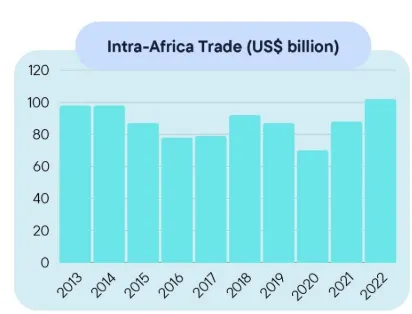 -
Over the decades Intra-Africa Trade, especially in agricultural produce has undergone rapid transformation, presenting significant opportunities for the continent’s economic growth and industrialization. A detailed analysis of Africa’s export statistics highlights a notable shift in the importance of regional markets compared to traditional export destinations like the European Union (EU).
Agricultural exports within Africa are growing at a much faster rate. For certain sub-regions, such as the East African Community (EAC), and countries like Zambia, Senegal, and Kenya, intra-African trade has already surpassed exports to the EU in importance (South Centre, 2010).
This trade continues to be fueled by agriculture, which remains Africa’s economic backbone.
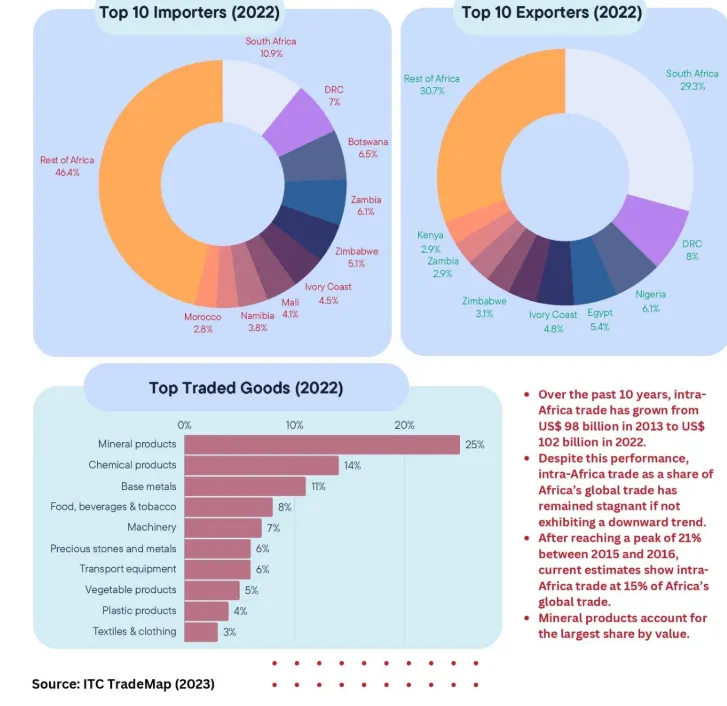
While the top 3 traded goods (accounting for 50% of Africa’s exports outside the continent) are non agricultural products, almost all of Inter-Africa trade exports is from manufactured and processed agricultural produce.
In fact, Africa is a much larger market for SSA’s manufactured agricultural exports than Europe. This trend underscores a critical opportunity for SSA countries aiming to move up the industrial value chain and diversify their trade. Unlike the EU market, where SSA exports primarily consist of raw materials and energy products—90% of SSA’s exports to Europe from 2004 to 2008 fell into this category, excluding South African exports—the intra-African market demands more manufactured goods, providing a platform for industrialization.
Smallholder family farmers dominate this trade. They representing 80% of all farms and produce up to 90% of food in some countries. Over 33 million smallholder farmers provide more than 70% of the food consumed across the continent, contributing to two-thirds of Africa’s workforce and approximately 35% of the region’s Gross Domestic Product (GDP) (AFSA, 2022; AfDB, 2023)
Africa’s Large Traders by Size (2024)
Agricultural exports are central to many African economies, contributing significantly to GDP and serving as a major source of employment. The sector accounts for 20–50% of GDP in sub-Saharan Africa and dominates exports in many countries. Key export crops include cotton, tobacco, coffee, cocoa, tea, and horticultural products like fruits and flowers. Pulses from East and Southern Africa are also critical for export, particularly to the Indian subcontinent.
For some countries, agriculture is the backbone of the economy. Ethiopia, for instance, derives over 70% of its export revenue from agriculture. However, the emphasis on exports often comes at the expense of domestic food security, as governments prioritize cash crops over staple food production. The relative importance of agriculture for export varies depending on the country's revenues from oil, metals and minerals.
In Ethiopia, for example, agriculture accounts for more than 70% of exports.2 If export targets are not met in terms of the contribution to African countries tend to focus on exports rather than food security.
The proportion of GDP earned from agriculture, forestry and fishing plotted against employment in agriculture for countries of sub-Saharan Africa ( (Data sources: Y-axis – World Bank Data, World Bank national accounts data, and OECD National Accounts data files, /; X-axis – ILOSTATS, Labor Force Survey and other country specific sources)
It is therefore surprising that Africa’s agricultural productivity growth has largely stemmed from land expansion rather than increased productivity Although agricultural production has increased substantially in sub-Saharan Africa over the past decades, this has largely been due to cultivation of more land rather than increases in land productivity (Sanchez, 2002).. A notable exception is Ethiopia, where productivity has surged since the adoption of its Agricultural Growth Plan, though some critics question the reliability of these statistics
Small holder Agriculture: The Backbone of Intra-Africa Trade
Smallholder family farmers dominate this trade. They represent 80% of all farms and produce up to 90% of food in some countries. Over 33 million smallholder farmers provide more than 70% of the food consumed across the continent, contributing to two-thirds of Africa’s workforce and approximately 35% of the region’s Gross Domestic Product (GDP) (AFSA, 2022; AfDB, 2023).
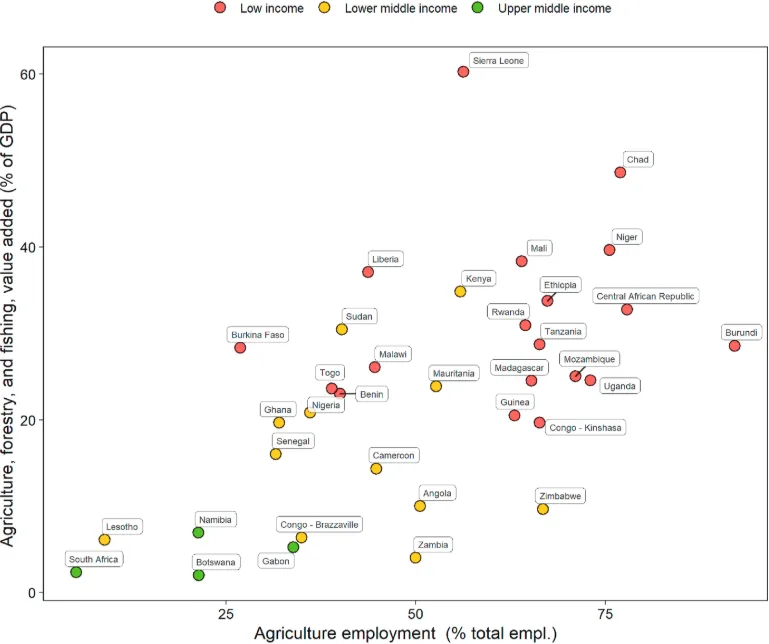
The proportion of GDP earned from agriculture, forestry and fishing plotted against employment in agriculture for countries of sub-Saharan Africa ( (Data sources: Y-axis – World Bank Data, World Bank national accounts data, and OECD National Accounts data files, /; X-axis – ILOSTATS, Labor Force Survey and other country specific sources).
It is therefore surprising that Africa’s agricultural productivity growth has largely stemmed from land expansion rather than increased productivity Although agricultural production has increased substantially in sub-Saharan Africa over the past decades, this has largely been due to cultivation of more land rather than increases in land productivity (Sanchez, 2002).. A notable exception is Ethiopia, where productivity has surged since the adoption of its Agricultural Growth Plan, though some critics question the reliability of these statistics.
Barriers to Intra-African Agricultural Trade
Intra-African trade in agricultural produce remains underdeveloped due to trade barriers like tariffs and non-tariff barriers (NTBs). For instance, in 2021, Senegal’s food exports to other African countries grew by 9%, but high tariffs limited further expansion. Similarly, while Tanzania exported nearly $1 billion worth of maize in 2022, NTBs imposed by neighboring countries such as Kenya and Zambia hindered market access. These barriers prevent smallholder farmers from fully benefiting from regional trade opportunities.
1. The Rise of Industrial Agriculture
One notable shift seen in African agriculture is the shift towards industrial models, marked by the monopolization of land, markets, and inputs by large corporations. Initiatives like the Memorandum of Understanding (MoU) between the Alliance for a Green Revolution in Africa (AGRA) and the African Continental Free Trade Area (ACFTA) Secretariat prioritize large-scale, industrialized farming at the expense of smallholder farmers.
Under this model, only farmers capable of scaling their operations are integrated into corporate value chains, leaving the majority excluded. This transition not only marginalizes smallholders but also undermines Africa’s agricultural sustainability. Industrial farming practices—such as monocultures, excessive chemical use, and short-term yield-focused strategies—degrade the environment and weaken ecosystem services.
2. Policy Misalignments and Environmental Risks
Agricultural policies aimed at combating hunger and malnutrition often replicate industrialized farming models without considering Africa’s unique environmental and socio-economic contexts (Leakey, Mabhaudhi, and Gurib-Fakim, 2021). This misalignment has stagnated productivity, leaving African nations increasingly reliant on food imports. If current trends continue, the projected growth of Africa’s agricultural market from $280 billion in 2023 to $1 trillion by 2030 (AfDB, 2023) will disproportionately benefit corporate entities while sidelining smallholder farmers.
It is impossible to engage in Trade in Africa without engaging with the African farmer. Agriculture, especially small-scale farming, is the backbone and lifeblood for a continent that has 33% of the world’s remaining arable land and 60% of its fresh water. It is therefore not surprising that agriculture and farming remain the centre of all trade agreements with Africa. Its other land wealth-oil, minerals and human resource, are the other central features in these agreements.
While much attention has been paid to Africa’s trade with external actors, Intra-African trade, driven primarily by agriculture and small traders, has undergone rapid transformation, presenting significant opportunities for the continent’s economic growth and industrialization. A detailed analysis of Africa’s export statistics highlights a notable shift in the importance of regional markets compared to traditional export destinations like the European Union (EU).
Agricultural exports within Africa are growing at a much faster rate. For certain sub-regions, such as the East African Community (EAC), and countries like Zambia, Senegal, and Kenya, intra-African trade has already surpassed exports to the EU in importance (South Centre, 2010).
Almost all of Inter-Africa trade exports is from manufactured and processed agricultural produce. In fact, Africa is a much larger market for SSA’s manufactured agricultural exports than Europe. This trend underscores a critical opportunity for SSA countries aiming to move up the industrial value chain and diversify their trade. Unlike the EU market, where SSA exports primarily consist of raw materials and energy products—90% of SSA’s exports to Europe from 2004 to 2024 fall into this category. Smallholder family farmers dominate this trade. They represent 80% of all farms and produce up to 90% of food in some countries. Over 33 million smallholder farmers provide more than 70% of the food consumed across the continent, contributing to two-thirds of Africa’s workforce and approximately 35% of the region’s Gross Domestic Product (GDP).
For some countries such as Ethiopia, agriculture is the backbone of the economy, driving over 70% of its export revenue. Africa’s agricultural productivity growth should come from increased productivity, not land expansion. Attempts at an African Green Revolution has failed in all ways except creating markets for large corporations the spectacular failure of AGRA. While African governments focus on expanding export markets, smallholder farmers face significant barriers to participation in global and regional trade. Intra-African trade in agricultural produce also remains underdeveloped due to trade barriers like tariffs and non-tariff barriers (NTBs).
One notable shift seen in African agriculture is the rise of industrial models, marked by the monopolization of land, seeds, markets, and inputs by large corporations. Under this model, only farmers capable of scaling their operations are integrated into corporate value chains, leaving the majority excluded. This transition undermines Africa’s agricultural sustainability. It is exacerbated by policies aimed at ending malnutrition that replicate industrialized farming models without considering Africa’s unique environmental and socio-economic contexts.
This misalignment has stagnated productivity, leaving African nations increasingly reliant on food imports. If current trends continue, the projected growth of Africa’s agricultural market from $280 billion in 2023 to $1 trillion by 2030, will disproportionately benefit corporate entities while sidelining smallholder farmers.