Trade agreements are not a new concept for Africa. For centuries, the continent engaged in various trade arrangements, such as those with the Omani Arabs along East Africa’s coast and the powerful kingdoms of Mali, Benin, Oyo, and the Ibo in West Africa. These were reciprocal agreements where the Arabs, for example, exchanged specific products for raw materials from the continent.
Trade agreements with Europe, on the other hand, are not just fairly recent, they had completely new rules.
In their groundbreaking research, African Export-Import Bank reveals how centuries of Euro-African trade, especially the export slave trade that privileged the use of firearms disrupted African production, brought a sense of insecurity, and made the cheaper metals and textiles Europe brought more attractive. Unlike the Arabs who focused on securing raw materials in exchange for raw manufactured products of their own, the Europeans embarked on a one-sided trade agreement where it extracted resources without giving anything in return.
Afrexim Bank research shows how the arrival of the British led to a dismantling of trade arrangements and a dramatic shift to manipulated trade agreements among Africans on the one hand and Arabs and Indians on the other by inserting themselves in the existing trade as middlemen and not as producers. The rise of commission agents in Europe, who for a small commission received the produce of African traders and sold them on the European market, and in return bought European manufactured goods and shipped these to their African clients opened up African trade to systemic one sided agreements where both the consumers and extractors were Europeans. Europe gradually became producers, but this time not of raw materials. Instead Africa’s raw materials became the engine of their production processes.
For a few decades European powers managed their affairs in Africa without significant conflict, as the sheer scale of resources they extracted was enough to maintain peace among them. However, tensions soon emerged over territorial resources, especially in parts of East, Central and West Africa, leading to the first ever trade agreement about Africa, with no African participation. Signed on February 26, 1885 the General Act of the Berlin Conference on West Africa (GA) agreed on key issues relating to a common framework for the recognition of European “effective occupation” of African territory and on the principle that control of territory could not be claimed until said territory was actually occupied.
In particular, Articles1, 2, 3 and 4 of the GA states in part:
In extending the principle of free trade to this eastern zone the Conference Powers only undertake engagements for themselves…Wares, of whatever origin, imported into these regions, under whatsoever flag, by sea or river, or overland, shall be subject to no other taxes than such as may be levied as fair compensation for expenditure in the interests of trade, and which for this reason must be equally borne by the subjects themselves and by foreigners of all nationalities. All differential dues on vessels, as well as on merchandise, are forbidden. Merchandise imported into these regions shall remain free from import and transit dues. The Powers reserve to themselves to determine after the lapse of twenty years whether this freedom of import shall be retained or not
What is worth noting is how closely the 38 Articles of the GA resemblance current Free Trade Agreements between European countries and countries and African countries.
For instance Articles 25 and 26 of the GA echo many of the provisions of the Samoa Agreement and EPAs while the provision for WTO dispute resolution is lifted from Articles 12 and 19 of GA.
These include:
1. Streamlining European Competition for Africa’s Raw Material.
European powers feared that if one nation did not participate in the colonization of Africa, others would benefit, leaving them without access to valuable resources. This competition for African resources shaped numerous clauses in later agreements aimed at safeguarding individual European interests while ensuring collective benefits. These concerns are reflected in several provisions of the Cotonou Agreement, particularly Articles 5, 22, 23, 34-36, 42, and 45. The same principles underpinned Articles 16, 50, and 51 of the 2023 Samoa Agreement and were crucial in the creation of regional EPAs. These principles also extend across the 14 EPAs signed with African nations to date, demonstrating the ongoing influence of colonial-era motivations in modern trade agreements.
Market Expansion
The GA was also seen as a form of market expansion, in which Africa acted as captive markets for exports from Europe. Interestingly this concept of having Africa purely as a market for Europe’s manufactured goods was the reason for the long stalemate in signing of Samoa Agreement by several African countries. Even after nearly two decades the structure of the agreement led to a walk out by 43 countries on the eve of the signing in November 2024. It is also the reason countries such as Tanzania and Nigeria have blocked the signing of the regional EPAs.
EU and UK Trade Agreements with Africa: From General Act of the Berlin Conference to Economic Partnership Agreements
"Under the effect of the example of the European Common Market, many countries of the Third World are lulled by excessive hopes conceived on the European model that is obtained by the gradual opening of markets. In my opinion, this is a false trajectory because the reduction of tariffs helps in the first place the expansion of multinational enterprises established within common markets, more powerful and better prepared to seize new opportunities"-Ignacy Sachs, La découverte du Tiers Monde, Flammarion, 1971
“I see them as an opportunity for the ACP regions to fast-track their way to regional integration.” Peter Mandelson, EU Commissioner For Trade, speaking at the ACP-EU Economic and Social Interest Groups Meeting, 29 June 2005
Introduction
Africa’s trade challenges stem from a complex web of overlapping agreements with external partners, often involving multilateral or unilateral commitments. These agreements, which go by various names, have significantly impacted the development of the African Continental Free Trade Area (AfCFTA) and hindered intra-African trade.
African countries are bound by their commitments to the World Trade Organization (WTO) and have entered into numerous trade deals with global partners. These include agreements with the G7 countries, which often contain clauses that frame them as "building blocks" for the AfCFTA. However, in practice, many of these deals undermine the goals of the AfCFTA and disrupt existing regional trade agreements.
Africa-EU Trade Volume
Despite claims that the EU is Africa’s largest trading partner, the reality is that a disproportionate amount of trade is concentrated in just six African countries—Morocco, South Africa, Algeria, Egypt, Nigeria, and Tunisia—which together account for 72% of Africa’s trade with the EU. These six countries represent only 10% of Africa’s total population and area, while the remaining 49 countries, comprising 90% of the continent, primarily engage in trade with other global players such as China, Russia, India, and the United States. This trade imbalance highlights a significant issue with Africa's reliance on the EU as a trade partner, especially when looking at the broader picture of intra-continental trade and economic development.
Africa’s Exports Africa’s Imports
The EU is Not Africa’s Largest Trading Partner
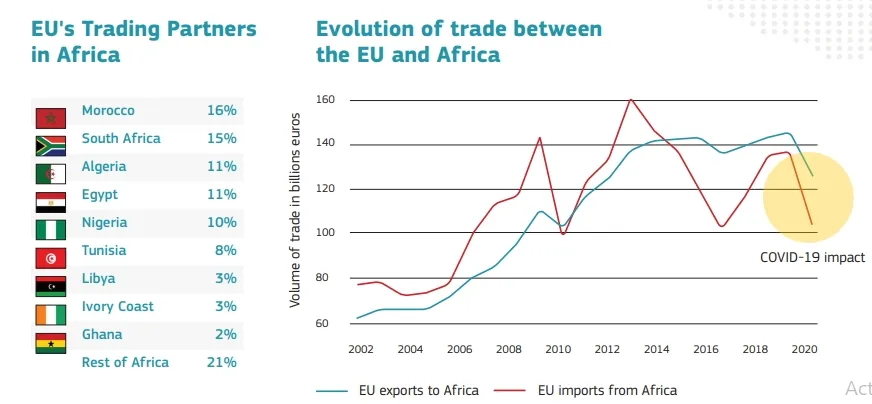 This trade concentration raises questions about the nature of Africa's economic relationship with the EU, particularly when the continent’s overall trade potential with Europe is not fully realized. The trade imbalance indicates that Africa’s broader economic needs and priorities are not adequately addressed within the EU's trade agreements, especially considering the limited scope of the agreements to less-developed and smaller African economies.
4.1Context of EU and UK Trade with Africa
The European Union (EU) and the United Kingdom (UK) maintain three distinct trade agreements with African countries. These include the Economic Partnership Agreements (EPAs) with 14 countries, Association Agreements with North African countries (4 countries), and a range of unilateral trade agreements under the Generalized Scheme of Preferences (GSP). The GSP comprises the standard GSP arrangement, which includes countries like the Congo and Nigeria; GSP+ for countries such as Cape Verde; and the "Everything But Arms" (EBA) arrangement for Least Developed Countries (LDCs), covering 33 African nations.
The UK, which previously negotiated trade deals under the EU framework, has continued with similar arrangements post-Brexit. The UK’s EPAs mirror the EU’s, covering countries such as Kenya, Ghana, Cameroon, Ivory Coast, and the Southern African Customs Union (SACU), which includes Botswana, Eswatini, Lesotho, Namibia, South Africa, and Mozambique. The similarity between the UK and EU EPAs highlights the lack of substantial change in the trade approach towards Africa post Brexit.
The EU claim that EPAs contribute to the implementation of the Africa-Europe Alliance for Sustainable Investment and Jobs, which is central to the EU’s Comprehensive Strategy with Africa.
The UK references its own Development and Investment strategy, still in draft form, which is largely unrelated to the UK’s EPAs. However, this analysis suggests that the EU and UK’s strategic focus on investment, competition policy, government procurement, and trade facilitation within EPAs may nullify many of the provisions proposed in their respective development strategies.
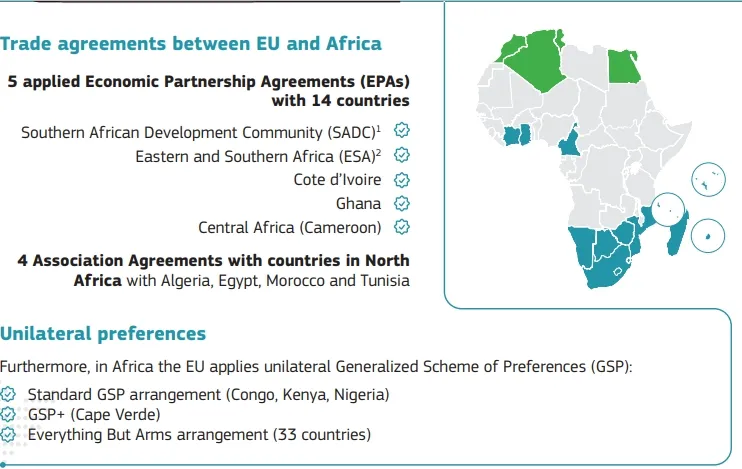
In this analysis, we focus on the Economic Partnership Agreements (EPAs), as they are the most consequential for Africa. EPAs not only encompass a wide range of agreements but also affect all African countries outside of North Africa. These agreements have significant implications for the structure and operation of regional trade agreements. Furthermore, the EPAs have far-reaching consequences for the African Continental Free Trade Area (AfCFTA), as they introduce numerous contradictions and overlaps between regional trade agreements and the AfCFTA framework
4.2The Road to Losing the Battle on EPAs
“This is a major quadrennial event where all UN Member States negotiate guidance for UNCTAD, a UN institution working on trade and development. For the European Commission, it would have been a propitious place for a signature ceremony in order to project the EPA as a ‘trade and development’ agreement to the benefit of EAC. Yet, the agreement is antithetical to Tanzania’s as well as the region’s trade and development prospects”-Benjamin Mkapa, President of Tanzania, opposing a push by the EU to have Africa Heads of States host an unscheduled meeting to sign the EPA during the 14th Ordinary Session of United nations Conference on Trade and Development (today renamed UNTAD)
“We were not legally obliged to enter into the EPA process but we did so because we thought it could be a step to regional integration. I’m afraid it has worked out in an end game that could contribute to regional disintegration.” Rob Davies South Africa Minister of Trade and Industry, 2009-2019
In 2016, Benjamin Mkapa, the retired President of Tanzania, expressed Africa’s frustration with the EU’s pressure to sign the Economic Partnership Agreements. His open letter highlighted what many African leaders had long been feeling: the EPAs were an imposition rather than a mutually beneficial trade agreement. Two years earlier, the United Nations reported significant tensions between African Heads of State and the EU over the EPAs. At the 2014 African Union (AU) Heads of State Summit, senior EU officials attempted to bypass regional bloc discussions within SADC, EAC, and ECOWAS to secure the signing of the EPAs. However, this approach was met with resistance, with African leaders accusing the EU of attempting to divide the continent into smaller blocs in order to weaken collective bargaining power.
The confrontation escalated into accusations of blackmail and manipulation, with Nigeria and Mauritius threatening to withdraw from the EPA talks.
According to the UN report, an AU official called the EU’s threats and blackmail “an unprecedented power game rarely witnessed at an African heads of nations meeting.” Nigeria and Mauritius, angered by such arm-twisting, announced they might renege on their provisional acceptance of the Free Trade agreement. Nigeria went ahead to do exactly that and has refused to sign the EPAs to date.
Kenya, under significant pressure, was forced to sign the EPA in 2016, following the EU’s threat of imposing heavy taxes on Kenya’s key exports, particularly horticulture. Other East African Community (EAC) countries managed to avoid signing the EPAs, as they were classified as Least Developed Countries (LDCs), qualifying for the more lenient Everything But Arms (EBA) arrangement. However, this situation underscores the coercive nature of the EU’s approach to securing signatories for the EPAs.
The process of signing the EPAs has therefore been marked by a long and contentious struggle. And yet, despite widespread protests across the continent and a decade-long civil society campaign known as “STOP EPAs Campaign”, many African governments gradually acquiesced to EU pressure. Six Southern African Development Community (SADC) countries signed the EPAs in 2016, with Kenya following suit. The EU’s has already announced that two additional countries-Rwanda and Cape Verde-are on their way to signing the agreements. This is despite James Ndahiro, Rwanda’s then representative to the East African Legislative Assembly, expressing Rwanda’s strong objection on grounds that “outstanding issues, if not resolved and if included in the EPA framework, will bind the EAC to poor trading terms,”
Chukwuma Soludo, former governor of the Central Bank of Nigeria said of the STOP EPA Campaign
”Despite…the reported public protests in 20 countries against the (EPA) raw deal, it seems all but certain to be rammed through. In private whisperings, not many Africans or policymakers are happy with the deal but there is a certain sense of helplessness,”
Onkundi Mwencha, then Deputy Chairperson of the African Union (AU) Commission said:
“Our advantage is regional integration. Can EPA help us to integrate our markets? If anything it will stall us. I don’t think EPA is a priority for Africa,”
It is instructive to in 2007 the UK House of Commons Committee on International Development Committee objected to the issues that had been included in the EPAs at that time, and which now form part of the UK EPA.
So what is the contention with EPAs that makes Africa governments so emotional about a trade agreement, and why is the EU so singularly focused on getting it signed that it has spent two decades literally forcing governments to sign on to it?
Beyond WTO: Free Trade Agreements (FTAs)
The WTO was proposed as a fairer and more structured space for global economies than its predecessor, the General Agreement on Tariffs and Trade (GATT). But right at its formation in what became known as the Doha Rounds, the advanced economies connived to grant themselves exemptions that allowed them to not only provide subsidies to their farmers at the expense of fair completion, they also opened room for their economies to dump excess agricultural and other products to weaker economies, the consequences that have seen the total collapse of maize sector in Haiti and the textile industry in East Africa.
The collapse of negotiations within the WTO, particularly after the failure of its dispute resolution system, led to trade crisis for the weaker economies, which exacerbated systemic protectionism and triggered trade wars. This turmoil became a key driver for the rise of Free Trade Agreements (FTAs). Between 2000 and 2022, over 360 FTAs came into force globally. In recent years, numerous African countries, including Kenya, Rwanda, Cape Verde, and 14 others, have either signed or are about to sign FTAs with countries in Europe, America, and East Asia. North African nations, curved out of Africa when it comes to trade agreements, also maintain multiple trade agreements with these regions.
While these trade agreements offer opportunities, they come with significant challenges where a region and country’s economy is not sufficiently diversified.
Between 1990 and 2024, for example, most of the world’s advanced economies , and those affiliated with them, took advantage of their control of raw materials trade, or closeness to countries that had this control, and diversified their industrial and export bases.
Africa, whose trade with the world continues to be structured around extractivism largely remained reliant on revenues from extractive industries. Only a few nations, such as Rwanda, Senegal, and Sudan, made strides toward export diversification. As a result, Africa’s export profile remained concentrated in a limited number of commodities. This lack of diversification continues to hold back broader economic development, as exports from Central and Northern Africa became increasingly dependent on just a few sectors. In contrast, East Asian economies rapidly diversified their exports and moved toward more industrialized economies, with countries like China and Korea achieving remarkable growth. The failure to diversify Africa’s economy during this period underscores the limitations of current trade agreements, which often reinforce Africa’s role as a supplier of raw materials rather than fostering value-added industries that could propel long-term economic transformation.
1.3
5.1 Benefits of EPAs
The EPA, signed between the EU and UK on the one hand, and 14 African countries on the other, has a few benefits
- Compliance with WTO Requirements
One of the primary benefits of the EPAs is their alignment with World Trade Organization (WTO) regulations. Specifically, the agreements ensure that preferential treatment, when granted to one country, does not unfairly disadvantage others. Under WTO rules, such preferential treatment must be offered for a “reasonable” duration, typically up to ten years. This provision allows African countries to maintain their trade privileges while ensuring compliance with global trade standards, which can enhance the credibility of African markets in the international trading system.
- 2. Duty-Free, Quota-Free Access to the EU Market
The EPAs eliminate quotas and duties on exports from African countries to the EU, providing local producers with enhanced access to one of the world’s largest and most lucrative markets. This duty-free, quota-free access is expected to benefit a wide range of sectors, including agriculture, textiles, and manufacturing, by expanding export opportunities and stimulating local economies. The elimination of trade barriers can also enhance the competitiveness of African goods in Europe, driving economic growth and facilitating deeper integration into the global economy.
- 3. Boost to the Textile Industry and Other Key Sectors
One of the sectors poised to benefit significantly from the EPAs is the textile industry. With duty-free access to nearly 500 million consumers in the EU, African countries will be able to tap into a vast market, complementing the existing opportunities under the US’s African Growth and Opportunity Act (AGOA). This expanded market access is particularly important for countries that have strong textile industries, as it provides them with an opportunity to diversify and expand their export base.
- 4. Boost to Horticulture
In addition to textiles, the horticultural industry in countries like Kenya is also expected to gain from the agreement. The ability to access a larger, duty-free, and quota-free market for products such as flowers, fruits, and vegetables can enhance the profitability of local farmers. However, the extent of this benefit is somewhat diminished by the fact that European flower farms dominate the market, limiting the growth potential for African producers in this sector.
- 5. Support Measures for African Countries
The EU has introduced several support mechanisms aimed at mitigating the potential negative effects of the EPAs on African economies. These include a fund to compensate for the loss of revenue resulting from tariff removals and a “capacity building fund” designed to help countries strengthen their trade capabilities. These initiatives are intended to help African countries adjust to the changes introduced by the EPAs, ensuring that they can fully benefit from the agreements while minimizing the impact of trade liberalization on domestic industries. Among these measures is a commitment to implementing a "Development Matrix" to support African countries in adjusting to the EPAs. The estimated cost of this initiative is $70 billion, though EU contributions to date remain limited, standing at just $3.49 million—equivalent to a mere 0.005% of the required funding. This gap in funding raises concerns about the EU’s commitment to ensuring that the EPAs have a positive and sustainable impact on African economies.
While the EU cites Cameroon as a success story, where cushioning funds have helped mitigate some of the adverse effects of tariff reductions, the limited scale of current contributions calls into question whether the EU’s support mechanisms are sufficient to realize the full potential of the EPAs across the continent.
- 5.2 How EPAs have weakened the ACFTA and Regional Trade Agreements
1. Undermining Regional Trade Agreements
The EPAs disrupt existing regional trade agreements among African countries, creating significant barriers to advancing both current sub regional trade agreements and negotiations under the African Continental Free Trade Area (ACFTA).This undermines efforts to establish a cohesive and integrated continental market, weakening Africa’s ability to pursue meaningful regional economic cooperation.
Indiscriminate opening of African economies further jeopardize regional integration initiatives as the EU (I) enforces the tendency of narrowing down regional co-operation and integration processes to trade liberation, (ii) forces the scope and pace of that liberalisation, (iii) causes the break-up of regional configurations, and (iv) wants to be part of any region (EPA negotiations as foreseen by the EPA consultations and follow up.
By creating unequal conditions across African countries, EPAs weaken regional trade integration. Selective EPA benefits for LDCs and North African nations foster internal competition rather than unity. This fragmentation undermines Africa’s collective negotiating power and complicates efforts to establish cohesive trade policies.
Cross-border trade, particularly among farmers and small traders, suffers significantly. The lack of a unified approach to external trade relations dilutes Africa’s ability to secure favorable terms with global partners like the EU and China. EPAs require liberalization of 80% of imports from the EU. These duty-free imports would find their way in all SSA countries given the lax rules of origin so that the expectations that the ACFTA would increase intra-African trade would not materialize. Because the products imported duty free from the EU would be more competitive than most African products despite the deeper level of liberalization the CFTA is expected to make. The South Centre for example has shown that only 6% of Nigerian tariff lines are more competitive than EU products. Third World Network concludes ACFTA that comes in being is simply a giant African marketplace with little of African products to trade in. The ACFTA is simply facilitating the movement of products imported from Europe and other areas across Africa. The ACFTA is a lower level of integration than the customs union already in place in some regions, such as West Africa and EAC, with their common external tariffs
And that is not all.
The AU recognizes 8 Regional trading communities and trading blocs. There are already overlaps in membership to these regional grouping that have slowed down the region’s integration agenda. And yet the EU brings more confusion by creating new geopolitical configuration of the regional EPAs. Kenya was sued, first by a citizen and later by the government of Tanzania by a trade lobby group because of the confusion brought to its EAC partners by signing an EPA. In Tanzania belong to the LDC and so is covered by EBA. Kenya, on the other hand belongs to the Lower Middle Income Category and is an EAC EPA signatory. Tanzania is also a member of SADC, where countries such as South Africa are included in the SADC EPA.
- 2. Crippling Competition and Innovation
EPAs have exposed the 14 African countries to devastating EU competition, especially in combination with the narrow interpretation the EU has made and which is clear from the texts of the agreements. For example, the texts in rules of origin and Most Favoured Nations as well as the short period (5 years) given before discussions on investment, intellectual property and other broader issues can begin, show that the EU is keen to use EPAs to completely decimate the economies of the signatory countries. The EU has not only closed the door on any flexibility for the African countries, the transition period is too short, the coverage is too broad, the elimination of tariffs too ambitious and there is too little regard for the position of Least Developed Countries, small vulnerable economies and land locked economies.
Here is what article 3 of the EU EPA with Kenya and other EPAs) states
The Parties undertake to conclude the negotiations in the subject matters listed below, within five (5) years from the entry into force of this Agreement: (a) Trade in services; (b) Trade-related issues-Competition policy; Investment and private sector development; Trade, environment and sustainable development; Intellectual property rights; Transparency in public procurement; (c) Any other areas that the Parties may agree upon.
- 3. Pushing EU Trade with Africa at Expense of Trade within Africa
One of the issues with the EPAs is that by creating conditions that are conducive to some countries (such as LDCs and North African countries) while making it difficult for the rest of the countries to trade with the EU, the EU is effectively creating internal competition on what is a weak trade benefit for Africa. If one notes that of all the current and proposed EPA signatories, only 3 have major exports to the EU, it becomes clear that the idea is to kill among African countries while allowing the EU to either cheaply sell or dump its products in Africa African.
The EPA also raises serious concerns about the future of cross border farmers that form the bulk of the regions trade. By negotiating independently with the EU and UK, African countries have set a dangerous precedent that could lead to further fragmentation of regional trade policies. The lack of a unified approach to external trade relations not only weakens the Africa’s bargaining power but also undermines efforts to establish a comprehensive and cohesive regional market. This will make it increasingly difficult for the Africa to negotiate with other trading partners, including the European Union and China, on favourable terms.
- 4. Killing Industrialization by Giving Incentives for Export of Raw Materials and Agricultural
The EPAs have provided significant incentives to the export of raw materials, critical minerals and unprocessed agricultural products while blocking exports of value added and industrial goods. Studies above by shows that in the area of manufactures trade, there will in fact be a reduction of exports from the ESA and SADC countries to the EU. The will in fact be increase in imports by African partner countries from the EU due to the EPAs, mainly driven by agricultural imports. On the import side, increased quantities at cheaper prices will generate welfare gains but this will be wiped out by losses of customs revenues due to agreed tariff reductions. Equally importantly, prospects of industrialization need to be carefully evaluated in light of increased competition from foreign markets.
Case In Point
East Africa does not need the EU Market
A study by the South Centre shows that the EAC is more competitive than the EU on only 10% of tariff lines .As a consequence, this would mean that the majority of products that are currently produced will be put at risk due to tariff elimination in the EPA, and the EU being more competitive, producers will lose market share to EU imports as well in
home markets and other EAC markets. The study further shows that 51.3% of tariff lines/products where there is current local production will be damaged (1,100 tariff lines out of 2,144) as these are lines where liberalisation will take place and the EU is more competitive on these lines than the EAC
Taking into account potential future production (tariff lines where there is no current production), 2,366 tariff lines will be liberalised making the possibility of having future production in these products questionable. In total, 68.8% of all tariff lines or products could be put at risk (current and future production).
Further, a short list of sectors where there is current production which could be jeopardised and tariff lines where there is at present regional trade which could be compromised by the EPA as the EU is more competitive includes: processed oil products; chemical products for agriculture; commodity chemicals; medicines, vaccines and antibiotics; intermediate industrial products; final industrial products; vehicle industry; agricultural products; and books, brochures and other printed material.
African exports to the EU are mainly raw materials especially crude oil raising the question of value addition and regional integration. The major trading partners with the EU from Africa are South Africa, Nigeria, Libya and Algeria. African countries still export raw materials to Europe and provide a ready market for European finished goods thirty years after signing the preferential treatment agreements.
In 1976, just after the first Lomé Convention was introduced, the ACP states accounted for 6.7% of the EU market, while by 2005 it accounted for only 3% (see Borrmann & Busse 2007: 403). ACP’s trade with the rest of the world has also fallen over the same period (Ochieng 2007: 377-8). In addition, about 68% of total ACP exports to the EU consists of agricultural goods and raw materials, with ten products accounting for some 74% of this (Borrmann & Busse 2007: 404). This is, of course, despite the trade preferences that the ACP countries have enjoyed over many decades. Thus, while trade with the EU continues to be important to ACP countries, there is evidence that it is in decline, at least proportionately, and that primary commodities continue to form a substantial part with little apparent progression to added value processed goods
EU EPA Contravening EAC Principles
Kenya did not adhere to the required Principles under the EAC Treaty, specifically Article 37 of the EAC Customs Union Protocol that lays out the need to engage collectively using the EAC mechanisms as opposed to a national approach.
While the Kenya-UK EPA consistently makes reference to the EAC and even purports that it is signed on behalf of Kenya and the EAC, it fails when examined against the above requirements of mutual cooperation.
Undermining EAC Trade by Ignoring EAC Common External Tariff
Kenya ignored the role of the EAC Common External Tariff and threw further into confusion the huge gains made towards achieving a Common External Tariff, a milestone in realizing the Customs Union. The result is a genuine concern that goods originating from Kenya into the rest of the EAC are actually imports from the UK that do not obey the EAC’s Rules of Origin.
Under the EAC Customs Union, goods originating from within the EAC are accorded preferential tax treatment when exported to another Partner State within the block while goods originating from outside the block are generally not accorded similar treatment.
Should unscrupulous traders repackage goods imported from the UK into Kenya as ‘made in Kenya’ there is inherent risk that other innocent goods originating from Kenya will be treated with suspicion.
Other Losses from EPA
1. Delayed Access to International Markets
The UK and EU argues that the EPA will benefit Africa by providing long-term tariff-free access to the UK market, which would theoretically lower production costs and enhance Africa’s agricultural competitiveness. However, the agreement’s provisions on tariff reductions are spread over an extended period, with many products not seeing significant cuts until 2028 or 2032, and complete liberalization unlikely until 2046. For Africa’s farmers these delays could hinder the country’s ability to access vital international markets and improve its economic standing.
Too Many Exclusions of Agricultural Produce
Moreover, the agreement’s exclusion of over 1,400 mainly agricultural product lines, including crucial agricultural goods such as maize, dairy, and vegetables, from tariff reductions severely limits the benefits to Africa’s agricultural sector. The EU and UK’s insistence on this exclusion demonstrates a lack of commitment to supporting Kenya’s primary industries, which remain a cornerstone of its economy. While Africa has the option to apply protective safeguard measures, these measures are not a substitute for meaningful tariff reductions that could enable African businesses to better compete in global markets.
Killing Domestic Agricultural Market
All EPA agreements involve liberalisation (market opening) on average, of eighty percent (80 percent) of all imports of goods into African countries who are party to the agreement from the European Union. That means 80 percent of products from the EU will duty free, quota. This, many experts and institutions, including the Africa Union Commission, objected to for a number of reasons. The EU-Mexico FTA, according to the factual abstract prepared by the WTO Secretariat and available on the WTO’s regional trade agreement (RTA) database,[5] only requires Mexico to liberalise 54.1 percent of imports from the EU by value over 10 years. In the Comprehensive Economic Cooperation Agreement between India and Singapore that entered into force on 1 August 2005, India was to maintain duties on 24.7 percent of trade with Singapore at the end of the implementation period. So, the insistence on the part of the EU for 80 percent was unjustifiable. Eighty (80) percent market opening is problematic. This is in addition to the fact that the EU had not indicated a willingness to abolish its agricultural subsidies. This poses major unfair competition against African producers of products such as milk, poultry, pork, beef, cereals etc. (Karingi, et al., 2005). These subsidies and domestic support are not being removed at the WTO, or in the EPA negotiations. The sectors that are viable for value chain development in Africa are the agricultural value chains and the minerals value chains.
EU Agricultural imports into Africa have been on the increase. The most dramatic example is the EU trade in poultry meat to Nigeria, which is exported via Benin. It is estimated that over 90 percent of EU poultry meat exports to Benin are destined for the Nigerian market. This situation had arisen in response to the strict Nigerian controls on imports of poultry meat via official ports of entry. This practice had seen Benin emerge as a leading destination for EU poultry exports. The sole purpose of this trade was to circumvent Nigerian poultry sector import controls. From 2015 the Nigerian authorities endeavoured to clamp down on cross border smuggling from Benin of poultry meat, rice, and second-hand cars. This had a significant impact on EU poultry meat export volumes to Benin, which fell by 38.2% between 2014 and 2017, with European exports of poultry meat to Benin falling a further 21% in the first 5 months of 2018 compared to the corresponding period in 2017.
Again, use of imported inputs as the primary feedstock for the production of value-added food products, with minimal linkage to the local producers, is most developed in the West African dairy sector, where a range of EU dairy companies have developed trade and investment strategies to capitalise on growing demand for dairy products in West Africa. From 2013, with the abolition of EU milk production quotas that was scheduled for April 2015, a range of EU dairy companies began to acquire local dairy companies or created joint ventures with food distribution companies in Africa to expand the sale of consumer ready dairy products derived from EU sourced milk powders[6]. A notable feature of most (but not all) of these investments was that they were largely unconnected to local milk production.
Farmers Losing to EU/UK Dumping
The safeguards in the EPAs for the protection of small-holder farmers are weak. The Agreement on Agriculture of the WTO, adopted during the Round leading to the establishment of the WTO, provided for an automatic safeguard for agriculture-that is when there is an import surge, it is invoked automatically to safeguard local producers from the imports surge.
However, it was only provided to those countries which converted non-tariff barriers to tariffs in that Round. As such, only 16 developed countries and 22 developing countries can avail of this Special Safeguard Provision (SSG). In Africa, only a small number of countries have access to the SSG - Botswana, Morocco, Namibia, South Africa, Swaziland and Tunisia. The EU also has access to the SSG. In fact, the SSG covers 31 percent of the EU’s agricultural tariff lines (i.e. should prices drop, or a volume surge take place) on the selected 31 percent of products, the EU can slap on much higher tariffs. Since 1995, the EU has used the SSG frequently – up to 61 times in 1996, 60 times in 1997, and 44 times in 2001.